
Insignorthezia
Insignorthezia
Description
How to identify
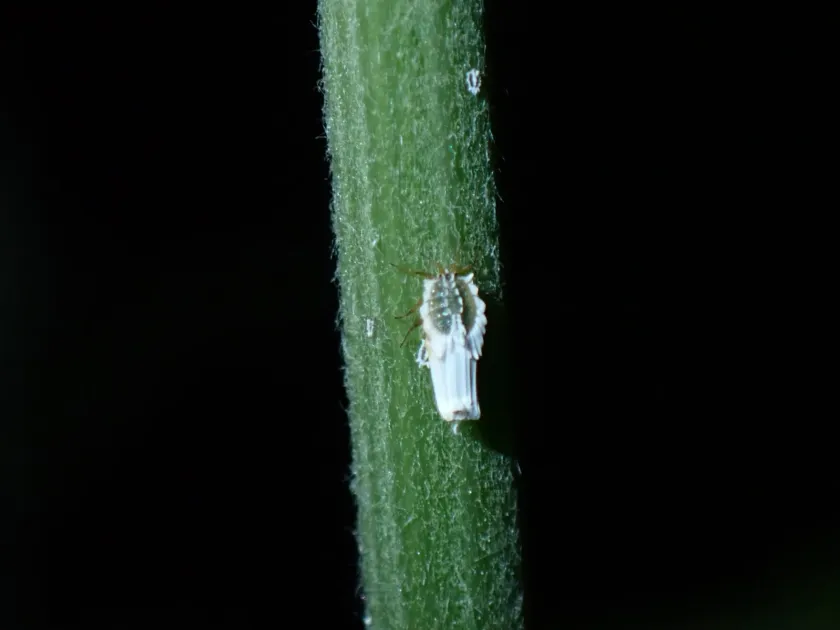
Insignorthezia (Insignorthezia insignis) is a small insect belonging to the family Ortheziidae. It is a type of scale insect that is often characterized by white, waxy plates that cover its body like a shell.
The female is the primary life stage encountered, measuring approximately 1.5 to 2 mm in length. These insects retain mobility throughout their lives and are typically found on the undersides of leaves and along stems.
Males are rarely seen and are significantly different from females, as they possess wings for movement. Females, however, are wingless and rely on crawling or external dispersal for colonization.
The body color is generally dark brown or black, but it is often obscured by thick, white waxy secretions. These secretions also form a protective ovisac (egg sac) attached to the posterior end of the female.
First-instar nymphs, known as crawlers, are very small and transparent, making them difficult to spot with the naked eye until they begin to feed and develop their waxy covering.
What it damages
This pest is a major polyphagous insect that attacks a wide variety of tropical, ornamental, and fruit-bearing plants. Common hosts include coffee plants, chrysanthemums, geraniums, citrus, and various nightshades.
In greenhouse settings, Insignorthezia can infest almost any host species, causing severe stress to the plants by extracting cell sap. This feeding process continuously drains the plant's nutrient reserves.
The damage manifests as stunted growth, yellowing leaves, and deformation of young shoots. In severe infestations, the plant may lose its aesthetic value and start shedding leaves prematurely.
Insignorthezia secretes large amounts of honeydew, a sticky substance that coats the leaves. This serves as a primary substrate for the growth of sooty mold, which blocks sunlight and hinders photosynthesis.
Because the pest multiplies rapidly, a single localized infestation can quickly spread to an entire collection if not managed promptly, leading to significant economic losses in commercial nurseries.
When it appears
In greenhouses and indoor environments, Insignorthezia can reproduce throughout the year, as the climate is constantly conducive to its life cycle. It does not require a winter diapause.
The optimal temperature range for rapid population growth is between 22 and 28 degrees Celsius with high humidity. Under these conditions, a generation can be completed in approximately 30 to 45 days.
In warmer outdoor climates, the population increases significantly during the spring and summer months when weather conditions are stable and plant growth is most vigorous.
Because of the short generation time, the pest can quickly reach high densities during the growing season. This requires constant monitoring to detect early signs of a flare-up.
Dispersal usually occurs through movement of infested nursery stock or via workers' tools and clothing, making biosecurity a key aspect of preventing seasonal outbreaks.
Signs of infestation
The most common sign of an infestation is the appearance of white, cotton-like wax clusters on the underside of leaves or at the base of petioles. These clusters are often clearly visible against the dark foliage.
Sticky residue (honeydew) on the leaves is a primary symptom. If left unchecked, this residue will darken and develop a black, powdery film known as sooty mold.
Yellowing of leaf margins and curling of young leaves are typical indicators of nutritional stress caused by sap-feeding. The plant may appear generally unthrifty and lose its luster.
The presence of ants attending to the colonies is a strong indicator that Insignorthezia is present, as ants are attracted to the sugary honeydew excreted by the insects.
On closer inspection, one can see the slow-moving, shell-covered adults clustered along the veins of the leaves, where they have easy access to the plant's vascular system.
Control measures
Effective management requires an integrated approach. Because the waxy covering protects the insect, contact-only insecticides are often insufficient for complete control.
- Manual removal and cleaning of affected leaves with a soap and alcohol solution.
- Pruning and destroying heavily infested plant parts to reduce the pest load.
- Applying systemic insecticides, such as neonicotinoids, which the plant absorbs to kill the feeding insects.
- Quarantining all new plants before introducing them into the main growing area.
- Regular monitoring and inspection of plant collections to catch infestations at an early stage.
Repeated applications are crucial because the eggs are protected within the waxy ovisacs. A single treatment will likely miss the emerging nymphs, so a follow-up is necessary within 7 to 10 days.
Systemic products are generally preferred for Insignorthezia because they penetrate the plant tissues, ensuring that the insects ingest the toxin while feeding, regardless of their waxy protective layer.
Maintaining a healthy environment and proper sanitation are the best preventive measures. Avoiding excessive humidity and ensuring good air circulation can help limit the potential for rapid population expansion.
Taxonomy
- Latin name
- Insignorthezia
- Order
- Hemiptera (bugs, aphids, leafhoppers)
- Family
- Ortheziidae
- EPPO code
- INSISP
Discussion
No discussions yet — be the first.