
Western white
Pontia occidentalis
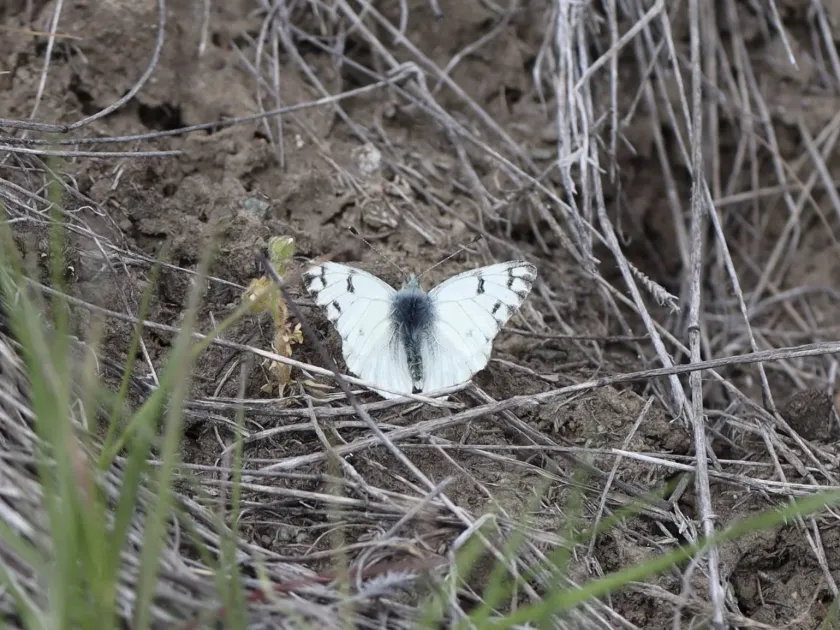
Description
How to identify
The western white (Pontia occidentalis) is a butterfly species within the Pieridae family, belonging to the order Lepidoptera. It is recognized as a pest in various agricultural and horticultural systems.
Adults are medium-sized butterflies with white wings characterized by dark markings on the forewings. The underside of the hindwings features a distinct grayish or greenish vein pattern.
The larvae, or caterpillars, are the primary damaging stage. They exhibit a patterned body, often with yellowish lateral stripes and fine dark setae, providing effective camouflage on host plant leaves.
Adult wingspans typically range from 35 to 50 mm. They are diurnal, active flyers often observed in open fields and garden areas during warm, sunny weather conditions throughout the growing season.
Eggs are laid individually on the underside of host plant leaves. They are spindle-shaped and possess longitudinal ridges, which serve as a diagnostic feature for scouting purposes.
What it damages
The primary hosts for Pontia occidentalis are plants in the Brassicaceae family. This includes important agricultural crops such as cabbage, broccoli, kale, and radish, as well as various wild mustard species.
Larvae consume leaf tissue, often starting by skeletonizing the leaf or creating small holes. As they mature, they increase their feeding rate significantly, leading to substantial foliage loss.
Damage reduces the photosynthetic capacity of the plant, directly impacting crop vigor. In cabbage, damage to developing heads can lead to reduced weight and poor market quality.
Heavy infestations can lead to total loss of seedlings or severe stunting of mature plants. This makes the affected produce unmarketable due to both tissue loss and fecal contamination.
Furthermore, feeding sites on foliage create entry points for opportunistic pathogens, such as bacterial soft rot, which can further degrade the plant and affect storage potential.
When it appears
The life cycle of the western white is highly dependent on environmental temperature. In favorable regions, the species can produce multiple generations per growing season.
Adults emerge in the spring once temperatures remain consistently above the threshold required for development. This synchronized emergence often aligns with the planting of early cruciferous crops.
The development from egg to adult butterfly takes several weeks. Larvae are most active during the warmer months, with peak feeding activity often observed mid-season.
Overwintering occurs typically in the pupal stage. These pupae are resilient and remain in sheltered locations, such as plant debris or fence rows, until the following spring.
Regular field scouting should commence early in the season to detect egg-laying activity. Identifying the first generation is crucial to prevent rapid population growth in subsequent generations.
Signs of infestation
Signs of infestation begin with the appearance of small, irregular feeding holes on the leaves. Early larval stages often feed gregariously, making these initial signs easier to spot.
The presence of frass (caterpillar excrement) on leaves is a clear indicator of larval activity. Finding frass deposits often helps locate the caterpillars themselves on the underside of leaves.
Careful inspection of the undersides of leaves during the early morning hours can reveal the presence of eggs. They appear as small, whitish-yellow elongated objects.
Leaf curling or the presence of sparse silk webbing can indicate protected feeding sites. Larvae often use these structures to hide during the day or during molting stages.
If entire leaves show advanced skeletonization, the infestation is likely well-established, and immediate action is required to protect the remaining crop canopy.
Control measures
Effective management of the western white involves an integrated approach combining cultural, biological, and, if necessary, chemical control measures to minimize economic damage.
Cultural practices are essential, including the removal of cruciferous weeds that serve as alternate hosts and deep plowing to destroy overwintering pupae in the soil.
Biological control, such as the use of Bacillus thuringiensis (Bt), is a highly effective, environmentally safe method to target larvae without harming non-target beneficial insects.
Chemical intervention should be reserved for cases exceeding the economic injury level. When used, selective insecticides should be chosen to minimize impact on pollinators and natural predators.
- Use of row covers to prevent adults from laying eggs on plants.
- Implementation of diverse crop rotations to disrupt life cycles.
- Scouting for egg clusters to time interventions precisely.
- Promoting natural enemies like parasitic wasps and predatory beetles.
Taxonomy
- Latin name
- Pontia occidentalis
- Order
- Lepidoptera (butterflies)
- Family
- Pieridae
- EPPO code
- PIEROC
Discussion
No discussions yet — be the first.