
Black-veined white
Aporia crataegi
Description
How to identify
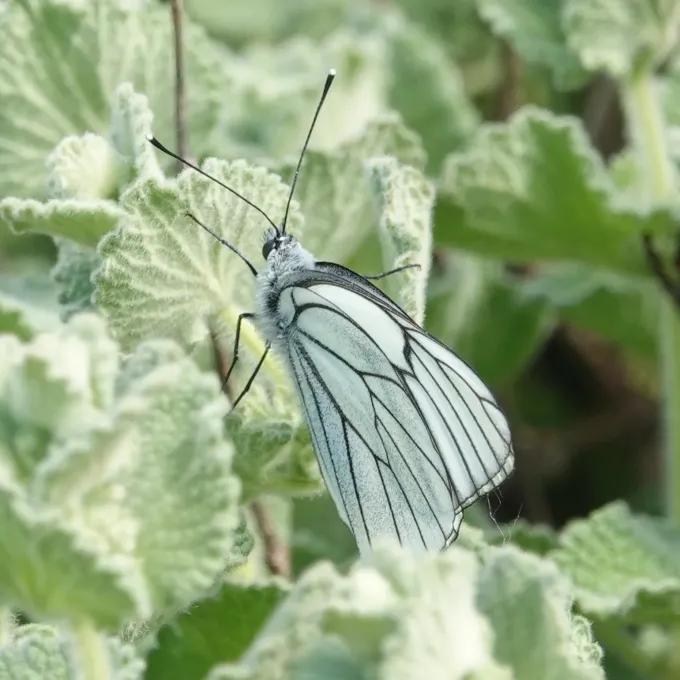
The black-veined white (Aporia crataegi) belongs to the order Lepidoptera, family Pieridae. The adult butterfly is large, with a wingspan of up to 70 mm, featuring white wings with distinct black veins.
The larvae, or caterpillars, grow up to 50 mm long. They have hairy bodies with a grey-brown base color and two prominent longitudinal orange stripes on their backs.
The pupae are angular in shape, colored yellowish-green or grey with dark markings. They attach themselves firmly to branches or tree trunks using silk pads.
Eggs are laid in batches of 30 to 200 on the upper side of host leaves. They are bottle-shaped, ribbed, and have a yellow hue when freshly deposited.
Young larvae overwinter in communal silken nests constructed from several dry leaves bound together with silk, hanging securely from tree twigs.
What it damages
The pest primarily affects trees and shrubs in the Rosaceae family. Key orchard targets include apple, pear, cherry, plum, and apricot trees.
In addition to commercial fruit crops, the larvae frequently infest hawthorn, mountain ash, and blackthorn, which can serve as reservoirs for future infestations.
The damage is caused by the caterpillars, which emerge in early spring to feed on developing buds and young foliage, often before the trees have fully leafed out.
Extensive defoliation leads to a significant decrease in photosynthesis, which severely impairs the tree's ability to produce fruit and store energy for winter.
In cases of severe outbreaks, caterpillars can strip entire branches, weakening the trees and making them more susceptible to frost damage and secondary diseases.
When it appears
Adult butterflies are typically on the wing from June to July, during which time they mate and lay eggs on the leaves of host plants.
Larvae hatch within two weeks, initially skeletonizing leaves before forming their winter nests to undergo diapause during the colder months.
Spring activity begins as soon as temperatures rise, usually coinciding with the onset of bud break, making this the most critical period for plant protection.
Pupation occurs in late May or early June. The pupal stage lasts approximately two to three weeks before the adult butterflies emerge to start the cycle anew.
The species completes one generation per year, meaning that timely intervention in winter and spring can effectively disrupt the population growth cycle.
Signs of infestation
The most reliable sign of a black-veined white presence is the sight of winter nests—clumps of withered, silk-bound leaves hanging from bare branches.
In early spring, damage appears as hollowed-out or completely consumed buds, preventing normal spring growth and flowering on the affected branches.
During the summer, one may observe groups of larvae feeding openly on leaves, leaving behind the midribs and creating a characteristic skeletonized appearance.
The observation of adult butterflies fluttering near fruit trees in June is a clear indicator that egg-laying is likely taking place in the canopy.
The presence of shed skins or pupae attached to trunks, fence posts, or lower branches also confirms that the pest has successfully completed its larval stage nearby.
Control measures
The most effective mechanical control is the manual removal and destruction of overwintering larval nests during the winter dormant period of the trees.
Regular inspection of the orchard during summer allows for the identification and destruction of egg batches before the larvae can emerge and begin feeding.
Chemical control using insecticides is most effective during the early spring stage, specifically at the green-tip stage, before the larvae disperse.
Biological control methods, including the use of bacterial agents like Bacillus thuringiensis, are highly recommended to protect beneficial pollinators.
- Encouraging natural predators and parasitoids, such as ichneumon wasps, can significantly keep population densities below the economic threshold.
Taxonomy
- Latin name
- Aporia crataegi
- Order
- Lepidoptera (butterflies)
- Family
- Pieridae
- EPPO code
- APORCR
Discussion
No discussions yet — be the first.