
Black-veined white
Aporia
Description
How to identify
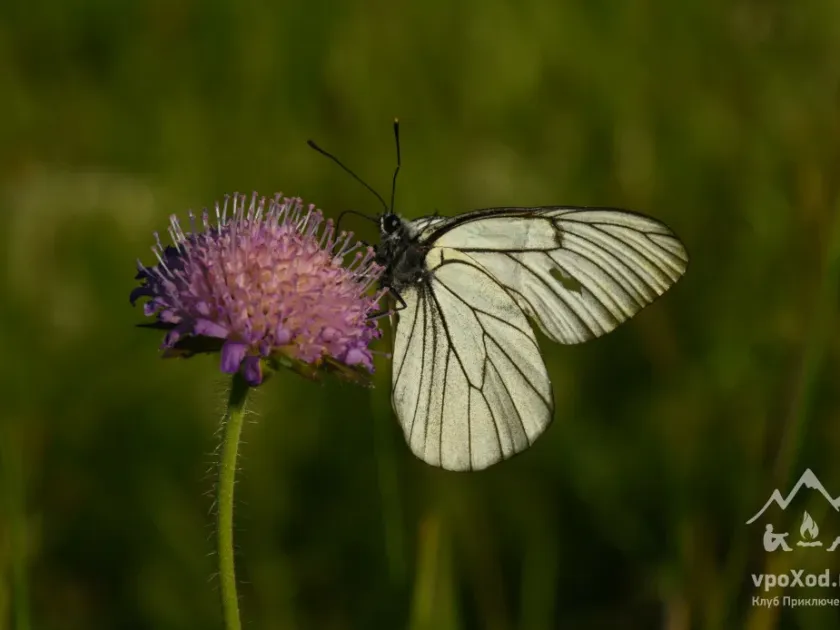
The Black-veined white (Aporia crataegi) is a large butterfly belonging to the Pieridae family, recognizable by its white wings with prominent black veins.
Adult butterflies have a wingspan of 50–70 mm and are covered in fine, dense hairs. They are active during the day, particularly in warm, sunny weather.
Eggs are yellowish-orange, barrel-shaped, and are deposited in clusters on the upper surfaces of leaves, making them relatively easy to spot.
The larvae, or caterpillars, are gray with brownish longitudinal stripes and a black head, growing up to 45 mm in length as they mature.
Pupae are yellowish-green with black spots and are typically attached to branches or tree trunks with silk, remaining exposed during their development.
What it damages
This pest primarily attacks fruit trees in the Rosaceae family, including apple, pear, plum, cherry, and apricot trees, causing significant economic damage.
Wild species like hawthorn, rowan, and serviceberry are also frequently infested, serving as alternative hosts for the caterpillar populations.
Young caterpillars skeletonize the leaves, eating the tissue between the veins, which eventually leads to widespread drying and defoliation of the trees.
Older larvae are extremely voracious, consuming buds, flowers, and mature leaves, which significantly impacts the development of fruits and tree vigor.
Heavy infestations can lead to total yield loss and weaken the overall vitality of the orchard, leaving trees vulnerable to secondary pests and winter damage.
When it appears
The species overwinters as third-instar larvae within colonial nests made of dried leaves held together by silk webbing attached to tree branches.
In spring, as buds begin to swell, the larvae emerge from their winter nests and move to feed on young plant growth, synchronized with host plant phenology.
Pupation occurs in late May or early June, lasting about two to three weeks before the adult butterflies emerge to mate and start the next generation.
Adult flight typically occurs between June and July, during which time females lay eggs on the leaves of host plants to start the summer cycle.
There is only one generation per year, and the timing of their lifecycle stages is highly predictable based on the ambient temperature of the region.
Signs of infestation
The most visible sign of infestation in late autumn and winter is the presence of silk-webbed leaf nests hanging from twigs throughout the canopy.
During the spring, the presence of damaged or destroyed buds and leaves indicates that the larvae have emerged from their dormant state to feed.
Large quantities of larval frass (droppings) on the leaves or branches are a clear indicator of active feeding by older caterpillars within the tree.
Mass sightings of white butterflies with black veins flying around the orchard in early summer confirm the presence of an active adult population.
The presence of exposed pupae on stems or nearby structures is a late-stage indicator that the current generation has reached its final development phase.
Control measures
The most effective mechanical control method is the manual removal and destruction of the winter nests during the dormant season to eliminate larvae early.
When infestation levels exceed the economic threshold, chemical control using systemic or contact insecticides can be applied during the larval feeding period.
Biological control, such as using preparations based on bacterial pathogens, is highly effective against younger caterpillars and poses minimal environmental risk.
Maintaining a healthy population of natural predators and parasitoids, such as ichneumon wasps, can significantly reduce the number of caterpillars in the orchard.
Proper orchard sanitation, including pruning and the removal of adjacent wild host trees, is critical for reducing the long-term risk of infestation.
Taxonomy
- Latin name
- Aporia
- Order
- Lepidoptera (butterflies)
- Family
- Pieridae
- EPPO code
- APORSP
Discussion
No discussions yet — be the first.