
Wart-biter
Polysarcus denticauda
Description
How to identify
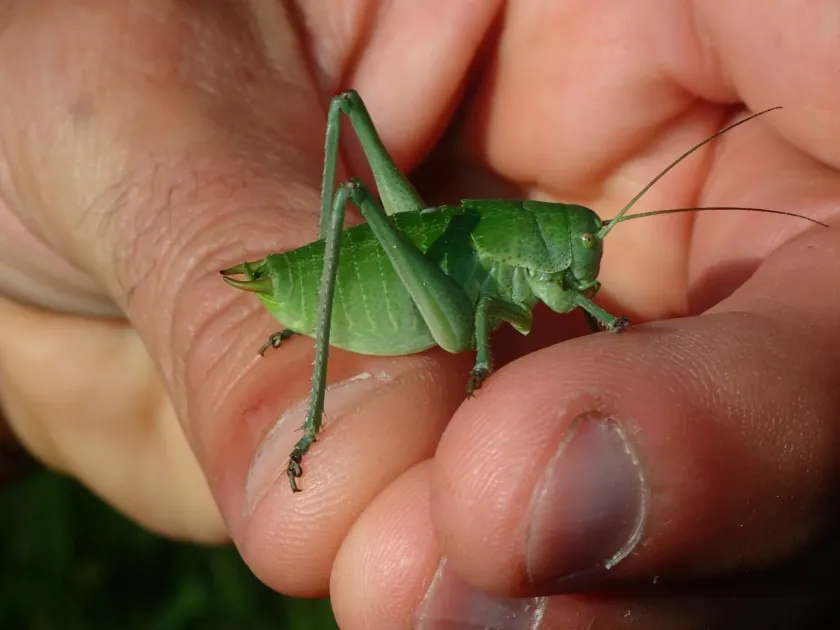
The Wart-biter (Polysarcus denticauda) is a large orthopteran insect that can reach up to 40 mm in length. Its body is robust, and its coloration ranges from bright green to brownish, which provides excellent camouflage within dense vegetation.
The most distinctive feature of the female is its long, slightly upturned ovipositor, which resembles a serrated tooth or a saber. This anatomical trait, used for laying eggs in the soil, is the origin of its common name.
These insects possess powerful mandibles suited for chewing tough plant tissues. Their hind legs are well-developed, allowing them to jump or move quickly across the ground when threatened, as they are primarily terrestrial.
While adults usually have shortened wings, their nymph stages look like miniature versions of the adults. The life cycle is heavily dependent on soil temperature, as the eggs must pass the winter in the ground before hatching in the spring.
During the warmer months, these insects maintain high activity levels in meadows and field edges, where they feed and reproduce. Dense populations can lead to migration events when local food sources become depleted.
What it damages
The Wart-biter is a polyphagous pest, meaning it feeds on a wide variety of plant species. Cereal crops such as wheat, barley, rye, and oats are highly susceptible, as the insects consume both leaves and the developing grain heads.
Vegetable gardens and agricultural fields face significant threats from these insects, which often target potatoes, cabbage, sugar beets, and various legumes. Young seedlings are particularly vulnerable and can be completely destroyed in a short time.
Damage to orchards and berry bushes is also documented, as the insects gnaw on succulent new shoots and foliage. This feeding pattern reduces the plant's photosynthetic capacity, ultimately stunting growth and reducing yield potential.
The harm caused by these pests is compounded by their feeding style, which leaves open wounds on the plants. These injuries serve as entry points for bacterial and fungal pathogens, potentially causing diseases that further weaken the crop.
In years with favorable climate conditions for the species, populations can explode, leading to widespread damage that requires systematic pest management interventions to preserve the quality and quantity of the harvest.
When it appears
The life cycle begins in the spring, typically around May, when nymphs emerge from the soil after the overwintering period. Hatching is highly sensitive to the temperature of the topsoil, where the eggs are buried.
The nymphal stage lasts throughout the summer, consisting of five distinct instars. During this time, the insects feed voraciously, growing larger with each molt as they develop their adult characteristics and reproductive systems.
Adult Wart-biters reach their peak activity levels during the mid-to-late summer months, specifically July and August. This is the period when agricultural damage is most severe, as the mature insects require significant sustenance for reproduction.
Following mating, females utilize their ovipositors to deposit eggs into the soil. This depth provides necessary protection against freezing temperatures and predators, ensuring the species survives the upcoming winter.
As autumn temperatures drop, the adult population gradually dies off, effectively closing the annual cycle. The species successfully persists until the next spring solely through the eggs remaining dormant in the ground.
Signs of infestation
A primary indicator of a Wart-biter infestation is the presence of irregularly torn leaf edges. Unlike caterpillars, which often leave veins behind, these insects can strip a leaf down to the stem, leaving noticeable gaps in the foliage.
In grain fields, one might observe damaged ears of corn or wheat and bare patches where the plants have been stripped to the base. Active inspection during dawn or dusk often reveals the insects resting on stems or leaf axils.
The accumulation of frass (excrement) on the leaves and at the base of plants is a clear sign that the pest is feeding in the immediate vicinity. The chirping sound produced by adults is another strong indicator of their presence on the property.
Damage to root vegetables often appears as shallow, scabby gouges on the parts of the root or tuber exposed above the soil surface. While often superficial, these wounds can lead to rot in storage if not managed correctly.
The sudden migration of insects from adjacent wild meadows into cultivated fields is a sign that the local population has exceeded the carrying capacity of their natural habitat, necessitating immediate monitoring and potential control measures.
Control measures
The most effective long-term agricultural practice is deep autumn plowing. This disturbs the soil, exposing the egg clusters to cold, wind, and avian predators, which significantly reduces the survival rate of the next generation.
When infestation levels exceed economic thresholds, the application of insecticides targeting the younger nymphal stages is recommended. Pyrethroids are often effective, provided that local regulations and pre-harvest intervals are strictly followed.
Managing the margins of fields is crucial; eliminating dense weeds on field borders removes both shelter and secondary food sources for the pests, making the area less attractive for migration and establishment.
Biological control, such as encouraging local insectivorous bird populations and preserving habitat for predatory insects, provides a sustainable way to manage population numbers without constant chemical input.
- Regular field monitoring during the June-July timeframe.
- Using light traps to sample and assess the density of adult populations.
- Maintaining clean fields and borders to discourage long-term residency.
Taxonomy
- Latin name
- Polysarcus denticauda
- Order
- Orthoptera (locusts)
- Family
- Phaneropteridae
- EPPO code
- POLSDE
Discussion
No discussions yet — be the first.