
Frosted Green
Polyploca ridens
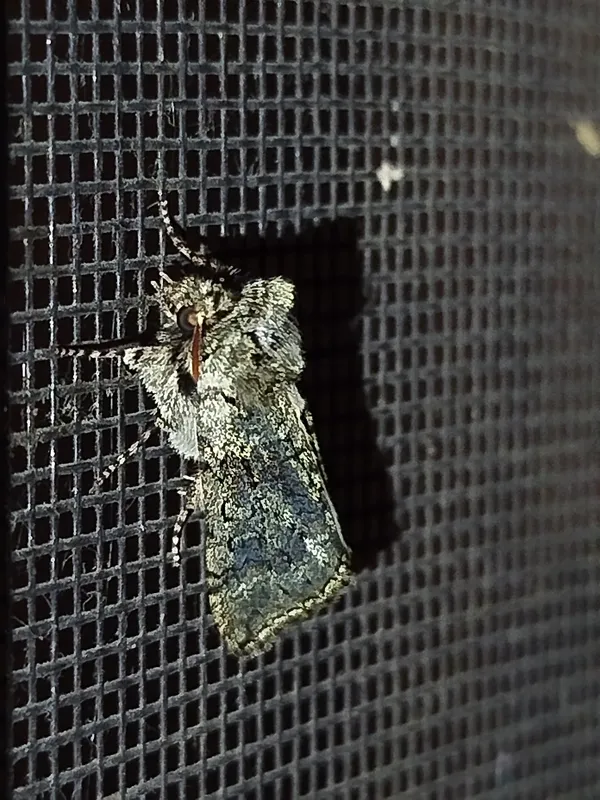
Description
How to identify
The Frosted Green (Polyploca ridens) is a moth belonging to the Drepanidae family. The adult moth has a wingspan of approximately 35–40 mm, with forewings featuring intricate grey to brownish-black patterns, providing excellent camouflage against tree bark.
The larvae, or caterpillars, reach a length of up to 40 mm. Their bodies are greenish-yellow with lighter longitudinal stripes and are covered in small, pale tubercles, each bearing fine hairs, which is characteristic of the species.
The pupa of the Frosted Green is dark brown and housed within a dense cocoon. These are typically formed in leaf litter or deep crevices of tree bark, where the insect successfully survives the winter until spring temperatures rise.
The species is univoltine, meaning it completes one generation per year. Adults emerge early in the spring, making them among the first pests to emerge and target the developing buds and young leaves of host trees.
This pest is found primarily in deciduous forests across temperate zones. It is commonly observed in both natural woodland ecosystems and parklands where suitable host tree species are present.
What it damages
The primary food source for the Frosted Green is the oak tree (Quercus). Caterpillars feed predominantly on young leaves and developing buds, which can significantly stress the tree during the critical early growing season.
Beyond oak, the pest may occasionally infest other deciduous trees, including beech and hornbeam. During years of high population density, these insects can cause partial defoliation of crowns, reducing the overall vigor of the stands.
In young saplings, heavy feeding damage can lead to stunted growth and weakened immunity, making the trees more susceptible to secondary fungal infections or attacks by wood-boring pests.
In large forest areas, high caterpillar density contributes to noticeable thinning of the canopy, which disrupts photosynthetic activity. This negatively impacts the storage of nutrients essential for the tree's winter survival.
For ornamental trees, the primary damage is aesthetic. Extensive leaf consumption leaves trees bare for long periods during the spring, which may be followed by secondary bud burst that exhausts the plant's resources.
When it appears
The flight period of the adult moth occurs in early spring, usually between March and April. Their activity is synchronized with the bud burst of oak trees, ensuring that larvae emerge exactly when food is available.
Females lay eggs singly or in small groups, typically on the twigs and buds of host plants. Oviposition takes place over several weeks following the emergence of the adults.
The larval feeding stage spans the spring months when leaves are tender and most nutritious. By early summer, as leaves harden, the caterpillars complete their development and begin the transition to the pupal stage.
The insect spends the majority of its life cycle, including summer, autumn, and winter, in the pupal stage. This extended diapause is a crucial survival mechanism that aligns the pest's development with the temperate climate.
Consequently, monitoring and protective efforts should be focused on the spring period, as this is when adult presence and initial larval feeding signs are most visible.
Signs of infestation
The first indicator of an infestation is the presence of skeletonized leaves on oak trees in early spring. Caterpillars consume the leaf tissue while leaving the larger veins intact, resulting in a characteristic "lacy" appearance.
Upon inspecting branches, one may notice young leaves twisted or tied together with silk webbing, where caterpillars hide during the day to avoid predators and environmental stress.
The presence of frass (caterpillar droppings) under the trees in late spring is a strong indicator of an active feeding population in the canopy above, as the insects produce significant amounts of waste.
Adult moths can occasionally be spotted resting on tree trunks in early spring. Their cryptic coloration makes them difficult to notice unless one is looking specifically for them.
Severe infestations result in premature leaf drop and overall crown thinning, which makes the affected tree appear visually distinct from surrounding healthy specimens.
Control measures
Control of the Frosted Green in garden settings involves applying insecticides during the peak larval feeding period, specifically immediately after bud burst when the insects are most vulnerable.
Biological control using Bacillus thuringiensis formulations is an effective, selective method that targets lepidopteran larvae without harming beneficial pollinators or predatory insects.
Mechanical control measures include hand-picking caterpillars from smaller or ornamental trees and pruning and destroying branches containing infested, webbed leaf clusters.
Promoting a healthy environment for entomophagous birds is an excellent long-term strategy. Species such as tits and nuthatches are significant predators of caterpillars and can help keep populations in check naturally.
- Targeted application of systemic insecticides in early spring.
- Collection and disposal of leaf litter where pupae may overwinter.
- Routine monitoring of tree canopy condition during the spring season.
Taxonomy
- Latin name
- Polyploca ridens
- Order
- Lepidoptera (butterflies)
- Family
- Thyatiridae
- EPPO code
- POLCRI
Discussion
No discussions yet — be the first.