
Ochropacha duplaris
Ochropacha
Description
How to identify
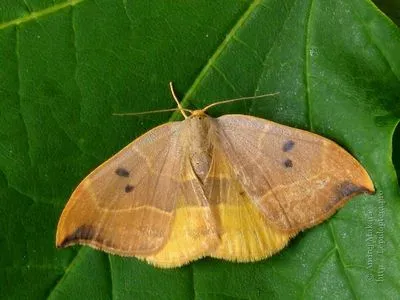
Ochropacha duplaris, commonly known as the common lutestring, is a moth species belonging to the family Drepanidae. These moths have a wingspan ranging from 25 to 30 mm, with forewings typically featuring a greyish-brown or ochre coloration, which provides excellent camouflage against tree bark.
The moth is characterized by two distinct dark transverse lines on its forewings, usually with a lighter patch in between. Males possess bipectinate antennae, which are highly sensitive to pheromones released by females, facilitating mating during the nocturnal flight period.
The larvae, or caterpillars, are cylindrical in shape, typically green with subtle dark longitudinal markings along their dorsal side. They are known for being quite active and possess a defensive mechanism that allows them to drop from leaves on silken threads when disturbed.
The life cycle undergoes complete metamorphosis, consisting of four stages: egg, larva, pupa, and adult. The species typically overwinters as a pupa, enclosed within a tough, camouflaged cocoon hidden in bark crevices or accumulated leaf litter at the base of the host tree.
These moths are native to temperate forest regions across Europe and Asia, where they thrive in deciduous forests, wooded parks, and gardens containing their primary host plants, such as oak, birch, and alder.
What it damages
The primary hosts for Ochropacha duplaris caterpillars are oak trees, though they frequently feed on birch, alder, and hazel. By consuming the leaves, the larvae can significantly impact the health and vigor of host trees.
Young larvae feed primarily on the leaf parenchyma, creating small, window-like holes. As they mature, they advance to consuming the edges of the leaves, eventually leaving behind only the tougher midribs and primary veins, which reduces the tree's photosynthetic efficiency.
Severe infestations can lead to widespread defoliation, particularly in young saplings or weakened trees. This reduces the energy reserves that the tree needs for winter dormancy and spring growth, making it susceptible to secondary infestations by wood-boring insects.
The cumulative damage caused by repeated infestations over several years can result in stunted growth and a general decline in the tree's health, making the pest a significant concern in nursery production and forest management.
In ornamental garden settings, the damage is often aesthetic but can lead to the death of small or newly planted trees if the caterpillar population is left unchecked throughout the active growing season.
When it appears
The adult moths are typically on the wing from late May through July. This is the primary period for mating and egg-laying, with females depositing eggs directly onto the leaves of host trees.
The larval stage is most active during the early and mid-summer months, specifically June and July. During this time, the caterpillars consume a large amount of leaf tissue, causing the most visible damage to trees.
Pupation usually occurs in late summer as the larvae complete their development. The pupae then enter a state of dormancy, remaining in their protective cocoons throughout the autumn and winter until the following spring.
Developmental timing can vary slightly based on local climatic conditions. Warmer springs may trigger earlier adult emergence, while cold spells can delay the life cycle, but the species remains strictly seasonal throughout its range.
Monitoring for adults using light traps is an effective practice for foresters and gardeners to determine the start of the flight period and to plan protective interventions before the larvae reach high densities.
Signs of infestation
Early signs of an infestation include the presence of small, translucent 'windows' on the leaves, which are the result of young caterpillars feeding on the softer tissues of the leaf blade.
The larvae are often difficult to spot due to their cryptic coloration, but their presence is frequently indicated by the fine silk webbing they use to fold or tie leaves together for shelter against predators and harsh weather.
Accumulation of larval frass (droppings) on lower branches or the ground underneath a tree is a strong indicator of an active population feeding in the upper canopy.
Visible leaf loss or premature defoliation in mid-summer is a clear symptom of a severe infestation. Trees showing such signs require a thorough examination to determine the extent of the caterpillar activity.
Empty pupal cases or discarded larval skins found in bark crevices near the base of the tree are signs that the pest has successfully completed its cycle and established itself in the area.
Control measures
Biological control, specifically the use of Bacillus thuringiensis (Bt), is highly effective against early-instar larvae. This method is preferred as it targets the pest while preserving beneficial insects and pollinators.
Chemical intervention with systemic insecticides may be necessary in extreme cases where high populations threaten the survival of valuable or young trees, though it should be used judiciously to avoid ecological imbalance.
- Remove and destroy fallen leaf litter in autumn to eliminate overwintering pupae.
- Scrape off loose, damaged bark from tree trunks to destroy hidden cocoons.
- Encourage insectivorous bird species that naturally predate on caterpillars.
Cultural management, such as ensuring adequate watering and soil nutrients, increases a tree's resistance to pest damage and allows it to recover more quickly from defoliation.
For small-scale garden infestations, manual removal of silk-tied leaves containing larvae can effectively reduce the population without the need for chemical sprays, provided the task is performed early in the season.
Taxonomy
- Latin name
- Ochropacha
- Order
- Lepidoptera (butterflies)
- Family
- Thyatiridae
- EPPO code
- OHRPSP
Discussion
No discussions yet — be the first.