
Cluster fly
Pollenia rudis
Description
How to identify
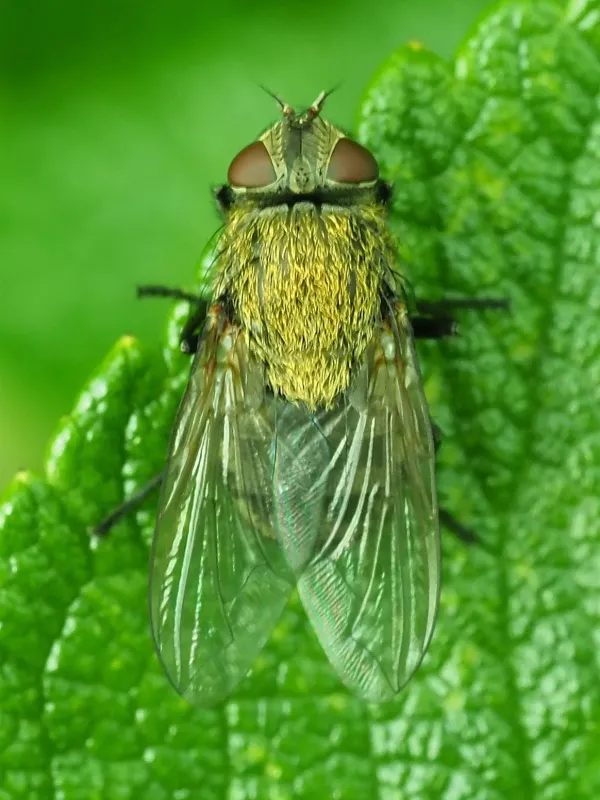
The cluster fly, Pollenia rudis, is a member of the Diptera order and the Calliphoridae family. Adult flies are characterized by their dark grey appearance and distinctive golden-yellow hairs on the thorax, which give them a dusty or mossy look.
Adults typically grow to be 8–10 mm in length. A distinguishing feature is the way they hold their wings: they overlap their wings completely while at rest, lying flat against their abdomen.
The biological cycle of the cluster fly involves earthworms. The female fly deposits eggs in soil crevices, and upon hatching, the larvae seek out earthworms to parasitize, eventually killing their host.
These insects are highly attracted to warmth and sunlight. They are social insects in their own way, often gathering in large clusters on the exterior walls of buildings to bask before entering for hibernation.
The fly gets its common name from its behavior of clustering together in wall voids and attic spaces. Their movement is generally slower and more sluggish compared to the common house fly.
What it damages
Cluster flies are not considered agricultural pests, as they do not feed on crops or plants. They do not pose a risk to food production in fields or gardens.
However, by parasitizing earthworms, they can potentially reduce earthworm populations in a specific area. While this rarely impacts soil health significantly, it is a noteworthy aspect of their life cycle.
The main concern with cluster flies is their status as an invasive household pest. They can be a major nuisance when they gather in thousands within wall spaces and attics.
When they emerge into living areas in spring or autumn, they cause significant distress to homeowners. Their presence leads to unsightly stains on curtains, walls, and windows due to their excrement.
Although they do not typically transmit diseases to humans in the same way house flies do, their dead bodies in wall voids can attract other household pests like carpet beetles or rodents.
When it appears
Activity begins in early spring when temperatures rise. Hibernating flies wake up and seek an exit from the building, often accidentally entering living rooms instead of the outdoors.
Throughout the warmer months, the flies breed and develop in the soil. Several generations can occur in a single year, provided there is a sufficient population of earthworms nearby.
The late summer and early autumn months represent the period of migration. As temperatures drop, cluster flies seek secure, insulated crevices to spend the winter months.
Hibernation is a critical phase for the species. They remain dormant in protected areas such as attics, crevices behind siding, or inside empty wall cavities of houses and barns.
On unusually warm winter days, it is not uncommon for some flies to wake up briefly and move about, potentially finding their way into the house before entering dormancy again.
Signs of infestation
The most obvious sign of an infestation is the sudden appearance of numerous sluggish flies on sunny windowsills, particularly in the spring or during late autumn.
If you notice a buzzing sound originating from within walls or attic spaces, it is a strong indicator that a cluster fly population is overwintering in those structures.
Visual confirmation involves inspecting the south-facing walls of a structure during the autumn. Clusters of flies basking in the sun are a clear sign that they intend to enter the building.
Dark, greasy spots on curtains or window frames are consistent with the presence of cluster flies, resulting from their waste during their indoor residency.
- Clusters of flies on exterior brick or siding.
- Increased fly activity on warm, sunny days.
- Large numbers of dead flies in window channels.
Control measures
The most effective strategy is the exclusion method. Seal all cracks and crevices around windows, doors, and utility entry points with high-quality caulk to prevent entry.
Ensure that all windows and attic vents are equipped with intact, fine-mesh screens to act as a barrier against these persistent insects during their autumn migration.
Once flies have entered a room, they are easily managed using a vacuum cleaner. This is the safest and most efficient way to remove them without the need for toxic insecticides.
For large infestations in attics, residual insecticides may be applied to entry points in the late summer, though this should be handled according to local safety regulations.
Regular maintenance of the exterior of your property, including sealing gaps around siding and roof eaves, is the best preventative measure to stop cluster flies from finding a winter home.
Taxonomy
- Latin name
- Pollenia rudis
- Order
- Diptera (flies)
- Family
- Calliphoridae
- EPPO code
- POLLRU
Discussion
No discussions yet — be the first.