
Blue bottle fly
Calliphora vicina
Description
How to identify
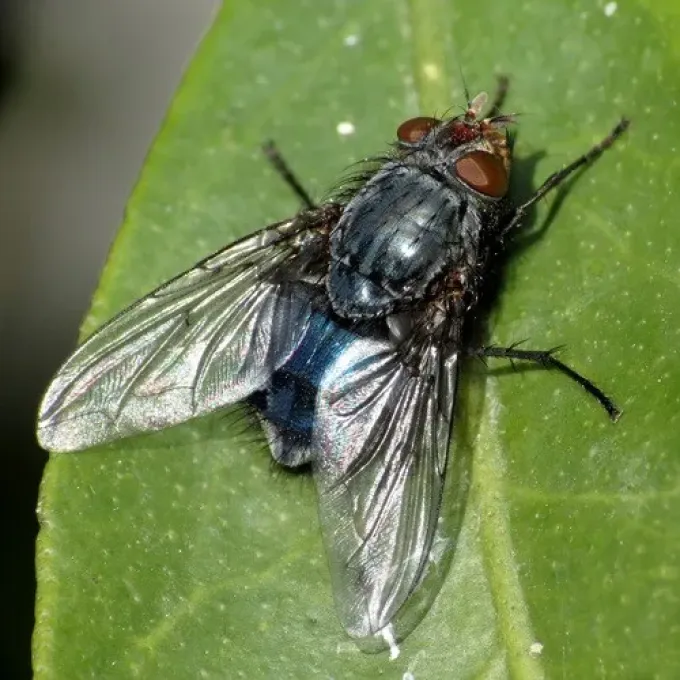
The blue bottle fly (Calliphora vicina) belongs to the order Diptera, family Calliphoridae. It is a large insect, typically 10–14 mm in length, easily recognized by its metallic blue abdomen and dark thorax.
The fly has a mobile head with large reddish-brown eyes that cover most of its surface. Its mouthparts are of the sponging type, adapted for feeding on liquid or semi-liquid organic materials.
The body is covered in numerous black bristles, especially prominent on the thoracic region. The wings are transparent with complex venation and are held horizontally over the abdomen when at rest.
Larvae are typical of higher flies: cylindrical, tapering towards the anterior end, and cream-colored. In the final larval instar, they can reach 15–18 mm in size.
The eggs are elongated and white, usually laid in compact clusters on substrates with high protein content, which is essential for the larvae's development.
What it damages
While Calliphora vicina is not a direct pest of agricultural crops in the field, it is a significant threat to agro-industrial complexes, food warehouses, and processing plants.
The primary damage occurs through the infestation of protein-rich products such as meat, fish, and offal stored in facilities where hygiene protocols are not strictly enforced.
The pest can contaminate food products during processing, packaging, or storage, rendering them unfit for consumption due to larval feeding and the introduction of pathogens.
These flies are efficient mechanical vectors for various microorganisms, bacteria, and parasite eggs, which they carry from waste sources to fresh human food supplies.
Infested products lose their commercial value instantly and must be disposed of, leading to severe economic losses for food processing companies and distribution centers.
When it appears
The blue bottle fly is most active during cooler seasons, beginning in early spring when air temperatures reach 5–8 degrees Celsius.
Peak population density occurs during the spring and autumn months, as Calliphora vicina prefers moderate temperatures and is less resilient to extreme summer heat than other fly species.
The life cycle from egg to adult depends on environmental temperature and typically lasts between 15 and 30 days under optimal conditions.
A single female can lay up to 500–600 eggs during her lifespan, ensuring rapid population growth if high-protein food sources are available indoors.
Overwintering occurs in sheltered areas such as buildings, basements, or soil, where they can survive until conditions become favorable for activity again.
Signs of infestation
The first indicator of infestation is the presence of adult flies with a metallic blue sheen near storage areas, loading docks, or waste management zones.
Observation of egg clusters on the surface of protein-based products is a clear sign that the flies are actively reproducing within the facility.
Visible damage to food tissue caused by larval feeding, often accompanied by an unpleasant odor and a change in the food's consistency, confirms an ongoing infestation.
Aggregated masses of feeding larvae moving on a substrate are a sign of heavy contamination and high activity levels of the pest.
The presence of puparia (pupal cases) in crevices of flooring or near waste containers provides evidence that the fly has completed its life cycle on-site.
Control measures
Effective management requires a comprehensive strategy focusing on the exclusion of flies from facilities and the rigorous maintenance of sanitary standards.
- Sealing windows and doors with fine-mesh screens to prevent entry.
- Regular disinfection of warehouse premises and prompt removal of organic waste.
- Utilization of insect light traps (ILT) for monitoring and population reduction.
- Installation of air curtains at doorways to create a barrier against flying insects.
- Use of approved insecticides in accordance with food safety regulations for indoor fly control.
Taxonomy
- Latin name
- Calliphora vicina
- Order
- Diptera (flies)
- Family
- Calliphoridae
- EPPO code
- CALLER
Discussion
No discussions yet — be the first.