
Blue bottle fly
Calliphora
Description
How to identify
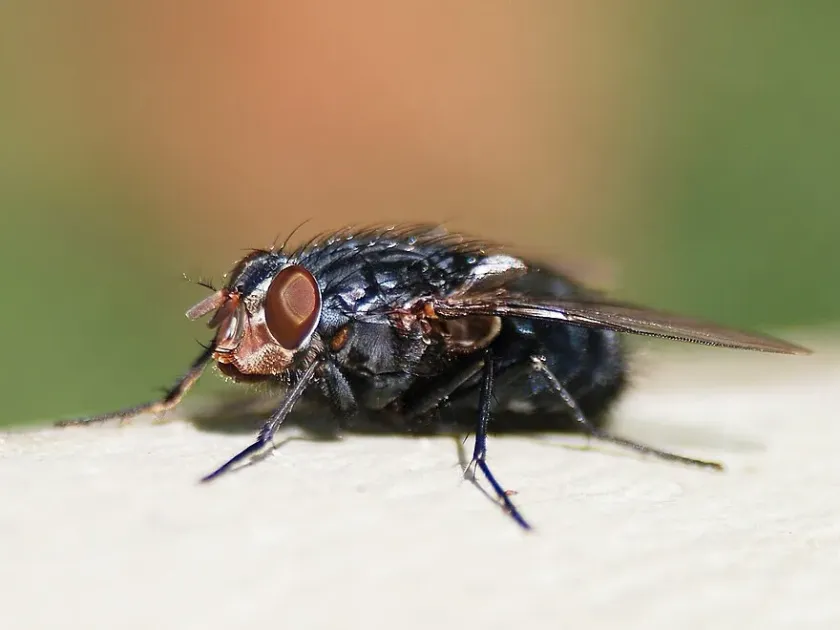
The blue bottle fly (Latin: Calliphora vicina) belongs to the family Calliphoridae and is one of the most common flies found in urban and rural environments. Adults typically measure between 8 and 12 mm and are easily recognized by their shiny, metallic blue or green-blue abdomen.
The life cycle of the fly comprises four stages: egg, larva, pupa, and adult. Females are attracted to decaying organic matter, such as carrion or meat, where they lay their eggs in clusters. A single female can produce several hundred eggs during her short lifespan.
Larvae are cream-colored and cylindrical, equipped with mouth hooks that allow them to consume tissues efficiently. They go through three larval stages before seeking a dry place to pupate, usually in the soil or protected crevices away from the food source.
Blue bottle flies are highly active fliers and are attracted to the odors associated with decomposition. They can travel several kilometers in search of suitable breeding sites, making them difficult to exclude from large facilities completely.
The speed of their development is highly dependent on ambient temperature. In warm weather, the entire cycle can be completed in less than two weeks, leading to multiple overlapping generations throughout the active season.
What it damages
The primary economic impact of blue bottle flies occurs in meat processing facilities and food storage warehouses. Infestation by larvae not only destroys the product but also renders it completely unfit for human consumption due to the contamination with bacteria.
As mechanical vectors, these flies transmit a wide range of pathogens, including Salmonella, E. coli, and various viruses. They transfer these germs by moving between unsanitary waste areas and clean production surfaces.
In livestock farming, these flies are a significant threat as they may cause myiasis in animals. Eggs laid on open wounds or moist skin result in larvae feeding on the animal's tissue, causing pain, stress, and secondary infections.
In agricultural storage, flies can accelerate the degradation of damaged fruits or vegetables by introducing rot-causing microorganisms. This damage often leads to substantial losses of inventory before it reaches the market.
The management costs associated with fly control, including sanitation, insecticides, and discarded inventory, represent a significant financial burden for the agricultural and food industries.
Signs of infestation
Visual presence of shiny blue flies buzzing near waste containers or storage areas is the primary indicator of an infestation. Their consistent activity is a strong signal that a breeding site is nearby.
Masses of eggs found in small crevices of meat or other organic matter indicate an active breeding cycle. These clusters are often overlooked until the larvae begin to emerge, causing visible damage to the material.
The presence of larvae is usually accompanied by the smell of decay and the liquefaction of the substrate. If larvae are found, it confirms that the product is heavily contaminated and should be disposed of immediately.
Small, hard, dark brown pupae shells are often found in corners, under debris, or near the edge of infested materials. These indicate that the fly population has successfully completed its lifecycle in the facility.
Increased activity of spiders or other predators in specific areas can also be an indirect sign that a high population of fly larvae is present in the immediate vicinity.
Control measures
The most effective strategy is rigorous sanitation. Eliminating access to waste, carrion, and other decaying materials is critical to preventing the establishment of a breeding population on the premises.
Exclusion techniques, such as installing high-quality fly screens on windows and air-curtains on loading bay doors, are essential to keep the adult flies out of food-handling areas.
Light traps (UV light) are highly effective tools for both monitoring and controlling fly populations. They should be strategically placed to attract flies away from food processing zones and into catch trays.
Chemical control measures include the use of baits and targeted insecticides. These must be applied strictly according to safety regulations to ensure that no residues contaminate the agricultural products or livestock environments.
- Maintain strict sanitation schedules.
- Seal all waste disposal containers.
- Install physical exclusion barriers.
- Regularly monitor with UV light traps.
Taxonomy
- Latin name
- Calliphora
- Order
- Diptera (flies)
- Family
- Calliphoridae
- EPPO code
- CALLSP
Discussion
No discussions yet — be the first.