
Blue meat fly
Calliphora augur
Description
How to identify
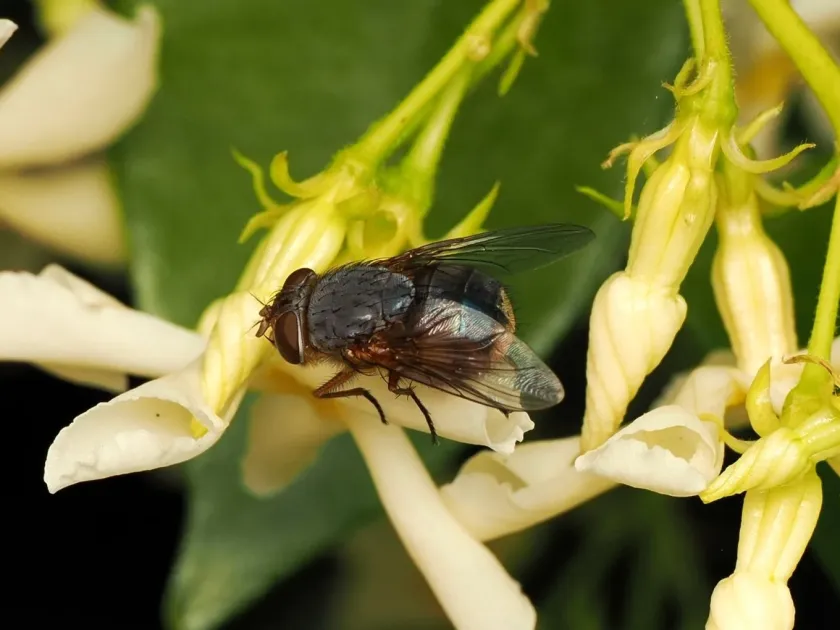
The blue meat fly (Calliphora augur) is a member of the Calliphoridae family within the order Diptera. Adults are recognized by their metallic blue abdomen and thick black hair.
These flies possess a robust exoskeleton and powerful wings, enabling them to travel long distances in search of organic matter for egg-laying.
The head features prominent compound eyes and a specialized sponging mouthpart, which allows the insect to feed on liquid food sources effectively.
The larvae are cream-colored, legless, and cylindrical in shape, specifically adapted for burrowing and feeding within soft, decaying materials.
Expert identification relies on the morphology of the posterior spiracles, which are distinct for the species and crucial for entomological diagnostics.
What it damages
The damage caused by Calliphora augur primarily affects fruits and vegetables that are overripe, damaged, or already beginning to rot in the field.
By landing on healthy produce, these flies act as vectors for various pathogenic bacteria and fungi, which can lead to rapid post-harvest decay.
Larval feeding causes rapid decomposition of plant tissues, quickly rendering the crop unsellable and reducing yields during storage.
In commercial agriculture, their presence in storage facilities creates an environment conducive to massive secondary infections and total loss of batches.
Even minor cosmetic damage to fruits makes them highly susceptible to fly strikes, as the juices attract adult females for immediate oviposition.
When it appears
The activity of the blue meat fly increases significantly when ambient temperatures consistently reach 15 degrees Celsius and above.
Peak population levels typically occur during mid-summer, coinciding with the maturation and harvest of various horticultural and orchard crops.
Multiple generations can emerge throughout a single growing season, provided that environmental conditions and food sources remain abundant.
As temperatures begin to drop in autumn, the population growth slows, and individuals seek sheltered sites to overwinter as pupae or adults.
Optimal conditions for their proliferation include warm, humid weather, which accelerates both larval development and the decay of host tissues.
Signs of infestation
The first sign of an infestation is the increased presence of adult blue flies hovering around discarded plant waste or damaged fruit bins.
Careful inspection of fruits often reveals clusters of small, white, elongated eggs deposited in skin crevices, stem ends, or existing mechanical wounds.
Localized softening of tissue and the presence of liquid exudate are definitive signs of larval activity occurring within the interior of the plant material.
A foul, putrid odor emanating from a crop pile is a classic indicator that fly larvae have successfully colonized and are consuming the organic matter.
Finding pupal casings on the surface of storage containers or near packing areas confirms that a generation of flies has successfully completed its cycle.
Control measures
Rigorous sanitation is the primary control strategy; prompt removal and destruction of decaying organic matter are essential to eliminate breeding grounds.
Installing fine-mesh screens on all storage facility openings effectively excludes adult flies from reaching vulnerable produce.
Sticky traps and non-toxic attractants can be deployed to monitor and manage fly populations effectively without contaminating the crops themselves.
Implementing careful harvesting techniques to minimize fruit bruising significantly reduces the attractiveness of the crop to female flies.
Chemical control with approved insecticides should be reserved for severe infestations and must always comply with strict pre-harvest interval regulations.
Taxonomy
- Latin name
- Calliphora augur
- Order
- Diptera (flies)
- Family
- Calliphoridae
- EPPO code
- CALLAU
Discussion
No discussions yet — be the first.