
Blue meat fly
Calliphora quadrimaculata
Description
How to identify
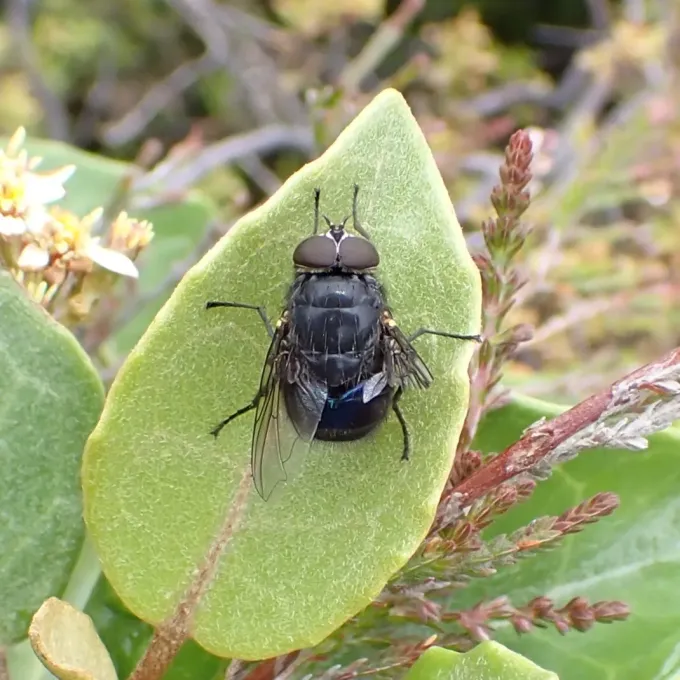
The blue meat fly, a member of the Calliphoridae family, is a large insect characterized by its metallic blue abdomen. Adult specimens typically measure between 8 and 12 millimeters in length.
The fly possesses prominent compound eyes and a sponge-like mouthpart adapted for feeding on liquid organic matter. Its body is covered with dense, coarse hairs that facilitate the transmission of pathogens.
The wings are transparent with a distinct venation pattern common to the family. When at rest, the fly keeps its wings held horizontally flat across its back.
The larvae are white to creamy in color, legless, and taper towards the front end. Pupation occurs within a dark-brown, rigid puparium which acts as a protective casing.
The life cycle encompasses four stages: egg, larva, pupa, and adult. The speed of this cycle is heavily influenced by ambient temperature and the availability of nutrient-rich substrates.
What it damages
The blue meat fly primarily damages stored agricultural and food products, particularly those of animal or protein-rich plant origin, rather than living plants.
Larvae feed aggressively on organic waste, processed meat products, and stored protein sources. In agricultural settings, they can contaminate dried commodities if not properly sealed.
The pest poses a significant threat to warehouse sanitation, as it contaminates products with excrement and liquefies food sources through enzyme secretion.
Large populations of this fly in processing facilities lead to substantial economic loss due to the total spoilage of affected commodities and the loss of sanitary quality.
Furthermore, these flies are known vectors of various infectious diseases, which can spread throughout a storage facility through contact with contaminated surfaces.
When it appears
Fly activity is strongly linked to seasonal temperature shifts. Adults are most active during spring and summer months when temperatures consistently remain above 15°C.
In climate-controlled warehouses, the blue meat fly can continue its life cycle year-round, provided that sufficient moisture and food sources are available.
Population peaks are typically observed during mid-summer, as higher temperatures accelerate the transformation from egg to adult, shortening the generation time.
Activity gradually wanes during autumn months, as insects begin to seek shelter in protected areas to overwinter until warmer conditions return.
In early spring, overwintered adults emerge to find food sources, starting the cycle anew as temperatures permit larval development.
Signs of infestation
The first indicator of an infestation is the presence of adult flies hovering around stored commodities or organic debris, often accompanied by a distinct buzzing sound.
Clusters of small, white eggs deposited on the surface of food or waste indicate the initial stage of a new infestation cycle.
The presence of larvae wriggling within a product is a definitive sign of advanced infestation and requires immediate corrective action.
A foul, putrid odor emanating from storage areas is often the result of larval activity, as they release digestive enzymes that cause rapid decay of the substrate.
The discovery of dark, oval-shaped puparia near feeding sites confirms that larvae have completed their development and are entering the final transition stage.
Control measures
Rigorous warehouse sanitation is the primary method of control. Removing organic waste and spillages eliminates the breeding grounds necessary for larval development.
Installing fine-mesh screens on windows and ventilation shafts prevents adults from entering the facility, while proper sealing of food containers is essential.
- Utilizing UV light traps to attract and kill adult flies.
- Applying insecticidal tapes and adhesive traps in high-traffic monitoring areas.
- Performing scheduled disinsection of warehouses using approved chemical agents.
Maintaining low humidity levels within storage areas significantly hinders larval development, as these insects require high moisture content to survive.
Active temperature management and regular product inspection are vital for preventing outbreaks and ensuring the long-term quality of stored agricultural goods.
Taxonomy
- Latin name
- Calliphora quadrimaculata
- Order
- Diptera (flies)
- Family
- Calliphoridae
- EPPO code
- CALLQU
Discussion
No discussions yet — be the first.