
Copper beetle
Poecilus cupreus
Description
How to identify
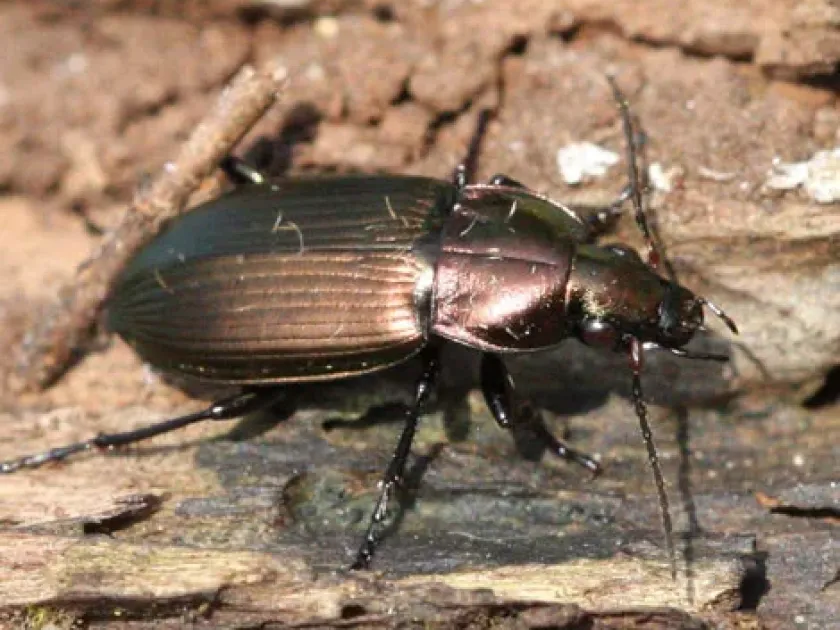
The copper beetle (Poecilus cupreus) belongs to the Carabidae family, commonly known as ground beetles. This is a medium-sized predatory beetle reaching 10–12 mm in length.
The insect's body has a distinct metallic luster, often with copper, greenish, or bronze shades, which is reflected in its common name.
Adults are highly mobile and possess developed elytra, allowing them to move rapidly across the soil surface.
The larvae of this species have an elongated form, well-developed mandibles, and three pairs of thoracic legs, typical for predatory ground beetles.
It is crucial to distinguish this species from beneficial entomophages, as the copper beetle can exhibit phytophagous behavior under certain conditions, damaging crop seedlings.
What it damages
The copper beetle primarily damages cereal crops such as wheat, barley, and rye, especially during the seed germination period.
Both adults and larvae can damage young seedlings by eating germinating seeds in the soil or cutting the stems at the very base.
In years of mass outbreaks, this pest can significantly thin out crops, reducing plant density during the early stages of vegetation.
The greatest danger to crops occurs during dry periods when beetles switch to plant tissue feeding due to a lack of animal prey.
In addition to cereals, damage can be inflicted on maize and sugar beet seedlings when grown in rotations with high cereal saturation.
When it appears
Beetles are active throughout the growing season, starting from early spring when soil temperatures reach 10 degrees Celsius.
The peak activity of adults usually occurs in May and June, which coincides with the active growth phases of cereal crops.
Reproduction and egg-laying take place in the soil, where larvae develop during the summer, feeding on organic debris and small invertebrates.
Pupation occurs in the late summer or autumn, after which young beetles emerge to hibernate in the upper soil layers or under plant residues.
Thus, the main risk of crop damage falls in the spring, when the number of overwintered individuals reaches its maximum.
Signs of infestation
The main sign of pest presence is thinning patches in the field, where seedling death or the appearance of bald spots is observed.
Upon inspecting dead plants, one can find characteristic damage: eaten seeds or stems severed at the base.
On the soil surface, especially during evening or morning hours, one can visually notice active, metallic-shining beetles.
Using soil traps often reveals high adult density, indicating a potential threat to future crops.
Seedlings may appear stunted, turn yellow, and wilt due to mechanical damage to the root collar by larvae or adult beetles.
Control measures
An effective control method is the strict adherence to crop rotation, excluding cereal monocultures that facilitate pest population buildup.
Deep autumn plowing helps destroy the overwintering sites of beetles and larvae, while also making the soil less suitable for their development.
The use of high-quality insecticidal seed treatment allows for the protection of seedlings from soil pests during the critical germination period.
It is essential to conduct timely weed control, as weeds can serve as additional reservoirs to support the pest population.
- Optimizing sowing dates to quickly pass vulnerable growth phases.
- Applying insecticides upon reaching the economic threshold of harmfulness.
- Maintaining optimal agronomic conditions for rapid crop establishment.
Taxonomy
- Latin name
- Poecilus cupreus
- Order
- Coleoptera (beetles)
- Family
- Carabidae
- EPPO code
- PTESCU
Discussion
No discussions yet — be the first.