
Alfalfa plant bug
Poecilocapsus
Description
How to identify
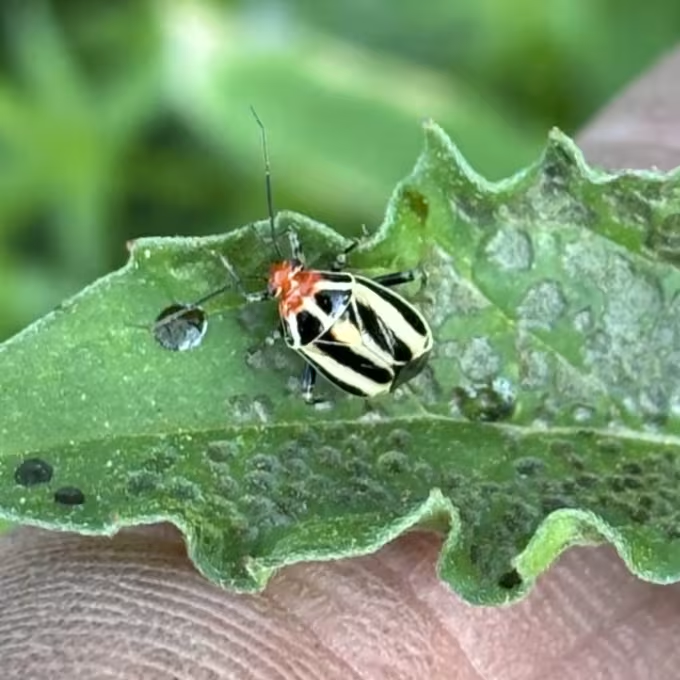
The alfalfa plant bug Poecilocapsus lineatus belongs to the order Hemiptera and the family Miridae. Adults are visually striking, measuring about 7–9 mm in length, with a yellow-green body marked by prominent black longitudinal stripes on the wings.
The insect is equipped with a sharp proboscis used to pierce plant tissues and extract vital cell sap. They possess long, thread-like antennae that allow them to navigate effectively through dense foliage and vegetation.
Nymphs resemble the adults in general shape but are significantly smaller and lack fully developed wings. Their coloration varies from bright orange to red, typically featuring black spots on the thorax and abdomen, making them easily distinguishable.
Adult bugs are highly mobile and exhibit strong flight capabilities, often escaping by jumping or flying to nearby plants when disturbed. They overwinter in the egg stage, with females inserting eggs into the stems of host plants.
The life cycle involves one or two generations per year, depending on regional climatic conditions. They thrive in warm, humid environments, which are optimal for rapid population growth and nymph development.
What it damages
This species is a polyphagous pest, meaning it attacks a wide variety of cultivated crops and wild plants. Common hosts include alfalfa, clover, sugar beets, sunflowers, and various vegetable species.
In orchards and berry patches, these bugs can damage the foliage and developing fruits of currants, gooseberries, and other fruit-bearing trees. Both adults and nymphs feed actively throughout the growing season.
Feeding occurs by piercing the plant epidermis and injecting saliva containing enzymes. These enzymes break down chlorophyll and destroy plant tissues, which disrupts photosynthesis and normal growth processes.
Severe infestations on alfalfa crops can lead to significant yield losses. By damaging the foliage, the bug reduces the nutritional value and total green mass production, while also impacting seed set quality.
For vegetable crops, the damage manifests as leaf curling, tissue necrosis, and fruit deformity. These defects make the produce less marketable and more susceptible to storage-related decay.
Signs of infestation
Early symptoms of infestation include tiny light-colored spots on leaves. As feeding continues, these spots coalesce into larger necrotic patches, eventually causing the leaf to yellow, curl, and drop prematurely.
Stems and leaf petioles often show characteristic dark puncture marks where the bug has fed. Young shoots may become stunted or distorted as the plant's vascular integrity is compromised.
During morning or evening hours, nymphs can be spotted hiding in the leaf axils. Adult bugs are more elusive and often fly away if the plant is shaken or approached too quickly.
On berry fruits, feeding results in corky patches and irregular pitting, which ruins the appearance of the product. This damage significantly lowers the commercial grade of the harvest.
In cases of heavy infestation, the entire field or garden bed appears stressed and weak. Stunted growth compared to healthy neighboring plants is a clear indicator of a persistent bug presence.
Control measures
Cultural control is the first line of defense, including strict weed management in and around fields to eliminate egg-laying sites. Fall plowing helps destroy overwintering egg populations in plant debris.
When the economic threshold is exceeded, application of contact or systemic insecticides is necessary. Treatments are most effective when applied early, targeting the young nymph stages before they reach maturity.
Biological control methods include encouraging natural predators such as assassin bugs, lacewings, and spiders. Maintaining a diverse ecosystem on the farm can help keep bug populations at manageable levels.
Regular monitoring using sweep nets is essential for early detection. Farmers should assess population levels before deciding on chemical intervention to minimize impact on beneficial pollinator species.
Promoting crop vigor through optimal fertilization and choosing resistant varieties are key components of an integrated pest management strategy. Healthy plants demonstrate higher resilience to feeding damage.
Taxonomy
- Latin name
- Poecilocapsus
- Order
- Hemiptera (bugs, aphids, leafhoppers)
- Family
- Miridae
- EPPO code
- POEASP
Discussion
No discussions yet — be the first.