
Green-striped bush-cricket
Poecilimon ornatus
Description
How to identify
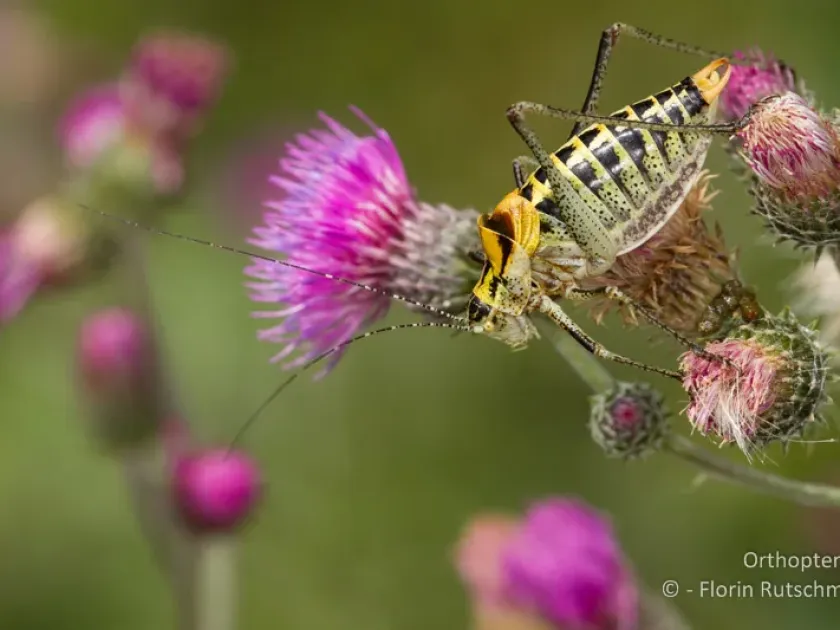
The green-striped bush-cricket (Poecilimon ornatus) belongs to the family Tettigoniidae, within the order Orthoptera. This insect is characterized by its slender, elongated body, which typically displays light green or yellowish tones, accented by distinct pale or dark stripes along its sides.
These bush-crickets possess significantly shortened wings, which in females are often largely hidden under the pronotum. Adults generally reach a length between 20 and 30 millimeters and are equipped with long, thread-like antennae that exceed the length of their body.
The species prefers habitats with dense vegetation, utilizing its cryptic coloration to blend into the greenery, which makes it difficult to detect during the daylight hours when it remains stationary.
Its life cycle follows a standard pattern for the family, encompassing egg, nymph, and adult stages. Females lay their eggs within plant tissues or directly into the soil, where they overwinter until the next season.
Favorable weather conditions allow for rapid development and reproduction, which can lead to significant population surges that threaten nearby agricultural zones and vegetable gardens.
What it damages
As a polyphagous insect, the green-striped bush-cricket feeds on a wide array of herbaceous plants. It is known to target various vegetable crops, including tomatoes, cucumbers, and legumes, causing notable economic loss.
In garden settings, they are known to feed on the tender shoots of fruit trees and berry bushes. Young seedlings and newly sprouted crops are particularly susceptible, as a small group of crickets can defoliate or completely destroy them.
They consume leaf tissue, creating irregular, jagged edges, or skeletonizing the leaves entirely. Furthermore, they frequently feed on flowers and developing fruit, which directly impairs yield quality and quantity.
Wounds caused by their feeding often serve as entry points for various phytopathogens, potentially leading to subsequent fungal or bacterial infections in the damaged crop tissue.
During dry seasons, when native vegetation becomes scarce, these insects are prone to migrating into irrigated agricultural fields, thereby increasing the level of damage to cultivated plants.
When it appears
The activity of the green-striped bush-cricket begins in late spring, as temperatures remain consistently warm. Overwintering occurs in the egg stage, typically buried in the soil or within plant debris.
The hatching of nymphs is often staggered and depends on soil warming. Throughout the summer, they pass through several molting stages, gradually maturing into adult insects.
The peak activity for adults is observed during mid-to-late summer, specifically in July and August, when they are most intensive in their feeding and reproductive efforts.
As autumn approaches and temperatures drop, their activity levels decrease. Following egg-laying, the life cycle of the adults concludes, and they die off with the onset of the first cold weather.
The specific climatic conditions during the spring are critical for the survival of first-instar nymphs and serve as a predictor for the pest density throughout the summer season.
Signs of infestation
The most prominent sign of an infestation is the presence of chewed or jagged leaf margins, particularly on crops located near field borders or dense weed patches.
Due to their primarily nocturnal behavior, finding the insects during the day requires careful inspection of the lower leaf surfaces or hidden spots within dense foliage.
The presence of a large population is often indicated by the characteristic stridulation (chirping) of the males, which becomes quite audible during the evening and night hours.
Fruit damage, which appears as small, shallow surface sores or scratches, is a diagnostic sign that the insects are targeting the reproductive organs of the plants.
When young seedlings disappear or show signs of severe defoliation without other obvious causes, it is advisable to conduct a systematic survey for bush-cricket activity.
Control measures
Management strategies for this pest involve an integrated approach, prioritizing both cultural practices and chemical interventions when necessary. Maintaining field hygiene is of primary importance.
- Deep plowing of the soil in autumn to destroy overwintering egg sites.
- Regular mowing of weeds along field margins and access roads to reduce shelter and food sources.
- Application of contact-stomach insecticides in cases where the pest density exceeds economic threshold levels.
- Creation of barrier strips around the perimeter of the crop area to limit migration.
- Preservation of natural predators, such as birds and carnivorous insects, which help regulate population levels naturally.
Monitoring should begin early in the spring, allowing farmers to identify potential outbreaks and initiate control measures before the pests reach their most damaging stage.
Chemical applications should be targeted to avoid harming non-target beneficial insects, ensuring that the ecosystem remains balanced and healthy for long-term production.
A combination of crop rotation, vigilant monitoring, and good agricultural practices constitutes the most robust long-term strategy for minimizing the damage caused by these bush-crickets.
Taxonomy
- Latin name
- Poecilimon ornatus
- Order
- Orthoptera (locusts)
- Family
- Tettigoniidae
- EPPO code
- POEMOR
Discussion
No discussions yet — be the first.