
Brunner's bush-cricket
Poecilimon brunneri
Description
How to identify
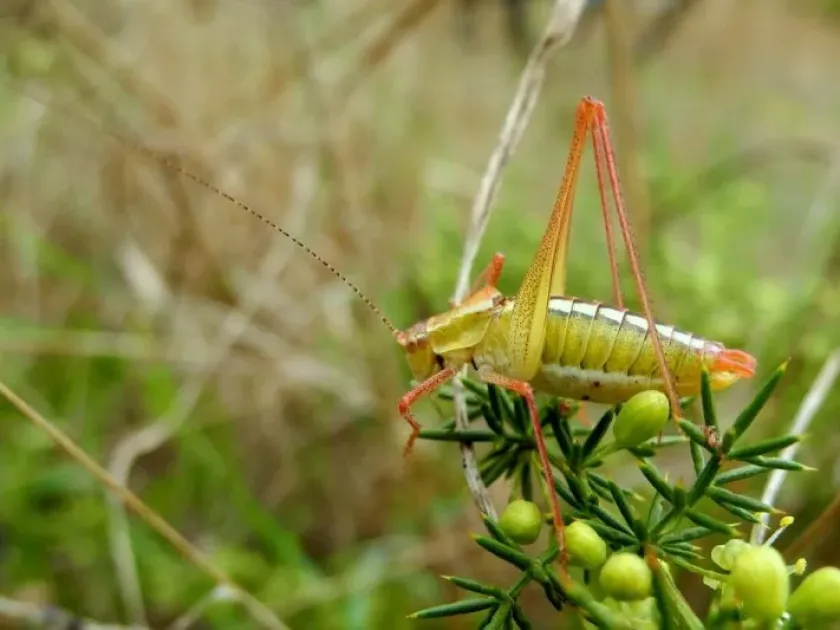
Brunner's bush-cricket (Poecilimon brunneri) is a member of the Tettigoniidae family, within the order Orthoptera. These insects are characterized by their green, leaf-like appearance, which provides excellent camouflage among crops and wild grasses.
Adults are relatively small, typically measuring between 15 and 25 millimeters. A distinguishing feature is the shortened wings, which are barely visible in females and only slightly protrude in males, giving them a larval-like appearance throughout their life.
The body is slender with strong, powerful hind legs adapted for jumping. They possess long, thread-like antennae that are significantly longer than the body, a trait typical of most bush-cricket species.
Unlike migratory locusts, this species does not form large swarms. Instead, it lives a solitary life, hiding in dense vegetation, which makes it difficult to detect during the early stages of infestation.
The life cycle involves incomplete metamorphosis. The nymphs resemble miniature adults but lack fully developed reproductive organs and wings, gradually growing through several molting stages until they reach maturity.
What it damages
This bush-cricket is a polyphagous pest, meaning it feeds on a wide range of plants. While it prefers wild grasses, it frequently attacks agricultural crops when population densities are high.
Grain crops such as wheat and barley are common targets. The insects feed on leaves, reducing the plant's photosynthetic capacity, and can also damage developing heads or ears, leading to direct yield loss.
Sunflowers and various vegetable crops are also prone to damage. The insects consume the epidermal layers of stems and leaves, often causing visible yellowing and tissue death in the affected areas.
In arid conditions, when wild vegetation dries out, these bush-crickets are forced to migrate into cultivated fields, which can lead to significant localized crop destruction.
The severity of the damage depends on the population density. Young nymphs cause minor leaf consumption, while adults can cause severe defoliation and stem damage, weakening the overall plant structure.
When it appears
The species overwinters in the egg stage. Eggs are laid in the soil or within plant debris by females during the late summer and early autumn, remaining dormant until the following spring.
Nymph hatching occurs in the spring when temperatures consistently rise. This period usually aligns with the active growth phase of winter and early spring grain crops.
The nymphal stage lasts for several weeks, with the insects molting and growing throughout late spring and early summer. By mid-summer, typically in July, most individuals reach the adult stage.
Adults remain active throughout the summer, focusing on feeding and reproduction. The population typically declines by the end of August or early September as the life cycle concludes.
Weather patterns significantly influence annual population numbers. Hot, dry springs tend to favor survival, whereas cold, wet conditions during the hatching period can drastically reduce the number of nymphs.
Signs of infestation
Early signs of infestation include irregular holes and jagged edges on the leaves of crops. These bite marks are typical of the chewing mouthparts of bush-crickets.
Auditory evidence is a primary indicator; males produce a distinctive, repetitive chirping sound during the day or evening, which confirms their presence in the field even if they remain hidden.
Small, dark fecal pellets on the leaves or the soil surface underneath the plants serve as physical evidence of feeding activity, particularly in dense crop stands.
In cases of severe infestation, stems may appear partially stripped or scarred. These feeding wounds can become entry points for secondary fungal or bacterial plant pathogens.
During visual inspections, bush-crickets are easily startled and will jump away into the vegetation, making it easier to spot them during the quiet early morning or late evening hours.
Control measures
Agricultural management begins with field sanitation. Removing weeds along the field margins significantly reduces the primary habitat and food source for early-stage nymphs.
Deep autumn plowing is an effective mechanical control method. This practice buries the eggs deeper in the soil or exposes them to the surface, where they succumb to freezing temperatures and predation.
Chemical control using registered insecticides should be considered if the population density exceeds the economic injury level. It is most effective when applied during the early nymphal stages.
Biological control plays a vital role in natural population regulation. Encouraging populations of birds and predatory insects around the farm can help manage bush-cricket numbers without chemical intervention.
Regular field monitoring is essential for timely detection. Using sweep nets or visual counts on sample plots helps agronomists determine whether intervention is necessary, avoiding unnecessary pesticide use.
Taxonomy
- Latin name
- Poecilimon brunneri
- Order
- Orthoptera (locusts)
- Family
- Tettigoniidae
- EPPO code
- POEMBR
Discussion
No discussions yet — be the first.