
Grey bush-cricket
Platycleis albopunctata
Description
How to identify
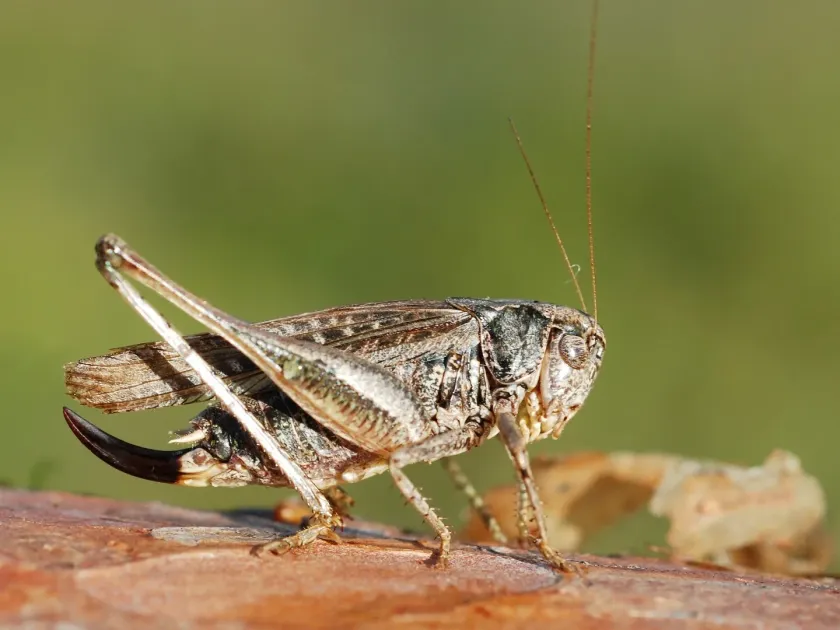
The grey bush-cricket belongs to the order Orthoptera, family Tettigoniidae. It is characterized by a greyish-brown body covered with small white spots, providing camouflage among dry vegetation.
Adults typically measure between 15 and 25 mm in length. Females possess a long, slightly curved ovipositor, which they use to lay eggs deep into the soil or plant tissues.
These insects have auditory organs located on their front tibiae, allowing them to detect vibrations effectively in tall grass or crop fields. They prefer dry, sunny habitats.
The life cycle involves incomplete metamorphosis, lacking a pupal stage. Nymphs appear similar to adults but smaller and without fully developed wings until their final molts.
This species is well-adapted to arid environments, making it a common sight in fields and meadowlands during the summer months.
What it damages
The grey bush-cricket is a generalist feeder that impacts a wide range of crops. It is particularly known for damaging cereal crops like wheat and barley during their growth stages.
It frequently attacks forage crops, including clover and alfalfa, where it feeds on leaves and stems, reducing the overall yield and nutritional quality of the hay.
In years of high population density, these insects may migrate to vegetable gardens and technical crops, causing significant destruction to young seedlings.
Beyond vegetative parts, they may feed on reproductive organs, such as ears of corn or wheat, leading to direct economic losses for farmers.
Heavy infestations lead to leaf skeletonization, which weakens the plant and leaves it vulnerable to secondary infections and environmental stress.
When it appears
The grey bush-cricket has an annual life cycle. It overwinters in the egg stage, with eggs deposited in the soil or plant remnants during the previous autumn.
Nymphs emerge in late spring, usually around May, as temperatures rise, signaling the start of their active feeding season.
Throughout the summer, nymphs undergo 5-6 molts, gradually increasing in size and feeding voraciously on available green plant matter.
Adults become most prominent during July and August, which is the period of peak mating activity and maximum potential damage to crops.
As autumn approaches, adult activity declines after egg-laying, and the generation cycle is completed as the population moves into the overwintering phase.
Signs of infestation
The primary sign of infestation is irregular, torn leaf margins where the insect has fed, leaving behind only the tougher veins of the plant.
In cereal crops, damage appears as gnawed tissues on the ears or stems, which can turn yellow and wither prematurely in dry conditions.
Auditory evidence, specifically the rhythmic chirping of males in sunny weather, is a strong indicator of their presence and population size in the field.
Accumulation of small, granular frass on the leaves or around the base of the plant confirms active feeding sites of these crickets.
Affected fields often show localized patches of stunted growth, which become more apparent as the insects congregate in favored areas.
Control measures
Deep autumn plowing is the most effective agronomic measure, as it buries and destroys the overwintering eggs located in the soil surface.
Maintaining clean field borders and eliminating weeds reduces the available habitat for the crickets, effectively lowering the local population density.
When infestation levels exceed economic thresholds, the application of registered insecticides (e.g., pyrethroids) provides quick control over the population.
Field monitoring using sweep nets is recommended to assess population density and determine the necessity of targeted chemical treatment.
Encouraging natural predators, such as birds and beneficial insects, can help suppress the population naturally and minimize the need for synthetic pesticides.
Taxonomy
- Latin name
- Platycleis albopunctata
- Order
- Orthoptera (locusts)
- Family
- Tettigoniidae
- EPPO code
- PTCLAL
Discussion
No discussions yet — be the first.