
Planchonia arabidis
Planchonia arabidis
Description
How to identify
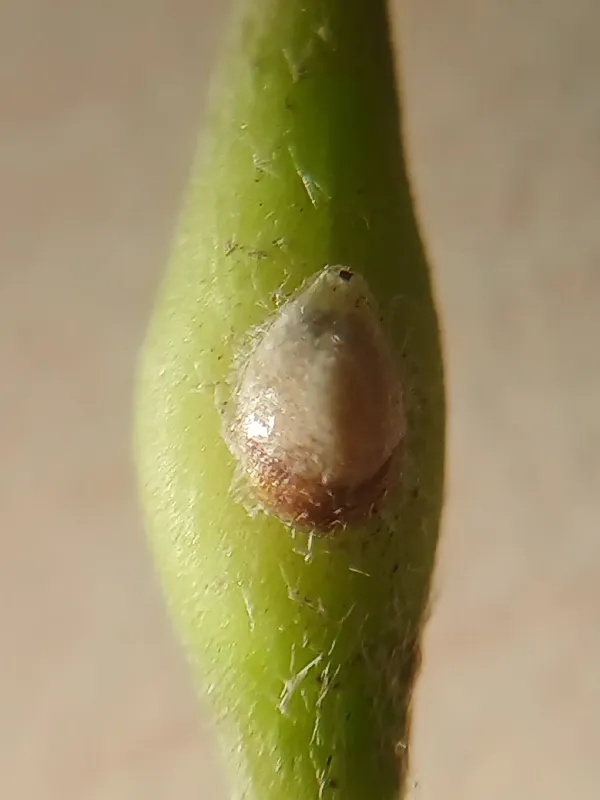
Planchonia arabidis is a small insect belonging to the order Hemiptera and the family Asterolecaniidae. Adult individuals are characterized by a specific scale that adheres tightly to the surface of the host plant's bark.
Externally, the insect resembles a small, convex flake, often matching the color of the tree bark, which makes it difficult to detect during an initial orchard inspection. The body of the female is completely hidden under a waxy secretion that performs a protective function.
The development of this species is closely linked to regional climatic conditions, as the insect prefers areas of bark protected from direct winds. It leads a sedentary lifestyle, moving very little after fixing itself to the plant.
To identify the species, agronomists use the method of careful examination of shoots and tree trunks, paying attention to uncharacteristic growths. It is important to distinguish this species from other scale insects by the structure of the peripheral edge of the waxy shell.
The biological cycle of this pest includes egg, larva (crawler), and adult stages, with the most vulnerable stage for applying insecticides being the period of active crawler emergence.
What it damages
This pest primarily damages woody and shrub species, particularly members of the Brassicaceae family, as well as various ornamental and fruit plantings. It feeds on cellular sap, sucking it from the tissues of the bark and young shoots.
Damage to the plant leads to the gradual exhaustion of vegetative mass, a decrease in photosynthesis intensity, and disruption of sap flow processes. In areas where the pest congregates, the bark begins to crack, creating foci for secondary fungal infections.
Significant damage is caused to young saplings, which can lose their viability completely under high pest population density. Mature trees lose productivity, growth slows significantly, and fruit quality declines.
A characteristic consequence of mass reproduction is premature yellowing and leaf drop. In severe cases, branches undergo necrosis due to constant disruption of tissue nutrition by the insects.
The economic significance of the pest is high for nurseries and orchards, as the presence of Planchonia arabidis traces is often a reason for quarantine restrictions or total rejection of planting material.
When it appears
The active phase of the pest's life cycle begins in early spring when mean daily air temperatures exceed the threshold for larval awakening. The main migration of crawlers occurs in May and June.
The summer period is characterized by intensive growth of females and the building of a protective scale; during this time, the insects are most protected from external factors. Reproduction often occurs in one generation, although in southern regions, two generations may develop.
By autumn, population density reaches its maximum, and the pest enters the overwintering stage as fertilized females or older instar larvae. During this period, they securely anchor themselves in bark crevices.
Mild winter conditions contribute to higher pest survival, leading to a sharp population surge the following season. Sharp temperature fluctuations in early spring may reduce the population but are not the deciding factor.
Monitoring should be carried out regularly, especially during the flowering periods of crops, as this is when visual detection of crawlers on the surface of branches becomes most accessible to the specialist.
Signs of infestation
The first sign of infestation is the appearance of small bumps on the smooth bark of young branches. Upon detailed examination with a magnifying glass, one can notice waxy secretions that may change color over time.
- Yellowing of individual shoots.
- Deformation of the bark at the attachment sites.
- Presence of sticky residue that becomes a medium for sooty mold.
- Stunted growth of apical buds.
- Bark peeling in areas of heavy infestation.
The presence of sooty mold covering branches with a black coating is an indirect but very reliable sign of sap-sucking insect activity. This fungus develops on the sweet excrement of the pest.
If the waxy scale is scraped off with a knife, the individual itself can be found beneath it, appearing as a soft, light-colored oval body. The lack of mobility in the adult stage facilitates the mechanical removal of the pest.
As the infestation progresses, the tree loses its ornamental value, and the foliage becomes sparse and small, which is noticeable even against the general background of healthy plantings in the garden.
Control measures
Control of Planchonia arabidis requires a comprehensive approach, combining mechanical, agrotechnical, and chemical methods. First and foremost, sanitary pruning of affected branches must be carried out.
An effective method is treating trees with mineral oils in early spring before bud break. This allows for blocking the breathing pores of the insects hiding under the scale and preventing their awakening.
During the crawler emergence period, systemic insecticides are used. It is important to adhere to application timelines, focusing on temperature charts, so the preparation reaches the larvae before they form a dense protective shell.
Prevention includes maintaining a high level of agrotechnology, timely watering, and plant fertilization, which increases crop immunity. A strong tree withstands pest infestation much better.
To prevent the spread of the pest in nurseries, phytosanitary control of all imported planting material should be conducted, and only verified, healthy saplings should be used.
Taxonomy
- Latin name
- Planchonia arabidis
- Order
- Hemiptera (bugs, aphids, leafhoppers)
- Family
- Asterolecaniidae
- EPPO code
- ASTLAR
Discussion
No discussions yet — be the first.