
Oak pit scale
Asterodiaspis quercicola
Description
How to identify
The oak pit scale, scientifically known as Asterodiaspis quercicola, belongs to the family Asterolecaniidae. It is a tiny sucking insect that specializes in attacking oak trees.
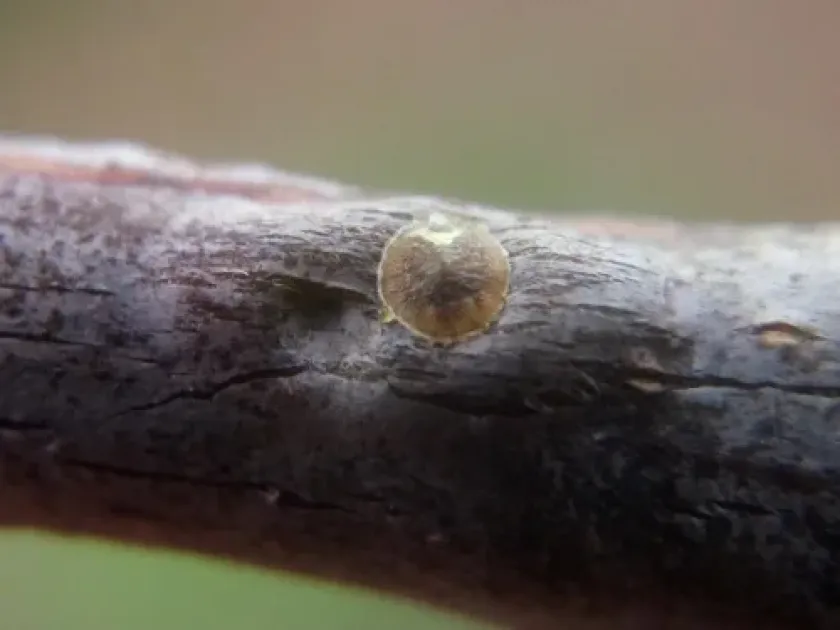
The adult female is sedentary and creates a distinct, pit-like depression in the host's bark by secreting a waxy substance that acts as a protective shield or capsule.
These insects are extremely small, often blending into the color and texture of the oak bark, which makes visual detection difficult for non-specialists.
The life cycle involves an egg stage, the mobile crawler stage (first instar), and the stationary adult stage. Crawlers are the only life phase capable of finding new feeding sites.
They are closely associated with oak hosts, often thriving in environments where their natural enemies are absent or where trees are under moderate stress.
What it damages
This pest primarily feeds on the young twigs and branches of various oak species, including English oak and sessile oak. Feeding leads to the extraction of essential plant sap.
The creation of pits in the bark causes permanent tissue damage, leading to surface irregularities and structural weakness in the affected branches.
Infested branches often exhibit stunted growth and loss of vigor. In severe cases, the branches may die back, resulting in visible gaps in the tree canopy.
By weakening the host's bark, the scale infestation invites secondary colonization by wood-boring insects or pathogens that exacerbate the damage to the tree.
The cumulative impact on the tree's vascular system reduces its ability to move nutrients efficiently, which affects the overall development and longevity of the oak.
When it appears
The activity of the oak pit scale is strictly seasonal, corresponding with the tree's growth cycles. Crawler emergence typically occurs in late spring to early summer.
During the summer months, the sedentary females focus on feeding and developing their protective waxy layer, making them highly resistant to common contact insecticides.
Autumn brings a decline in metabolic activity. The scale insects prepare for winter, typically by reaching maturity and forming durable, thick waxy shields.
Winter is spent in a dormant state, with the insects remaining firmly attached to the host bark throughout the coldest months of the year.
There is generally one generation per year, though in warmer climates, development can be slightly accelerated depending on ambient temperature conditions.
Signs of infestation
The most prominent sign is the presence of small, yellowish-green or brown bumps on the smooth bark of young oak twigs.
The formation of circular or elliptical pits or depressions around each scale is a diagnostic feature that distinguishes this pest from other scale types.
In cases of heavy infestation, the affected twigs may become noticeably twisted, distorted, or swollen due to the physiological reaction of the bark tissue.
Early in the season, the presence of active crawlers may appear as a fine, dusty white movement on the surface of the twigs.
Yellowing of leaves on specific branches can serve as an indirect sign that the vascular tissue of those twigs is being heavily exploited by scale colonies.
Control measures
Management of the oak pit scale relies heavily on identifying the timing of the crawler stage, as they are the most vulnerable life stage for treatment.
Systemic insecticides, which are absorbed into the sap of the tree, are often more effective than contact sprays because they bypass the protective waxy shield of the adult scale.
Cultural control includes pruning and disposing of heavily infested branches, which effectively removes large portions of the population from the tree.
Promoting tree health through proper irrigation and soil management helps the tree tolerate pest pressure and reduces the attractiveness of the tree to the scale.
- Monitor crawler activity in late spring.
- Apply systemic treatments before waxy shields harden.
- Maintain tree health to improve resilience.
- Remove and destroy severely infested twigs.
Taxonomy
- Latin name
- Asterodiaspis quercicola
- Order
- Hemiptera (bugs, aphids, leafhoppers)
- Family
- Asterolecaniidae
- EPPO code
- ASTDQU
Discussion
No discussions yet — be the first.