
Oak pit scale
Asterodiaspis variolosa
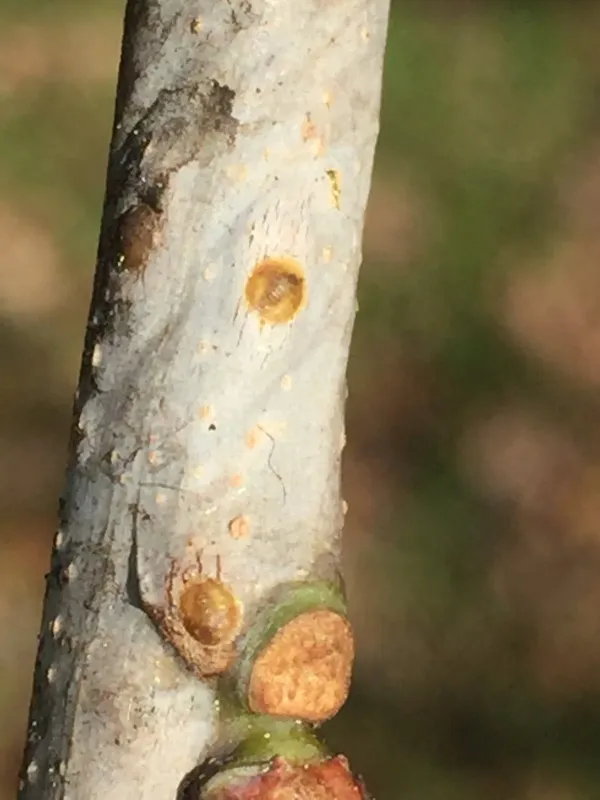
Description
How to identify
The oak pit scale, scientifically known as Asterodiaspis variolosa, is a small scale insect within the Asterolecaniidae family. Adult females are tiny, oval, and often exhibit a yellowish-green or brown coloration that blends with the host's bark.
The most distinctive characteristic of this pest is the formation of small, circular depressions or "pits" in the bark where the insect settles. These pits are a direct result of the insect's feeding behavior and constant pressure on the plant tissue.
The insect is covered by a waxy test (shield) which is secreted for protection. This shield makes the insect highly resistant to contact insecticides, as it forms a tight seal against the surface of the bark.
Reproduction is typically parthenogenetic, meaning males are rarely present. The population can multiply rapidly under suitable conditions, creating dense colonies on infested branches.
As a sedentary insect in its adult stage, it stays fixed in one location for its entire life cycle, relying on the host plant to provide continuous nourishment through sap extraction.
What it damages
The primary host for this pest is the oak (Quercus species), particularly the English oak. While mature trees can tolerate infestations to some degree, young trees or those under environmental stress are significantly more vulnerable.
The insect feeds by inserting its mouthparts into the phloem of young twigs and branches. This extraction of nutrients weakens the tree and disrupts the normal flow of sap to the developing parts of the plant.
Repeated or severe infestations lead to the deformation of branches, resulting in stunted growth and a gnarled, sickly appearance of the affected twigs. In extreme cases, this can lead to twig dieback.
The damage caused by pit scales can render trees susceptible to secondary infections, such as fungi or wood-boring beetles, which exploit the weakened tree's inability to defend itself.
In nursery settings, this pest can cause significant economic losses by reducing the quality and aesthetic appeal of saplings, often requiring rigorous intervention to maintain the health of the stock.
When it appears
The oak pit scale completes one generation per year. They overwinter primarily as fertilized females or eggs protected beneath the waxy scale on the bark of twigs.
In late spring, usually around May or June, the eggs hatch into active, mobile nymphs known as "crawlers." This is the only stage in their life cycle where they can easily move to new locations on the tree.
Once the crawlers settle on a suitable part of the twig, they lose their mobility and begin to feed, secreting their waxy covering as they mature throughout the summer months.
By late summer and early autumn, the insects reach maturity. They remain in their fixed locations, feeding and developing, before preparing to lay eggs for the next cycle.
The life cycle concludes as autumn approaches, with the adult females laying eggs that will remain dormant on the bark until the following spring, ensuring the species' survival through the winter.
Signs of infestation
The hallmark sign of an infestation is the appearance of sunken, circular pits on the bark of young twigs. These marks are often mistaken for natural growth characteristics of the tree's bark.
Tiny, greenish-brown or yellowish bumps may be visible on the surface of the twigs, which correspond to the bodies of the scales hidden beneath their protective waxy covering.
Affected branches often show signs of reduced vigor, including yellowing leaves (chlorosis) and reduced leaf size. The twigs may appear twisted or show cracks in the bark where the insects have been feeding.
Sooty mold growth is another indicator. Since these scales excrete honeydew while feeding, the branches often become coated in a sticky substance that promotes the growth of black, unsightly mold.
- Formation of characteristic pits in the bark.
- Reduced shoot growth and stunted twigs.
- Premature leaf drop in heavily infested areas.
- Accumulation of sooty mold on bark and leaves.
- Visible yellowish scales on one- or two-year-old wood.
Control measures
The most effective chemical control involves the application of systemic insecticides at the time of crawler emergence in the spring, as the crawlers lack the protective shield of the adults.
Cultural practices are essential for management. Pruning and destroying heavily infested branches can help reduce the overall population and prevent the spread to healthier parts of the tree.
Maintaining tree health through proper fertilization and irrigation is a key preventative measure. A well-nourished tree has a better ability to withstand or recover from scale infestations.
Biological control agents, including various predatory beetles and parasitic wasps, can help manage populations in stable forest or parkland ecosystems.
When using contact insecticides, timing is critical. Because adult scales are protected by their waxy test, treatments applied outside the crawler phase are generally ineffective, making precise monitoring essential.
Taxonomy
- Latin name
- Asterodiaspis variolosa
- Order
- Hemiptera (bugs, aphids, leafhoppers)
- Family
- Asterolecaniidae
- EPPO code
- ASTLVA
Discussion
No discussions yet — be the first.