
Orchid scale
Asterolecanium epidendri
Description
How to identify
The orchid scale (Asterolecanium epidendri) is a scale insect belonging to the family Asterolecaniidae. This pest is frequently confused with common armored scales due to its protective, hard, and shiny waxy covering.
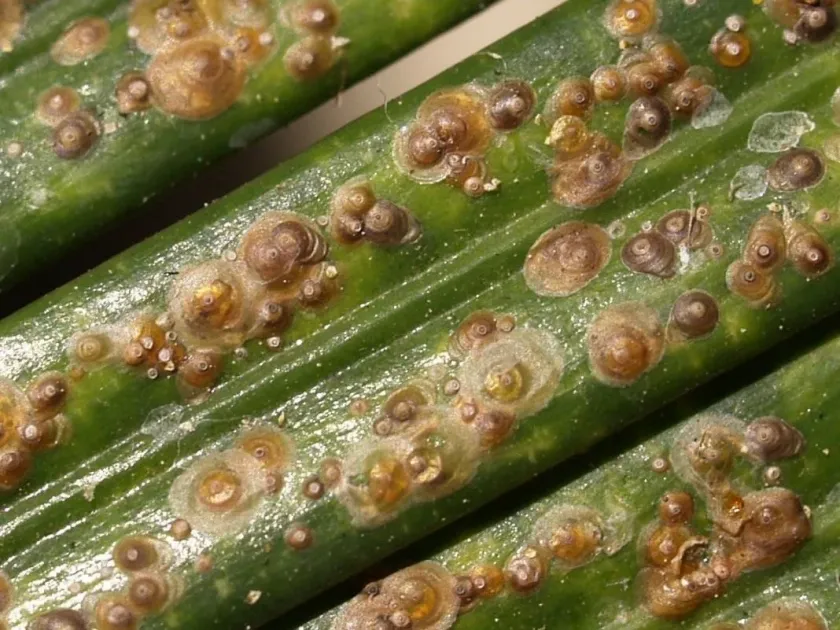
Adult females have a semi-spherical, convex body that secretes a shiny, hard, and often yellowish-green or brown test. This secretion acts as an impenetrable shield that protects the insect from environmental factors and chemical treatments.
These insects are largely sessile, attaching themselves firmly to the host plant's surface. Unlike many other insects, they remain in one place for most of their adult life, constantly feeding on the plant’s sap through their specialized mouthparts.
The life cycle involves a mobile crawler stage. These minute larvae are the only individuals capable of moving significantly, allowing them to spread across the plant or colonize adjacent pots in a greenhouse environment.
Reproduction often occurs via parthenogenesis, enabling a single female to establish an entire colony rapidly. This high reproductive rate makes the orchid scale a significant threat to indoor plant collections.
What it damages
As the name suggests, Asterolecanium epidendri primarily targets plants in the Orchidaceae family. It is most commonly found on succulent tissues like pseudobulbs, thick stems, and the bases of leaves.
Beyond orchids, this pest can inhabit various other tropical and decorative species found in greenhouses. It thrives in the controlled, humid environments typical of orchid cultivation areas.
By piercing the plant's epidermis, the scale insect extracts essential plant juices. This constant sap withdrawal leads to severe physiological stress, stunted growth, and a noticeable decline in the plant's overall vigor.
Damage often manifests as chlorotic spots, tissue deformation, and sunken lesions where the insect has fed. In extreme cases, the affected pseudobulbs may shrivel and die, significantly compromising the plant's structural health.
The feeding sites create open wounds that serve as entry points for secondary fungal and bacterial pathogens. These infections often cause rot, which can kill the plant much faster than the scale insects themselves.
Signs of infestation
The most distinct sign of an infestation is the presence of small, shiny, blister-like bumps on the stems or pseudobulbs. These bumps are immovable and feel hard to the touch, often blending in with the plant's color.
Yellowing or chlorosis surrounding the insect's attachment point indicates localized toxicity or damage from the feeding process. These spots are often the first alert that a plant is under attack.
General lack of growth or failure to flower is a classic symptom of a heavy infestation. Since the plant is being deprived of nutrients, it lacks the energy to produce healthy foliage or inflorescences.
Sticky honeydew secretions, which eventually turn into a dark, sooty mold, are a major red flag. This mold blocks light absorption on leaves and indicates a large, active colony of sucking insects.
Using a magnifying lens, one can detect the presence of small, pale crawlers in the leaf axils or under the edges of the adult scales, confirming an active and expanding infestation.
Control measures
Quarantine is the most critical preventative measure. Every new plant should be inspected carefully under a magnifying glass and kept isolated for several weeks before being introduced into the collection.
Mechanical control is effective only in the early stages of infestation. Use a soft brush or cotton swab dipped in rubbing alcohol to gently dislodge the scales, ensuring all crevices of the plant are cleaned.
Systemic insecticides are the preferred chemical method. These treatments are absorbed by the plant and make the sap toxic to the scales, which is particularly effective against insects protected by a hard shell.
A structured treatment program is necessary. Since scales have a protected life stage, repeat applications every 10–14 days are required to target new crawlers as they emerge from beneath the mother scales.
- Implement strict quarantine protocols.
- Use systemic insecticides for effective control.
- Perform regular, thorough visual inspections.
- Maintain proper ventilation to prevent mold growth.
- Sanitize tools after every interaction with plants.
Taxonomy
- Latin name
- Asterolecanium epidendri
- Order
- Hemiptera (bugs, aphids, leafhoppers)
- Family
- Asterolecaniidae
- EPPO code
- ASTLEP
Discussion
No discussions yet — be the first.