
Chrysanthemum plant bug
Plagiognathus chrysanthemi
Description
How to identify
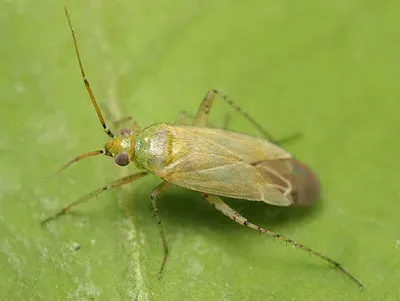
The chrysanthemum plant bug (Plagiognathus chrysanthemi) belongs to the order Hemiptera and the family Miridae. This small insect measures approximately 4–5 mm in length and exhibits a greenish or yellowish-brown coloration.
Adult bugs are highly mobile and possess long antennae, which help them navigate through dense foliage. The insect has an oval-shaped body covered with fine hairs, giving it a slightly matte appearance.
Nymphs resemble adults but are significantly smaller, wingless, and often display a brighter green color, which acts as effective camouflage among the leaves of host plants.
The life cycle involves egg, nymphal stages, and adult phases. These bugs overwinter as eggs deposited by females within the stems of various herbaceous plants.
In the field, identification is based on the specific type of plant damage and the presence of the insect on host flowers, as they can look similar to other Mirid species to the untrained eye.
What it damages
This pest is polyphagous, meaning it feeds on a wide range of plants, particularly those in the Asteraceae family, including garden chrysanthemums, daisies, yarrow, and oxeye daisies.
In addition to ornamental flowers, the bug inhabits various weeds that serve as reservoirs for breeding, allowing the population to persist throughout the growing season.
Significant economic losses occur in nurseries and commercial flower farms, as the bugs damage young tissue and buds, directly affecting the marketability of the flowers.
During outbreaks, chrysanthemum plant bugs can migrate to vegetable crops and berry bushes located near infested ornamental areas, increasing the overall threat to the garden.
The feeding process involves extracting cell sap from young tissues, which disrupts the plant's metabolism and leads to physiological stress and stunted growth.
When it appears
The activity of the chrysanthemum plant bug begins in spring when temperatures rise, triggering the hatching of nymphs from overwintered eggs.
Nymphs are most active and cause the greatest damage during May and June, as they feed on succulent new shoots and developing buds during the peak growing phase.
The second generation of adults typically emerges in mid-summer, around July, and continues its activity until the arrival of cooler autumn weather.
The duration of each developmental stage is heavily influenced by climate conditions, with high humidity and moderate temperatures often favoring rapid population growth.
As temperatures drop in autumn, adults mate, and the females lay eggs inside plant tissues, where they remain dormant throughout the winter until the following spring.
Signs of infestation
The first signs of infestation are small light-colored or yellow spots on the leaves, which eventually merge, causing deformation and necrosis of the leaf blade.
When the bugs attack flower buds, it results in twisted or malformed blossoms, or sometimes the total abortion of the bud, which ruins the plant's decorative value.
The stems may develop small necrotic areas at the puncture sites, which restrict the flow of nutrients and water to the upper parts of the plant.
Plants often exhibit a "curly" or stunted appearance, which can be mistaken for viral infections; however, close inspection of the leaf undersides usually reveals the insects.
- Yellow spots and stippling on leaves.
- Deformation of stems and young shoots.
- Damaged or aborted flower buds.
- Reduced plant vigor and growth rate.
Control measures
The primary control measure is sound agronomic practice, including the regular removal of weeds, especially those in the Asteraceae family, which serve as hosts.
Proper garden sanitation, such as deep autumn digging and the removal of plant debris, is crucial to eliminate the overwintering eggs hidden in stems.
For large-scale operations, systemic insecticides are effective when applied at the early nymphal stages to prevent significant population buildup.
Biological control involves promoting natural enemies such as predatory bugs (e.g., Anthocoridae) and parasitic wasps that prey on the eggs and nymphs of this pest.
Monitoring using yellow sticky traps allows growers to detect the arrival of the bugs early, enabling targeted interventions before the damage becomes widespread.
Taxonomy
- Latin name
- Plagiognathus chrysanthemi
- Order
- Hemiptera (bugs, aphids, leafhoppers)
- Family
- Miridae
- EPPO code
- PLAICH
Discussion
No discussions yet — be the first.