
Pine woolly aphid
Pineus pini
Description
How to identify
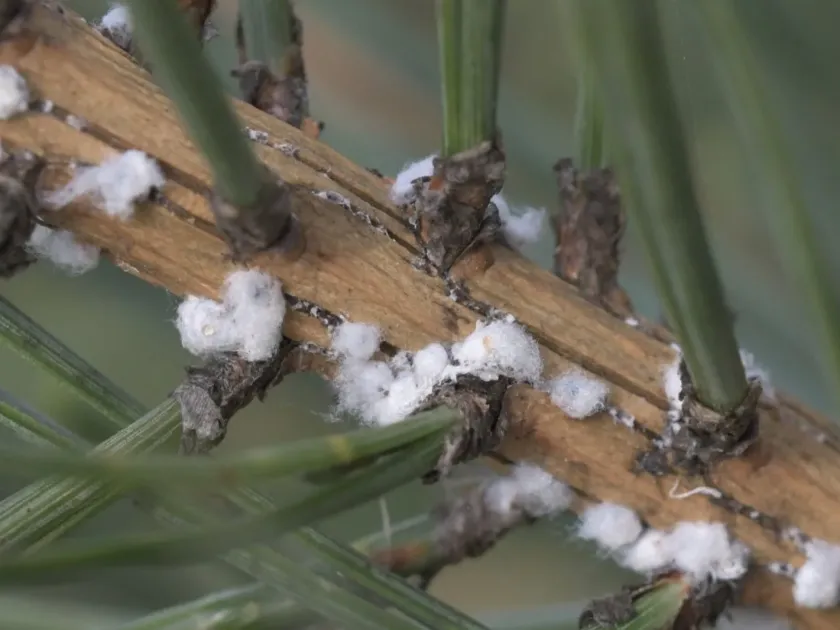
The Pine woolly aphid (scientific name: Pineus pini) is a member of the Adelgidae family, order Hemiptera. These small insects are best known for the white, fluffy, cotton-like wax secretions that cover their bodies, serving as a protective layer against external factors.
Adult females are typically sedentary, spending most of their life cycle firmly attached to the bark or needles of the host plant. They utilize their specialized piercing-sucking mouthparts to penetrate the plant tissue and extract vital sap.
The life cycle of this pest is complex, often involving several stages of development and specific forms that appear at different times of the year. During these stages, the appearance of the insect can change significantly as it moves between different parts of the tree.
Colonies of Pine woolly aphid are frequently found in cracks in the bark, at the base of needles, or on young, tender shoots. These white wax patches are the most characteristic feature used for field identification.
Correct identification is essential because this species is often confused with other adelgids or scale insects. Understanding the specific host plants and the location of the wax deposits helps in planning an effective management strategy.
What it damages
The primary hosts for Pineus pini are various species of pine, although they can infest other conifers under favorable conditions. Young trees in nurseries and newly planted landscapes are particularly susceptible to severe damage.
By constantly sucking sap, the insects weaken the tree, leading to reduced vitality and stunted growth. The damage caused by their feeding often results in micro-wounds, which serve as entry points for secondary fungal and bacterial infections.
Affected shoots often show signs of deformation, curling, or inhibited development. As the infestation progresses, needles may turn yellow and drop prematurely, which significantly reduces the tree's overall aesthetic and health.
In cases of high population density, the cumulative stress can lead to the dieback of branches and, in vulnerable specimens, the eventual death of the tree. This pest is particularly dangerous for trees already stressed by drought or poor environmental conditions.
In forest management, the presence of these aphids reduces wood quality and overall forest productivity. It creates an environment that makes trees more vulnerable to secondary infestation by bark beetles and other wood-boring insects.
When it appears
Activity typically begins in early spring as soon as temperatures rise and tree sap begins to flow. Overwintering nymphs emerge from their dormant state to commence intensive feeding on fresh, emerging growth.
The species can complete multiple generations within a single growing season. Continuous monitoring is therefore required from early spring through autumn to ensure that population spikes are detected and treated promptly.
Summer months are characterized by the migration of crawlers, which spread across the canopy and to neighboring trees. Wind can also assist in the distribution of these small nymphs, leading to rapid infestation across a stand.
As temperatures drop in autumn, the population transitions into a overwintering stage. Individuals find refuge in protected crevices or at the base of needles to survive the winter frost in a state of suspended activity.
Agronomic management must be consistent, with scouting performed regularly. By understanding the seasonal peaks of the aphid, growers can apply protective measures at the most vulnerable stages of the insect's life cycle.
Signs of infestation
The most prominent sign of an infestation is the presence of white, cottony wax deposits on twigs, branches, or at the needle bases. These patches often look like small flakes of wool or mold attached to the plant surface.
Yellowing of the needles is another classic symptom of stress caused by sap depletion. If a tree suddenly loses its deep green luster, it is a strong indication that an infestation has reached a critical level.
Noticeable deformation or twisting of young shoots is a consequence of persistent aphid feeding. The plant reacts to the insect's saliva, which disrupts normal tissue growth and causes the observed abnormalities.
The presence of ants on the trees is a strong secondary indicator of aphids. Ants are attracted to the sugary honeydew excreted by the aphids and often protect the colonies from natural predators, further exacerbating the pest problem.
If you shake a branch and observe white, powdery flakes falling off, it confirms the presence of an active colony. This observation should trigger an immediate assessment of the surrounding trees to prevent further spread.
Control measures
Integrated pest management starts with good cultural practices, such as proper irrigation and fertilization, to maintain high plant vigor. Healthy trees are better equipped to resist and tolerate pest attacks naturally.
Systemic insecticides are the most effective chemical control method. Products containing compounds like imidacloprid or acetamiprid are absorbed by the tree and circulate in the sap, targeting the aphids from within.
Applications should be timed to coincide with the crawler stage to achieve maximum efficacy. Rotating insecticides with different modes of action is recommended to delay the development of resistance within the aphid population.
Controlling ant populations on the tree is also vital for successful management. Using sticky bands around the trunk can prevent ants from protecting the aphids, thereby allowing natural predators like ladybugs to reduce the aphid population.
When applying foliar sprays, ensure complete coverage of the canopy, including the underside of branches. The use of a wetting agent (surfactant) is highly recommended to penetrate the protective waxy covering of the pest effectively.
Taxonomy
- Latin name
- Pineus pini
- Order
- Hemiptera (bugs, aphids, leafhoppers)
- Family
- Adelgidae
- EPPO code
- PINEPI
Discussion
No discussions yet — be the first.