
Pineus patchae
Pineus patchae
Description
How to identify
Pineus patchae is a specialized pest belonging to the Adelgidae family, often referred to as spruce adelgids. It is a tiny sucking insect that spends most of its life cycle on spruce trees.
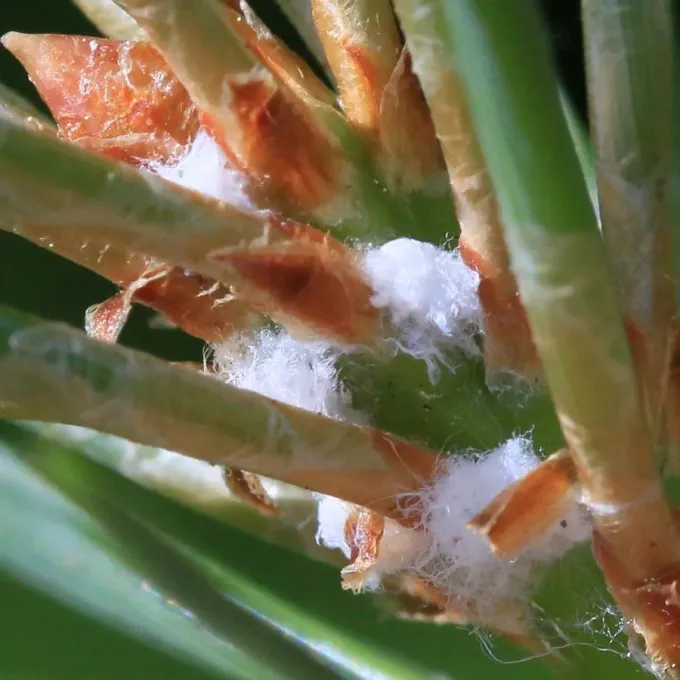
Adults are extremely small and inconspicuous, often protected by a layer of white, waxy, wool-like secretions that serve as a defense mechanism against predators and environmental stress.
The insect's biological cycle involves several stages, including nymphs that move across the needles to find optimal feeding sites during the growing season.
Due to its high degree of specialization, Pineus patchae has evolved to effectively exploit the host plant's physiological resources throughout the year.
Identification typically requires close inspection with a hand lens, looking for the characteristic white wax patches located near the base of the needles.
What it damages
The primary host for this pest is the spruce tree, affecting both young seedlings in nurseries and established decorative trees in urban landscapes.
These insects feed by inserting their stylets into the plant tissue, extracting sap and injecting salivary enzymes that disrupt the tree's normal metabolic processes.
Feeding leads to severe needle distortion, yellowing, and premature needle drop, which significantly diminishes the visual appeal of the spruce tree.
Heavy infestations can cause stunted growth of new shoots, leading to a thin, sparse crown and reduced vitality in the overall tree structure.
Trees weakened by Pineus patchae are more susceptible to secondary attacks from bark beetles and fungal pathogens that thrive on distressed host plants.
When it appears
The activity of Pineus patchae begins in early spring when the overwintering nymphs emerge from dormancy to resume feeding on the new, succulent plant tissue.
The population reaches its peak density during the late spring and early summer months, which coincide with the most intense period of shoot elongation in spruce trees.
Mid-summer is characterized by the dispersal of winged forms that migrate to different parts of the tree or to neighboring trees to establish new colonies.
As autumn approaches, the nymphs settle into protected locations on the bark or needle bases, preparing to survive the winter season.
Climate patterns, particularly the severity of winter and the warmth of spring, play a critical role in the survival rate and annual population expansion of this species.
Signs of infestation
The most reliable sign of an infestation is the appearance of white, cottony, or woolly masses of wax at the base of the needles on the current year's growth.
Affected branches often show significant yellowing or browning, as the needles lose their chlorophyll and begin to drop prematurely from the twig.
The presence of honeydew, a sticky excretion produced by the insects, often leads to the growth of black sooty mold on the surface of needles and stems.
- White woolly wax patches at needle bases.
- Curled, yellowed, or discolored needles.
- Premature needle fall leaving bare twigs.
- Dark sooty mold coverage on affected shoots.
- Reduced crown density and stunted branch growth.
Close inspection often reveals the tiny dark bodies of the insects hidden beneath the protective white wax filaments on the twigs.
Control measures
Effective control requires a multi-faceted approach, emphasizing timely intervention and the maintenance of tree vigor through proper horticultural practices.
Dormant oil sprays applied in early spring can be highly effective in suffocating the overwintering nymphs before they become active and start feeding.
During the growing season, systemic insecticides are recommended as they are absorbed by the tree and target the insects as they feed on the sap.
Pruning and disposing of heavily infested branches can help lower the overall population pressure and reduce the risk of spreading to healthy parts of the garden.
Maintaining proper tree health, including adequate irrigation and balanced fertilization, increases the tree's natural resilience against minor adelgid infestations.
Taxonomy
- Latin name
- Pineus patchae
- Order
- Hemiptera (bugs, aphids, leafhoppers)
- Family
- Adelgidae
- EPPO code
- PINEPA
Discussion
No discussions yet — be the first.