
Eastern spruce gall adelgid
Pineus orientalis
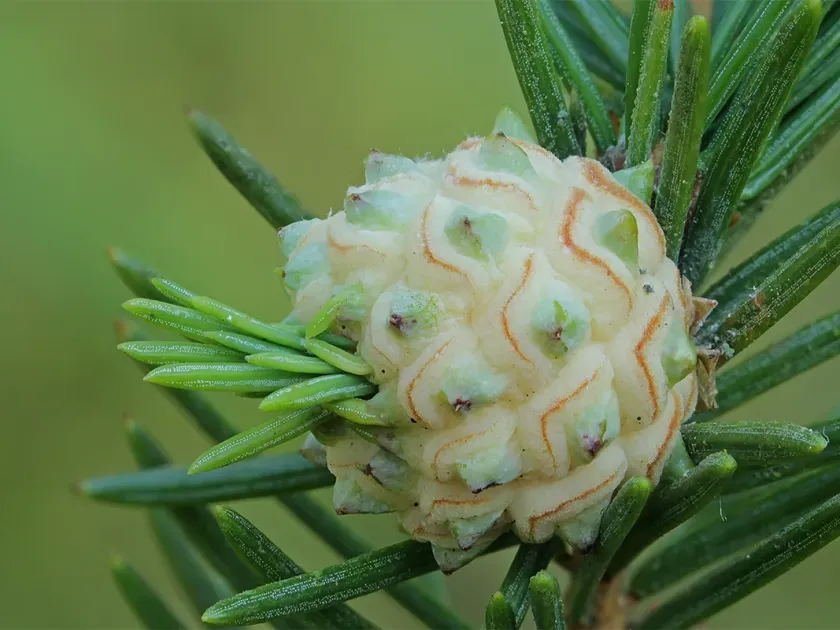
Description
How to identify
The eastern spruce gall adelgid, scientifically known as Pineus orientalis, is a small insect species belonging to the Adelgidae family. It is a specialized pest that thrives on various conifer species, particularly those in the Picea genus.
These insects are characterized by their small size and the production of a white, waxy secretion that covers their bodies. This waxy substance acts as a protective shield against environmental stressors and many types of chemical pesticides.
The biological cycle of this adelgid is complex and often involves multiple generations within a single season. The transition between different life stages is finely tuned to the host tree's phenological development.
Overwintering usually occurs in the first instar nymph stage, where the insects remain attached to the tree bark or near the base of buds. They become highly active as soon as spring temperatures start to rise.
Because of their minuscule size and camouflaging waxy coating, detection requires careful observation. Gardeners are advised to use a magnifying glass to inspect the undersides of needles and twig joints for the presence of colonies.
What it damages
The primary hosts for Pineus orientalis are spruce trees. The pest feeds by piercing plant tissues with its specialized mouthparts to extract sap, which directly impacts the tree's vitality and overall development.
Feeding causes localized damage that can lead to needle discoloration, premature needle drop, and stunted growth of shoots. In severe cases, the damage may manifest as deformities in the branching structure of the tree.
While an occasional presence might not kill a healthy tree, heavy and persistent infestations significantly weaken the host. This stress makes the tree more susceptible to opportunistic fungal infections and secondary pest attacks.
In nursery settings, the economic impact is substantial due to the loss of aesthetic value and the potential for stunted growth in young trees. Ornamental spruces in landscaping are also frequently affected by this pest.
Continuous sap extraction exhausts the tree's energy reserves, leading to a thinning of the canopy and, in extreme cases, the death of individual branches or the entire tree.
When it appears
The activity cycle of the adelgid is strictly correlated with the tree's growth season. Activity begins in early spring, as nymphs emerge from their overwintering sites to feed on developing buds.
Peak population density is observed during late spring when the new growth is most succulent. During this window, the insects are actively feeding and reproducing, which coincides with the optimal time for treatment.
Summer brings the emergence of winged forms that facilitate the spread of the population to neighboring host trees. Multiple generations can occur within a single warm season if conditions remain favorable.
As autumn progresses, the population starts to transition into a dormant stage. The insects seek out crevices in the bark to survive the winter, effectively waiting for the return of warmer weather.
Consistent monitoring during the spring and early summer is essential to catch early signs of colonization. Early intervention significantly reduces the likelihood of a widespread infestation.
Signs of infestation
The most visible sign of an infestation is the presence of white, cotton-like masses on the twigs and needles. These are actually the protective wax filaments secreted by the adelgids.
Discoloration of the needles, often appearing yellow or brownish, indicates significant feeding pressure. In many cases, the affected needles will drop prematurely, leading to sparse or patchy foliage.
The presence of honeydew, a sticky substance excreted by the insects, often indicates a high population density. This sugary residue frequently leads to the growth of sooty mold, which appears as a black, dusty coating on the needles.
Upon closer inspection, clusters of tiny, dark-colored insects can be seen attached to the base of the needles. They often aggregate in the junctions between needles and twigs where protection is highest.
If a tree shows a general lack of vigor, thinning foliage, or deformed new growth, a thorough inspection of the branches is necessary to confirm the presence of this specific pest.
Control measures
Managing the eastern spruce gall adelgid requires an integrated approach that includes cultural practices and chemical interventions. Pruning and destroying heavily infested branches is a critical first step.
Systemic insecticides, particularly those containing imidacloprid or similar active ingredients, are highly effective. These treatments are absorbed by the tree and provide long-term protection by targeting the pest during feeding.
Application timing is crucial: early spring treatments target the overwintering nymphs before they start laying eggs. A follow-up application during the active growing season can address emerging generations.
Horticultural oils applied early in the season provide a non-toxic control method by suffocating the overwintering stages of the pest. This approach is highly effective for maintaining the health of trees in urban gardens.
- Regular inspections of all spruce trees in the landscape.
- Proper irrigation and fertilization to keep trees stress-free.
- Avoid over-fertilizing with nitrogen, which can attract aphids and adelgids.
- Encouraging natural predators such as ladybugs and lacewings in the garden.
Taxonomy
- Latin name
- Pineus orientalis
- Order
- Hemiptera (bugs, aphids, leafhoppers)
- Family
- Adelgidae
- EPPO code
- PINEOR
Discussion
No discussions yet — be the first.