
Pine woolly adelgid
Pineus floccus
Description
How to identify
The Pine woolly adelgid (Latin: Pineus floccus) is a member of the Adelgidae family, a group of specialized sap-sucking insects that primarily affect coniferous trees. They are closely related to aphids but possess unique life cycles and behaviors.
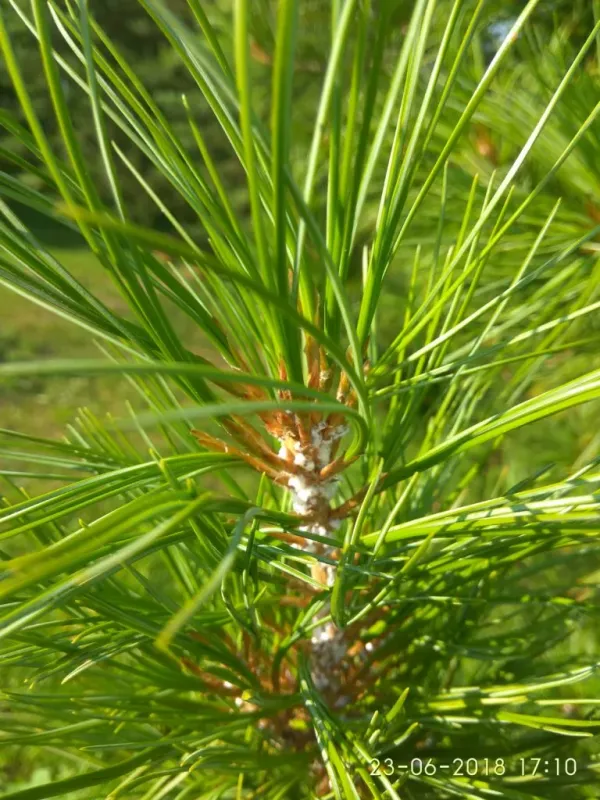
Adults are tiny, often barely visible to the naked eye. They frequently cover themselves in a white, cotton-like substance, which acts as a protective shield against predators and desiccation during their development.
These pests have a complex life cycle that often involves alternating between two different host plants, typically species of spruce and pine or larch. This host-switching behavior makes them particularly challenging to eradicate.
Adelgids reproduce parthenogenetically, meaning females can produce offspring without mating. This reproductive strategy allows them to build up massive populations in a very short time if conditions remain favorable.
They are highly specialized, meaning they have evolved specific ways to manipulate tree growth to provide optimal nutrients for their larvae, often causing the host plant to produce gall-like structures.
What it damages
On spruce trees, the primary damage caused by these insects is the formation of galls. These structures develop at the base of new needles and distort the natural growth of the shoot, weakening the tree significantly.
On pine trees, the adelgids settle on needles and young bark to feed. This persistent sap-sucking activity results in chlorosis, where the needles lose their green color, turn yellow, and eventually drop prematurely.
Heavy infestations reduce the overall vigor of the conifer. As the tree loses its foliage and energy reserves, it becomes susceptible to secondary infections by wood-boring beetles and various fungal pathogens.
In ornamental gardens and nurseries, the damage caused by Pineus floccus renders plants aesthetically unappealing. The stunted and deformed growth patterns are often permanent and difficult to correct.
Severe infestations can ultimately lead to the death of young trees. In forest plantations, this pest can cause significant economic losses by reducing timber quality and slowing down the growth rate of trees.
When it appears
Activity begins in early spring as soon as temperatures rise enough for the buds to swell. The overwintering nymphs emerge from their dormant state and begin feeding on the young, tender plant tissue.
The late spring and early summer period marks the migration phase, during which winged adults develop and fly to new host plants. This is a critical time for monitoring and intervention to prevent further spread.
Throughout the summer, multiple generations may be produced depending on local climate conditions. The continuous life cycle keeps the pressure on the host plant throughout the growing season.
As autumn approaches, the development slows down. The nymphs seek out protected sites, such as bark crevices, the base of needle clusters, or bud scales, to enter their overwintering stage.
Environmental factors like humidity and heat play a major role in the timing of the life cycle. Warm, humid weather generally accelerates the development of the generations and increases the pest load.
Signs of infestation
The most distinctive sign on spruce trees is the presence of galls. These are often mistaken for small, abnormal pine cones that appear on the tips of branches, but they have a distinct, softer texture.
On pine needles, the presence of white, cottony tufts is a clear indicator of an adelgid infestation. These are the protective wax secretions produced by the insects while they feed in clusters.
The needles of infested trees often show signs of premature yellowing or browning. A thinning canopy is a classic late-stage symptom, indicating that the tree has been under stress for an extended period.
Deformed or hooked shoots are another visual cue. Because the insects concentrate on one side of a shoot while feeding, the shoot often bends or curls, disrupting the tree's vertical or radial growth.
An unusual number of ants on a conifer is often an indirect sign of an adelgid problem. Ants are attracted to the honeydew-like substance excreted by these pests and will often protect them from predators.
Control measures
The first line of defense is physical removal. Pruning out and destroying infested shoots, especially those with galls, during the early spring before the insects emerge, can significantly lower the pest population.
Chemical control using systemic insecticides is highly effective. Products containing neonicotinoids like imidacloprid are often used as soil drenches or stem injections to reach the sap-feeders efficiently.
Contact insecticides should be applied during the periods when nymphs are active and exposed on the needles. Thorough coverage is essential, as the wax coating can prevent the chemical from reaching the insect.
Biological control can be encouraged by preserving local populations of beneficial insects such as ladybird beetles and lacewings, which are natural predators of adelgids in healthy landscapes.
Good horticultural practices, including regular irrigation and proper fertilization, help trees maintain their health. A well-nourished tree is far more resilient to adelgid damage than a tree under stress.
Taxonomy
- Latin name
- Pineus floccus
- Order
- Hemiptera (bugs, aphids, leafhoppers)
- Family
- Adelgidae
- EPPO code
- PINEFL
Discussion
No discussions yet — be the first.