
Spruce adelgid
Pineus coloradensis
Description
How to identify
Spruce adelgid is a tiny insect belonging to the Adelgidae family, order Hemiptera. These pests are closely related to aphids but are distinguished by their complex life cycles and the white, woolly wax filaments that cover their bodies for protection.
Their life cycle typically involves multiple generations that can migrate between different parts of the tree or, in some species, between different host plants. Identifying them can be challenging due to their small size and ability to hide in bark crevices.
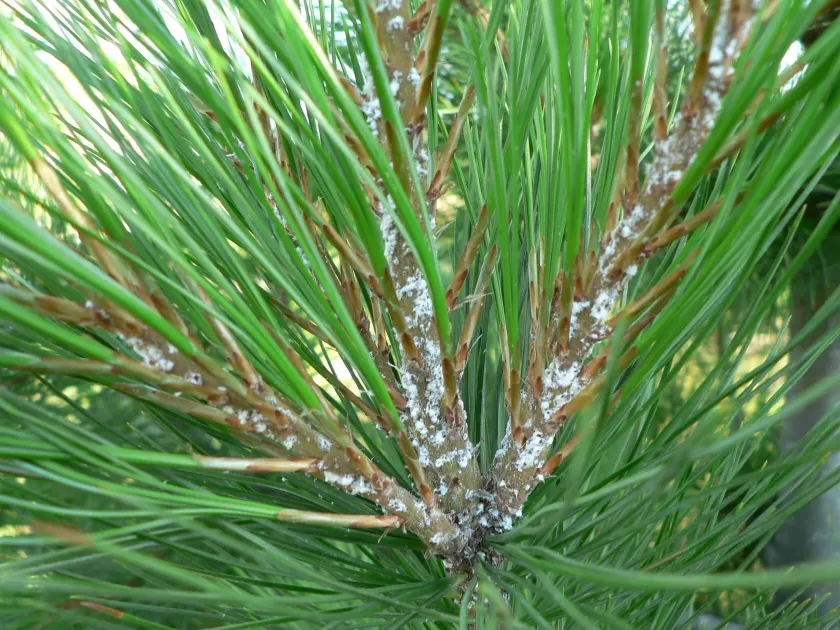
Adult females and their offspring are usually found clustered at the base of needles or on young shoots. The wax coating they produce often resembles tiny tufts of cotton, which is a key diagnostic feature for field observation.
Specialists use magnifying lenses to identify the specific life stage of the adelgid. Since they look different throughout the year, understanding the seasonal morphology is essential for correct identification.
These insects spread primarily through wind dispersal and can also be transferred by birds, insects, or pruning tools. Once established, they can spread rapidly through a forest or an ornamental landscape.
What it damages
The spruce adelgid primarily targets various species of spruce (Picea). By feeding on the sap of young shoots, they interfere with the tree's natural nutrient distribution and growth cycle.
A hallmark of their damage is the formation of galls—distorted, cone-like growths on the branches. These galls are essentially the tree's reaction to the chemicals injected by the insects while they feed.
As the infestation progresses, the needles on the affected shoots begin to yellow and eventually drop prematurely. The loss of foliage reduces the tree's photosynthetic capacity, leading to severe overall weakness.
Severe infestations can lead to stunted growth, distorted branch architecture, and in extreme cases, the death of the tree. Weakened spruce trees also become highly susceptible to secondary infestations by bark beetles and fungal pathogens.
In nurseries, spruce adelgid is considered a major economic pest as it ruins the aesthetic and marketable value of conifers, necessitating strict phytosanitary measures.
When it appears
The activity of the spruce adelgid begins in early spring when overwintering nymphs emerge from their hiding spots on the bark. They crawl to the developing buds to begin feeding as the growing season starts.
The most active period for gall formation is late spring to early summer, which coincides with the period of rapid shoot elongation. This is the window when the pests are most exposed and visible.
During the summer, several generations develop, making the pest pressure constant during the warm months. Winged forms may emerge to migrate and colonize new branches or host trees.
As autumn approaches, the insects begin to seek shelter for the winter. They tuck themselves into deep cracks in the bark or near bud scales, where they remain in a state of diapause until the following spring.
Warm, dry springs tend to be particularly favorable for the reproduction of adelgids, leading to significant outbreaks in populations if left unchecked.
Signs of infestation
The most obvious sign of infestation is the appearance of white, cottony, or woolly masses on the needles and stems. These are the protective wax secretions produced by the feeding nymphs.
The presence of galls, which look like swollen or distorted buds resembling miniature cones, is a definitive symptom of spruce adelgid activity. These galls can remain on the tree even after the insects have emerged.
Needle discoloration, ranging from yellowing to browning, is a common indicator of sap depletion. Affected branches often appear sparse and unhealthy compared to the rest of the tree's canopy.
Because these insects excrete honeydew, you may notice an increased presence of ants on the branches. Ants often "farm" these pests, protecting them from predators in exchange for the sugary substance.
- white, cottony wax filaments on the needles;
- distorted shoots and development of gall-like growths;
- premature needle yellowing and loss;
- increased ant activity on the tree;
- stunted branch growth.
Control measures
Effective management begins with regular monitoring of the tree canopy, particularly in early spring. If only a few branches are infested, physical removal and destruction of the galls can help reduce the population.
Chemical control is most effective using systemic insecticides that are absorbed by the tree's vascular system. This ensures that the pesticide reaches the insects even when they are protected by their waxy secretions.
Contact insecticides can be applied during the period when the nymphs leave the galls and move to new feeding sites. Multiple applications are often required to manage the different stages of the pest's life cycle.
Maintaining tree vigor through proper fertilization, watering, and mulching is a vital preventive measure. A healthy tree can better withstand the pressure of sap-sucking pests compared to a stressed one.
Pruning out infested limbs and maintaining proper spacing between trees are essential for preventing the spread. Always inspect new planting material carefully to ensure it is free of pests before introducing it to your site.
Taxonomy
- Latin name
- Pineus coloradensis
- Order
- Hemiptera (bugs, aphids, leafhoppers)
- Family
- Adelgidae
- EPPO code
- PINECO
Discussion
No discussions yet — be the first.