
Spruce adelgid
Pineus boerneri
Description
How to identify
The spruce adelgid (Pineus boerneri) is a member of the Adelgidae family, order Hemiptera. These tiny sap-sucking insects are notorious for their complex life cycles and their ability to camouflage themselves under waxy, wool-like secretions on conifer branches.
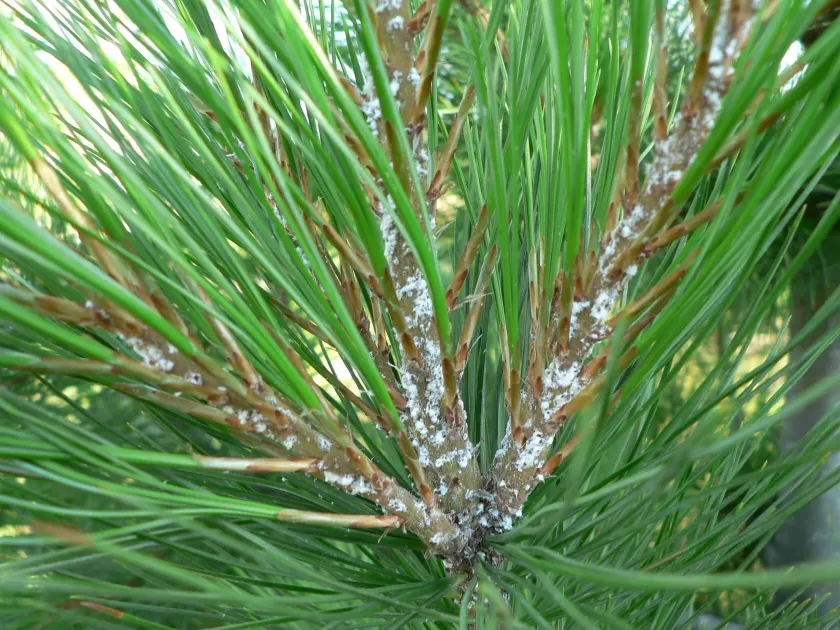
Adult adelgids are extremely small, often barely visible to the naked eye. Their characteristic white, cottony wax coating serves as a protective barrier against dehydration and environmental stress, making it easier for them to thrive on host trees.
The life cycle of Pineus boerneri involves multiple generations, with individuals transitioning between different forms. Some stages involve mobile crawlers that disperse across the host tree to establish new feeding sites, while others remain stationary.
Reproduction can be both sexual and parthenogenetic, allowing populations to grow rapidly under favorable conditions. Understanding these stages is critical for determining the best timing for monitoring and intervention.
Correct identification is often confused with fungal infections like powdery mildew due to the white, fuzzy appearance of the colonies. To confirm the presence of adelgids, one should gently disturb the wax to reveal the tiny insects hiding underneath.
What it damages
Spruce trees are the primary hosts for this pest. Depending on the species and environmental conditions, spruce adelgids can cause significant damage to both mature forest trees and decorative ornamental plantings.
Adelgids feed by inserting their stylets into the needle and shoot tissues to suck out cell contents. This constant extraction of sap weakens the tree's metabolic processes and reduces its overall vigor over time.
The damage caused by feeding leads to stunted growth and needle discoloration. Severe infestations can cause young trees to experience needle drop and branch dieback, eventually compromising the survival of the host.
Mature trees, although more resilient, suffer from reduced aesthetic appeal due to deformed shoots and canopy thinning. Continued feeding often opens the door for secondary pests or opportunistic pathogens to colonize the tree.
Repeated yearly infestations lead to chronic stress, which makes the tree less capable of handling external factors like drought or poor soil nutrients. This downward spiral is the main reason why management is essential for long-term health.
Signs of infestation
The most telltale sign of an infestation is the presence of white, cottony tufts at the base of the needles. These tufts protect the egg-laying females and are easily identifiable during the spring and early summer months.
Infested branches often exhibit abnormal curling or twisting of the new shoots. In some cases, feeding sites can stimulate the development of gall-like swellings, which significantly disrupt the natural shape of the spruce canopy.
Yellowing or chlorosis of the needles is a common symptom of a long-term infestation. As the needles lose their healthy pigment, they often become brittle, fall off prematurely, and create a sparse look in the branches.
Honey-dew, a sticky substance secreted by the adelgids, covers the needles and stems. This substance often attracts secondary organisms, such as sooty mold, which creates a dark, unsightly coating on the bark and foliage.
An increased presence of ants on the spruce tree often serves as a warning sign. Ants farm the adelgids to collect the sugary honeydew, effectively protecting the pests from natural predators and making them harder to control.
Control measures
Managing the spruce adelgid requires an integrated approach that combines cultural practices with targeted chemical treatments. Early detection through regular inspections is the most effective way to prevent widespread damage.
For light infestations, physical removal is a viable option. Using a high-pressure water spray can help wash away many of the adelgids and their protective wax, effectively reducing the pressure on the tree.
Systemic insecticides, particularly those containing imidacloprid or acetamiprid, are the gold standard for chemical control. These chemicals are absorbed by the tree and provide long-lasting protection against sap-sucking insects.
Timing the application is crucial; the most effective window for treatment is during the crawler stage, when the insects are most exposed and active. Multiple treatments may be necessary to target different generations throughout the season.
Maintaining tree vigor through proper fertilization, adequate watering, and removing overly crowded branches is essential for building natural resistance. A healthy spruce is much better equipped to tolerate and survive pest attacks.
Taxonomy
- Latin name
- Pineus boerneri
- Order
- Hemiptera (bugs, aphids, leafhoppers)
- Family
- Adelgidae
- EPPO code
- PINEBO
Discussion
No discussions yet — be the first.