
Pine adelgid
Pineus
Description
How to identify
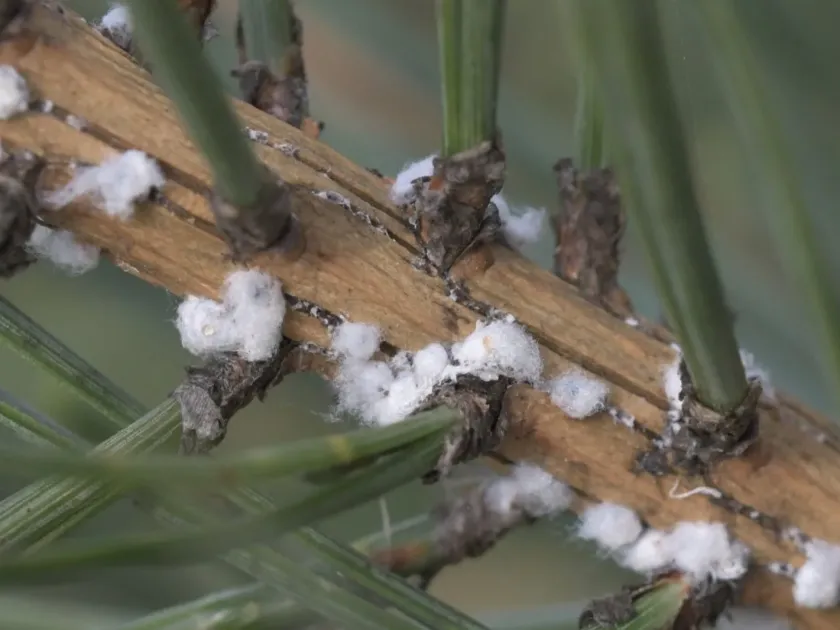
Pine adelgid (genus Pineus) belongs to the Adelgidae family, which comprises small, sucking insects specialized in feeding on coniferous trees. These pests are easily recognized by the white, cotton-like wax filaments they produce on needles and bark.
These insects are extremely small, often hidden under their own waxy secretions, which provide a robust defense against weather conditions and many contact insecticides. Their microscopic size makes early detection difficult.
The life cycle of Pine adelgids is complex, often involving alternating generations that may migrate between different parts of the host tree or even between different conifer species, depending on the specific genus.
Adelgids reproduce rapidly, and their ability to generate multiple offspring per season allows them to colonize entire trees quickly if not addressed immediately. Certain stages are winged, facilitating spread across large areas.
In the field, one should look for the white, fluffy, or woolly masses located at the base of the needles, in branch crevices, or near the bud scales where they prefer to feed and overwinter.
What it damages
These pests primarily target species within the Pinaceae family, including various pines (Pinus), spruces (Picea), and occasionally firs or larches. Young, weak, or stressed trees are particularly susceptible.
The damage is caused by the insects extracting cell sap from the needles and tender twigs. This feeding process depletes the tree's nutrient reserves, causing systemic weakness and stunted growth.
Visual damage includes yellowing, needle distortion, and premature needle drop. In many cases, the affected twigs become crooked or deformed, permanently ruining the aesthetic value of the ornamental tree.
Their sugary secretions often lead to the development of sooty mold, a black fungus that coats the foliage. This layer interferes with the tree's ability to photosynthesize, further stressing the already weakened plant.
Severe infestations can lead to top dieback, branch mortality, and, if left uncontrolled for several consecutive seasons, the potential death of the entire tree, especially in drought-prone environments.
When it appears
Activity typically begins in early spring as temperatures rise, signaling the overwintering nymphs to emerge from their protected sites and start feeding on developing buds and needles.
The population reaches its peak during late spring and early summer, which is the most critical window for migration and further colonization of new branches or adjacent healthy trees.
Summer activity continues as the population cycles through multiple generations, with some species being more active during specific temperature windows, though most remain present until the onset of cooler autumn weather.
During the fall, the final generation of the season seeks out protected areas on the bark or needle bases to lay eggs or settle as nymphs, ensuring their survival through the harsh winter months.
Scouting should be conducted consistently throughout the growing season, but the most important inspection times are during the early spring and late summer when the pests are at their most vulnerable stages.
Signs of infestation
The most prominent sign is the white, fuzzy, cottony mass on the foliage, which is essentially the protective wax covering for the nymphs and egg masses, appearing distinct against the green needles.
Trees may show general signs of poor health, such as off-color needles, reduced annual growth increments, and general thinning of the canopy as the needles drop prematurely.
The presence of ants on coniferous trees is a reliable secondary indicator of an adelgid infestation, as ants are often attracted to the honeydew produced by the feeding insects.
The development of sooty mold on the branches and needles is a hallmark of an established colony, creating a dirty, black appearance that indicates the tree has been under stress for quite some time.
Deformed growth of twigs or branches—characterized by curling or stunted development—serves as a clear diagnostic marker that the infestation has reached a level requiring immediate intervention.
Control measures
Systemic insecticides are the most effective management tool, as they are absorbed into the vascular system of the tree, providing long-lasting protection against these sucking pests.
Targeted applications should be timed to coincide with the crawler stage, which is when the nymphs are mobile and most susceptible to treatment before they establish their protective waxy layer.
Sanitation practices, such as pruning and destroying heavily infested branches, help reduce the immediate population pressure and slow down the spread of the colony to other parts of the tree.
Improving overall tree vigor through proper irrigation, mulching, and balanced fertilization increases the tree's internal resistance, making it less likely to support large adelgid populations.
Integrated Pest Management (IPM) strategies, including the conservation of beneficial predators like lady beetles and lacewings, can play a significant role in keeping adelgid populations under natural control.
Taxonomy
- Latin name
- Pineus
- Order
- Hemiptera (bugs, aphids, leafhoppers)
- Family
- Adelgidae
- EPPO code
- PINESP
Discussion
No discussions yet — be the first.