
Caper white butterfly
Pieris teutonia
Description
How to identify
The Caper white butterfly (Pieris teutonia) is a diurnal butterfly belonging to the Pieridae family. It is widely recognized for its distinct appearance and is a significant pest in various agricultural regions.
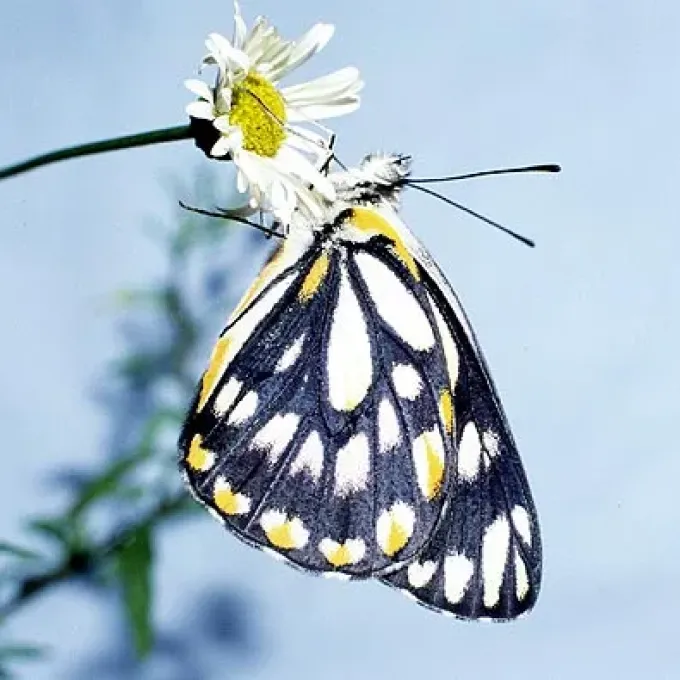
The adult butterfly features a prominent black-and-white wing pattern with specific dark spots, which can vary in intensity depending on the local environment and the seasonal generation.
The body is covered with fine hairs, and the wingspan typically ranges from 40 to 50 millimeters, making them highly visible while flying around host plants.
Larvae, or caterpillars, are known for their gregarious behavior, often found in large clusters on the foliage of host plants, which facilitates easier detection during field scouting.
The pupae possess excellent camouflage, mimicking the color and texture of plant stems, which serves as a protective mechanism against predators during their transformation stage.
What it damages
The primary damage is caused by the caterpillars, which are extremely voracious and can consume large amounts of leaf tissue in a very short period of time.
In their native habitat, they prefer plants from the Capparaceae family, but they are also capable of infesting related agricultural crops if host plants are nearby.
The larvae feed on the leaves, creating large holes or skeletonizing the entire leaf surface, leaving only the tough midribs and veins behind.
Mass infestations can lead to complete defoliation of young seedlings, severely hindering the plant's photosynthetic capacity and stunt its overall growth and vigor.
Damage to the apical meristem or growth point is particularly detrimental, as it can cause permanent plant deformity and a significant reduction in marketable yield.
When it appears
The life cycle of the Caper white butterfly is highly temperature-dependent, with peak activity occurring during the warmer months of the spring and summer seasons.
Adults emerge and begin their flight activity once soil temperatures rise and stable daily temperatures are established, often coinciding with the active growth phase of crops.
Females deposit eggs in clusters on the undersides of leaves, and after a few days, the larvae hatch and immediately begin their intensive feeding process.
Multiple generations can occur throughout the growing season, which poses a continuous threat to crops until the onset of cooler autumn weather.
As temperatures drop in the autumn, the population size naturally declines, and the insects enter a resting phase or diapause to survive the unfavorable conditions.
Signs of infestation
The most reliable sign of an infestation is the presence of caterpillar frass (excrement) scattered on the leaf surfaces and the soil surrounding the affected plants.
Careful visual inspection of the underside of leaves will reveal yellowish egg masses, which are often laid in tight clusters by the female butterflies.
Damaged foliage often appears chlorotic or yellowed, with irregular edges that eventually wither, indicating a disruption in the plant's nutrient transport.
Another indicator is the presence of caterpillars gathered in groups during the cooler parts of the day, as they tend to feed and congregate together.
- Skeletonized leaves with heavy tissue loss.
- Large amounts of frass on the soil surface.
- Visible curling or stunting of young leaves.
- Active butterfly flight observed over the garden.
Control measures
Managing the Caper white butterfly begins with good cultural practices, such as the consistent removal of weeds belonging to the Capparaceae family to eliminate alternative hosts.
Manual removal of caterpillars and infested leaves containing egg clusters is highly effective for small-scale gardens to keep the population under control.
For larger commercial operations, biological insecticides containing Bacillus thuringiensis are recommended as they selectively target the caterpillars with minimal ecological impact.
Chemical control measures should be reserved for instances where the economic injury level is reached, ensuring that safety intervals before harvest are strictly followed.
Installing physical barriers, such as fine-mesh netting over vegetable beds, is a highly effective preventive method to stop adult females from laying eggs on the crops.
Taxonomy
- Latin name
- Pieris teutonia
- Order
- Lepidoptera (butterflies)
- Family
- Pieridae
- EPPO code
- PIERTE
Discussion
No discussions yet — be the first.