
Checkered White
Pieris protodice
Description
How to identify
The Checkered White Pieris protodice is a butterfly belonging to the Pieridae family within the order Lepidoptera, commonly found in North America.
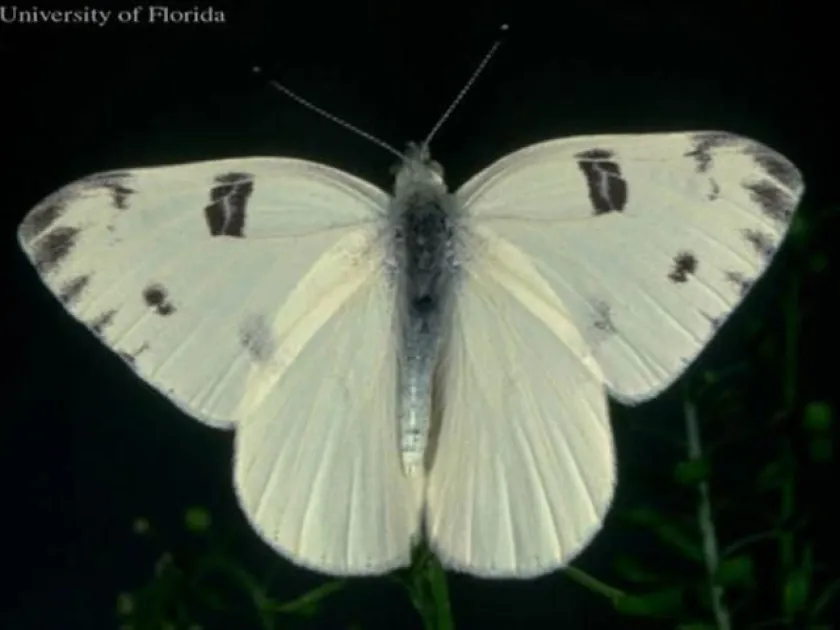
Adults are identified by the distinct checkered pattern on their wings, which features dark spots on a white background, distinguishing them from other whites.
The larvae progress through five instars, with their appearance evolving from pale yellow to a more greenish-grey hue with longitudinal stripes.
Larval stages are characterized by the presence of small, dark hairs covering the body, which serve as a diagnostic feature for identification in the field.
Pupae exhibit camouflaged coloration, often appearing in shades of green or grey, allowing them to blend effectively with host plant stems and foliage.
What it damages
The Checkered White primarily feeds on plants within the Brassicaceae family, posing a significant risk to various cruciferous crops.
Commonly damaged agricultural crops include cabbage, cauliflower, broccoli, kale, and radishes, which can suffer substantial loss in leafy tissue.
Beyond cultivated fields, the species relies on wild mustard and other cruciferous weeds, which sustain the population throughout the growing season.
The larvae consume leaves rapidly, often skeletonizing them and leaving only the main veins, which severely impacts the plant's ability to photosynthesize.
Heavy infestations can lead to significant reduction in crop yield and market quality, as the foliage damage makes the produce unappealing for commercial sale.
When it appears
The life cycle of the Checkered White is highly dependent on environmental temperature, with the species producing multiple generations annually.
Adults typically emerge in early spring once temperatures are sufficient to facilitate flight, mating, and the subsequent egg-laying process.
Females deposit eggs individually on the undersides of leaves, a behavior that often makes early detection of an infestation challenging for farmers.
Development from egg to adult is relatively fast during warm summer months, often completed in just a few weeks under optimal climatic conditions.
As the season progresses, overlapping generations can occur, leading to a sustained presence of larvae feeding on host plants throughout the summer and autumn.
Signs of infestation
Initial signs of infestation appear as irregular holes in the leaf surface, created as early-stage larvae begin their active feeding process.
The presence of dark larval frass (excrement) on leaf surfaces or near the crown of the plant is a strong indicator of an active feeding population.
Larvae are often found resting on the undersides of leaves or near veins, necessitating careful inspection of the foliage during scouting activities.
In severe cases, entire leaves may be consumed, resulting in stunted plant growth and overall reduced vigor of the crop, especially in young seedlings.
- Irregular holes and ragged leaf edges.
- Accumulation of larval excrement on leaves.
- Visible larvae on the undersides of foliage.
Control measures
Cultural management starts with rigorous weed control, specifically targeting cruciferous weeds that serve as alternative hosts for the butterfly larvae.
Crop rotation is an essential strategy to minimize the long-term buildup of pest populations within a specific field location over successive seasons.
Biological control using Bacillus thuringiensis (Bt) based formulations is a highly effective way to manage larvae without harming beneficial insects.
When populations exceed economic thresholds, growers may need to apply appropriate insecticides following label guidelines for application and harvest intervals.
Consistent field monitoring is recommended to track the arrival of adults and the timing of egg-laying to ensure intervention occurs at the most vulnerable larval stage.
Taxonomy
- Latin name
- Pieris protodice
- Order
- Lepidoptera (butterflies)
- Family
- Pieridae
- EPPO code
- PIERPR
Discussion
No discussions yet — be the first.