
Large white
Pieris
Description
How to identify
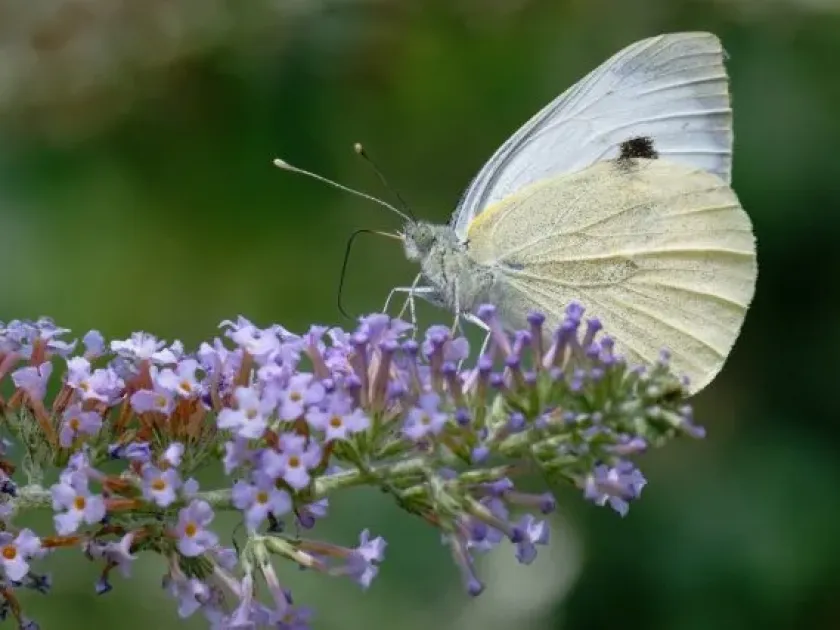
The Large White (Pieris brassicae), also known as the cabbage butterfly, is a member of the Pieridae family within the order Lepidoptera.
Adult butterflies are easily recognized by their white wings featuring distinctive black tips on the forewings, with a wingspan of approximately 50–60 mm.
Females lay batches of bright yellow, cone-shaped eggs, typically depositing them on the underside of leaves belonging to brassica plants.
Larvae, commonly known as cabbage worms, are green with yellow stripes and black spots, growing up to 40 mm in length throughout their development.
The pupae are angular and cryptically colored, often found attached to stalks, fences, or garden structures, enabling them to survive various environmental conditions.
What it damages
The caterpillars are highly voracious feeders that can strip entire vegetable patches of their foliage in a matter of days if left unchecked.
They primarily attack crops from the Brassicaceae family, including cabbage, kale, broccoli, Brussels sprouts, radishes, and horseradish.
Severe infestations lead to extensive defoliation, where only the main leaf veins remain, effectively halting the plant's photosynthesis and growth.
Besides leaf damage, the larvae often bore into the hearts of cabbage heads, causing secondary rot and rendering the produce unmarketable and inedible.
Young plants are particularly vulnerable, and heavy feeding pressure can lead to the total destruction of seedlings before they become established.
When it appears
The flight season typically begins in spring, around April or May, when adult butterflies emerge from their overwintering pupae.
The species is multivoltine, meaning it can produce two or even three generations per season, depending on local climate conditions and temperature.
The peak activity of caterpillars often occurs during mid-summer, when rapid population growth poses the highest threat to vegetable production.
Development from egg to adult is relatively fast, with the larval stage lasting between three to four weeks under optimal summer weather.
The species overwinters in the pupal stage, strategically positioning itself in sheltered locations to endure winter frosts until the next spring arrives.
Signs of infestation
The first indicator of an infestation is the presence of yellow egg clusters on the underside of leaves, which are easy to spot during regular garden checks.
Visible feeding damage, such as large, irregular holes in leaves, is the most common sign that caterpillars have begun their destructive work.
Accumulation of dark green frass (caterpillar droppings) on the leaf surfaces or around the base of the plant confirms the presence of active larvae.
High numbers of white butterflies hovering over a vegetable patch are a warning sign of imminent egg-laying, signaling the need for immediate action.
Wilting plants and skeletonized leaves demonstrate the advanced stage of an infestation that requires urgent pest management intervention.
Control measures
Cultural control involves removing cruciferous weeds from the garden area to eliminate alternative host plants and reduce the overall pest population.
Manual removal of egg clusters and young larvae is highly recommended for small-scale gardens as it is simple, effective, and environmentally friendly.
The use of fine-mesh netting over cabbage beds acts as an effective physical barrier, preventing butterflies from accessing the plants for egg-laying.
Biological control agents, such as Bacillus thuringiensis, offer a targeted way to kill caterpillars without harming beneficial insects or the environment.
- Application of appropriate insecticides during the early larval stages for heavy infestations.
- Encouraging natural predators, such as parasitic wasps (Cotesia glomerata), which feed on the larvae.
- Tilling the soil in late autumn to expose and destroy overwintering pupae.
Taxonomy
- Latin name
- Pieris
- Order
- Lepidoptera (butterflies)
- Family
- Pieridae
- EPPO code
- PIERSP
Discussion
No discussions yet — be the first.