
Reed leopard moth
Phragmataecia castaneae
Description
How to identify
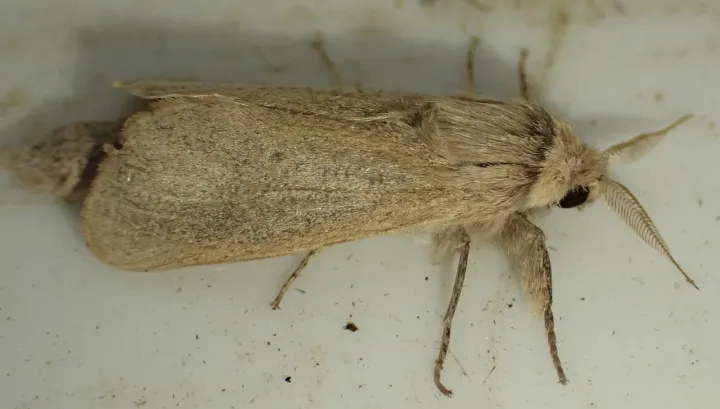
Phragmataecia castaneae, commonly known as the reed leopard moth, is a species of moth in the family Cossidae. The adult moth has a wingspan of approximately 60 mm with yellowish-grey patterned wings.
The larvae, which are the main damaging stage, grow up to 50 mm in length. They have a pale body and are specifically adapted to living inside the stems of large grasses.
The species undergoes complete metamorphosis: egg, larva, pupa, and adult. The larval stage is the longest and most significant part of its life cycle.
Overwintering typically occurs in the larval stage inside the stems of host plants, providing them with essential protection from environmental extremes.
Adult moths are nocturnal and are attracted to light, which makes light traps an effective method for agricultural monitoring of this pest's population.
What it damages
The primary food source for the reed leopard moth is common reed (Phragmites). However, it can also infest cereal crops when grown near wetlands or reed-rich areas.
The larvae bore into the plant stems, eating the pith and creating long tunnels, which disrupts the structural integrity of the plant and limits nutrient transport.
Significant economic loss is observed in industrial reed plantations, where stem density is directly correlated with biomass production and total yield.
Damaged stems lose their mechanical strength and become highly prone to breaking under wind pressure, leading to extensive lodging in affected patches.
Feeding tunnels serve as entry points for secondary infections by fungi and bacteria, which often cause the stems to rot, leading to crop death.
When it appears
Adult flight usually occurs during the months of June and July, when mating and egg-laying take place on the leaves and stems of host plants.
Embryonic development is relatively fast, leading to the hatching of larvae that immediately bore into the stems to ensure their safety and food supply.
During the late summer and autumn, the larvae feed actively to store the necessary energy reserves required for the long winter diapause.
The winter period is spent in a dormant state inside the reeds, where the larvae are insulated from cold temperatures and most predators.
Spring reactivation coincides with the beginning of the plant growing season, allowing larvae to resume feeding before pupating in late spring or early summer.
Signs of infestation
The first external sign of an infestation is the appearance of small entry holes on the surface of the reed stems.
Piles of brown frass (larval excrement) near the entry points are clear indicators of active internal feeding by the larvae.
Apical parts of the affected stems show signs of wilting and yellowing as the larvae sever the vascular bundles, preventing the plant from receiving water.
Reduced stem rigidity is a major sign; affected stems will snap easily when bent by hand or during windy weather conditions.
Dissecting suspected stems during the spring months will reveal larvae inside the tunnels or, later in the season, empty pupal casings.
Control measures
Effective management begins with the destruction of infested plant residues, as this removes the overwintering habitat for the larvae.
Agricultural practices, including proper crop rotation and deep soil cultivation, significantly reduce the localized population density of the pest.
Biological control using entomopathogenic fungi or bacteria can suppress larval populations without the heavy use of chemical pesticides.
Systemic insecticides may be used in severe infestations, though their application must be timed precisely with the moth's flight and egg-laying periods.
- Monitor flight activity using light traps.
- Remove and destroy infected plant debris after harvest.
- Maintain optimal plant density and moisture levels.
Taxonomy
- Latin name
- Phragmataecia castaneae
- Order
- Lepidoptera (butterflies)
- Family
- Cossidae
- EPPO code
- PHRTCA
Discussion
No discussions yet — be the first.