
Dark bush-cricket
Pholidoptera griseoaptera
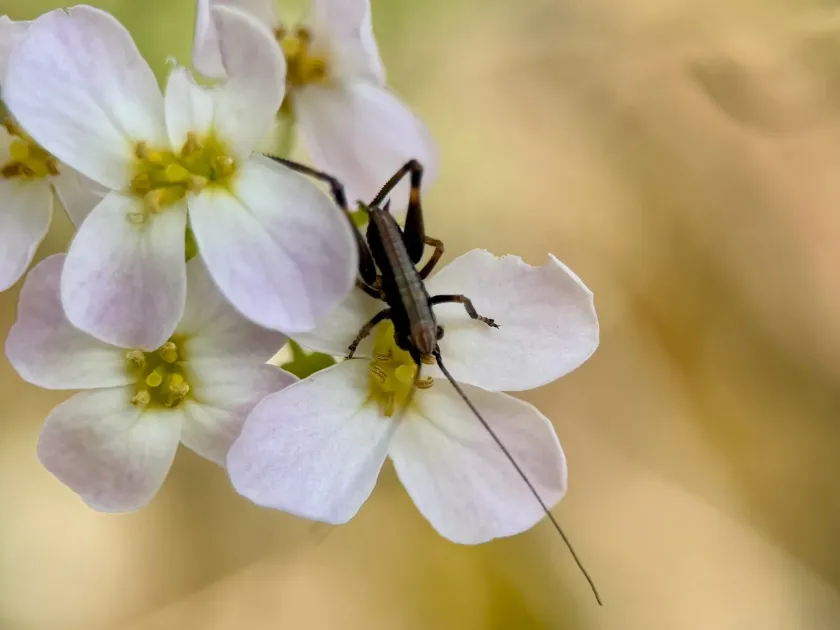
Description
How to identify
The dark bush-cricket belongs to the Tettigoniidae family of the Orthoptera order. This is a large insect, with body lengths ranging from 15 to 22 mm for males and up to 26 mm for females.
Its coloration varies from grey-brown to dark brown, providing excellent camouflage among dry grass and fallen leaves. The species is named for its significantly reduced wings, which are not adapted for flight in adult specimens.
A distinctive feature is its robust build and powerful hind legs, which allow for sudden jumps. Females possess a long, slightly upward-curved ovipositor, which is almost equal in length to their body.
Visually, this species is often confused with other orthopterans; however, the absence of developed wings is the primary field diagnostic trait for an agronomist.
Sexually mature individuals are active mainly during the daytime, preferring sun-warmed field margins, forest edges, and dense weed thickets.
What it damages
The dark bush-cricket is a facultative pest exhibiting polyphagous behavior. In agroecosystems, it causes damage to young vegetable and grain crop seedlings.
It poses a particular threat to berry bushes and fruit trees by gnawing on young shoots and leaves. During dry periods, these insects shift to feeding on the succulent parts of cultivated plants in search of moisture.
Damage is caused by both nymphs and adults. Mature specimens can damage flower clusters and young fruits, which reduces the marketability of the produce.
While this pest rarely causes total crop failure, high population densities can lead to significant yield losses in private gardens and agricultural plots.
Beyond direct tissue consumption, secondary fungal and bacterial infections can enter through the feeding wounds, causing rot and wilting in the affected plants.
When it appears
The life cycle of the dark bush-cricket is closely tied to seasonal temperature changes. The species overwinters exclusively at the egg stage, with eggs deposited by females in the soil or plant debris.
Nymph hatching begins in late spring, usually in May, once the soil has warmed to optimal temperatures. Nymphs pass through several developmental stages, gradually increasing in size.
The peak adult population occurs in the second half of summer, from July to September, when the insects actively feed and reproduce.
In late summer and early autumn, a period of mass oviposition occurs, after which the adults die off with the onset of the first significant frosts.
Thus, the main risk period for crops spans the interval from the beginning of the vegetation season in June to the active fruiting phase in August.
Signs of infestation
The primary sign of the dark bush-cricket's presence is the characteristic "eaten" leaf edges, which exhibit uneven, serrated contours.
Deep bite marks can be observed on young shoots, which, if damaged extensively, lead to deformation or necrosis of the terminal parts of the plant.
The presence of the pest is often signaled by the male's distinct stridulation, which intensifies during hot sunny hours, helping to detect the population before significant damage occurs.
Visual inspection of the underside of leaves and stems in the morning hours allows for the detection of both the insects themselves and traces of their excrement in the form of small dark granules.
In greenhouses or dense vegetable plantings, signs of infestation include the appearance of holes on the lower foliage, where pests prefer to hide from the midday heat.
Control measures
Controlling the dark bush-cricket requires a comprehensive approach, starting with agrotechnical measures aimed at reducing the pest's food supply.
- Regular mowing of weeds along the perimeter of fields and gardens.
- Deep autumn soil cultivation to destroy egg clutches.
- Use of light traps for monitoring and trapping adult individuals.
- Application of biological products based on entomopathogenic fungi during the period of mass nymph emergence.
- Targeted use of contact-intestinal insecticides when the economic threshold of damage is exceeded.
Chemical treatments must be carried out in compliance with pre-harvest intervals, especially for vegetable crops intended for fresh consumption.
It is important to maintain an optimal irrigation regime, as dehydrated plants become more attractive to bush-crickets during hot spells.
Attracting natural predators to the site, such as birds and insectivorous mammals, contributes to the natural suppression of the pest population.
Taxonomy
- Latin name
- Pholidoptera griseoaptera
- Order
- Orthoptera (locusts)
- Family
- Tettigoniidae
- EPPO code
- PHDPGR
Discussion
No discussions yet — be the first.