
Phlegetonia moth
Phlegetonia
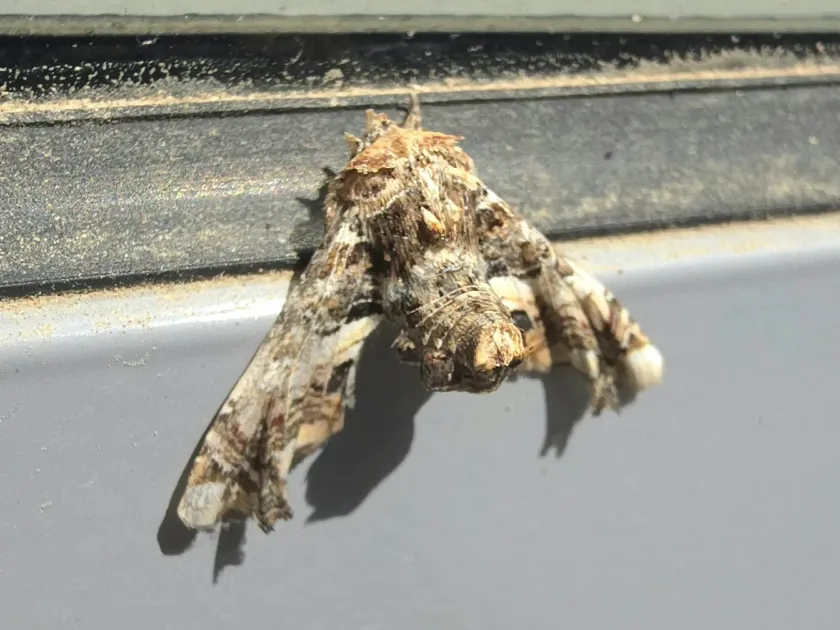
Description
How to identify
Phlegetonia, commonly encountered as the moth species Phlegetonia delphinii, belongs to the family Noctuidae (owlet moths) of the order Lepidoptera. This insect possesses a structure typical of noctuids: a stout body covered in hair-like scales and broad wings with a characteristic mottled pattern.
The adult moth is relatively small with a wingspan of approximately 25–30 mm. The coloration of the wings ranges from greyish to brownish tones, which allows the insect to camouflage itself effectively on tree bark or dried leaves.
The larvae, or caterpillars, have a typical appearance for this family: well-developed abdominal prolegs and a cylindrical body with distinct segmentation. Their coloration is often adapted to match the host plant for better concealment.
Females lay eggs individually or in small clusters on the underside of leaves or on young shoots. The egg shell is dense, providing significant protection against adverse environmental factors.
Pupae form in the soil or within tight cocoons constructed from silken threads and substrate particles, which assists them in successfully overwintering during the cold season.
What it damages
The primary food source for the larvae consists of plants from the Ranunculaceae (buttercup) family. They cause particular damage to ornamental species, such as Delphinium, as well as several wild flora species.
Damage is caused by the caterpillars, which actively feed on the vegetative mass of plants. They are capable of consuming leaf margins, turning leaves into lace-like structures, or, in cases of high population density, completely skeletonizing the foliage.
During the flowering period, the caterpillars often switch to the reproductive organs of the plants. They bore into buds and damage ovaries, resulting in a total loss of the crop's ornamental value and preventing seed formation.
The pest exhibits high nutritional plasticity; therefore, when its primary food source is scarce, it may migrate to closely related garden crops, expanding its area of impact within the growing site.
The most significant damage is observed during years with moderately humid summers, which create ideal conditions for population development and active reproduction across several generations.
When it appears
The moth flight period begins in late spring, usually in May or June, once stable warm weather is established. Adult activity is primarily observed during twilight and nighttime hours.
The larval feeding period occurs in the first half of summer. This is when agronomists report the peak population growth dynamics and the highest intensity of damage in fields and gardens.
Depending on the climatic zone, one or two generations of the pest may develop per season. Pupation of the summer generation occurs mid-summer, after which the cycle repeats.
In autumn, the final generation of larvae enters diapause or pupates within the soil layer for hibernation. In this phase, the insect is maximally protected from autumn frosts and inclement weather conditions.
Monitoring for the presence of the pest should begin as soon as the first true leaves appear on susceptible crops, utilizing pheromone traps to track adult population numbers.
Signs of infestation
A primary indicator is the presence of characteristic "windows" and deep gouges on the leaf blades. The margins of damaged areas dry out quickly, turning a distinct brownish color.
The presence of caterpillar frass in the form of small, dark pellets on leaf surfaces or beneath the plant is a reliable indicator that an active pest is present.
Deformation or wilting of terminal shoots suggests that larvae are feeding in growth points or inside unopened buds, which frequently leads to the stunted development of the stem.
The presence of rolled leaves secured by thin silk webbing indicates that the caterpillar has created a shelter for daytime rest, a behavior common among many noctuid moth species.
At night, one may observe the caterpillars themselves on the leaves, as they often display agitation when exposed to artificial light or coil into a ring when touched.
Control measures
Agronomic methods include deep autumn plowing of soil in tree circles and row spaces, which leads to the destruction of pupae currently in winter diapause.
Regular weeding of Ranunculaceae family weeds near cultivated crops significantly reduces the food base for the pest and limits its reproduction within the managed area.
Biological preparations based on bacteria (Bacillus thuringiensis) are effective against young larvae. Treatments should be performed in the evening when caterpillars are most active.
In cases of high pest population density, contact-stomach insecticides registered for use on ornamental and agricultural crops should be applied.
The use of pheromone traps helps not only to detect the onset of moth emergence but also to significantly decrease the number of mating individuals within the population when applied on a mass scale.
Taxonomy
- Latin name
- Phlegetonia
- Order
- Lepidoptera (butterflies)
- Family
- Euteliidae
- EPPO code
- PHGTSP
Discussion
No discussions yet — be the first.