
Philorhizus
Philorhizus
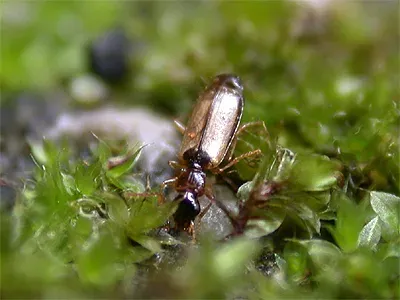
Description
How to identify
The genus Philorhizus belongs to the ground beetle family (Carabidae). These are small, often narrow-bodied beetles that exhibit the typical appearance of many representatives of the Lebiinae subfamily.
Adult individuals possess a pronounced flight ability, distinguishing them from many other species of ground beetles. Their coloration ranges from brown to almost black, often with a metallic sheen or spotted patterns on the elytra.
The insect's life cycle is closely linked to the soil environment and plant debris. Imagos and larvae lead a hidden lifestyle, preferring moist and shaded areas, which makes them difficult to detect during initial field inspections.
Systematically, these beetles are predatory, yet some species exhibit facultative phytophagy, making them potentially dangerous to young crop seedlings.
Development proceeds through egg, three larval instars, pupa, and imago stages. Overwintering usually occurs at the adult stage in the topsoil layer or under plant residues.
What it damages
The primary damage occurs during the early phases of crop development. Beetles can damage cotyledonous leaves, growth points, and young shoots, leading to thinning of the stand.
Damage manifests as eaten tissue areas on leaves, which weakens the plant and makes it vulnerable to secondary infections or pathogens.
Under conditions of high population density, Philorhizus can significantly reduce crop density, especially in dry periods when alternative food sources are limited.
Harmfulness is most pronounced in cereal, vegetable, and some technical crops, where beetles congregate during periods of mass emergence from overwintering sites.
Beyond direct feeding on tissues, these insects may transport fungal disease spores, facilitating their spread within the field.
When it appears
Beetle activity begins in early spring, immediately after snowmelt and when topsoil temperatures reach optimal levels.
The peak abundance of imagos usually coincides with the germination phase and the appearance of seedlings for most field crops in the spring.
The summer generation is active during the vegetation period, though their numbers can fluctuate depending on moisture levels and plant cover availability.
In autumn, beetles migrate to overwintering sites, such as forest strips, road verges, and perennial grass plots.
Weather conditions, such as a prolonged spring or heavy rainfall, significantly influence Philorhizus activity and the intensity of their feeding on crops.
Signs of infestation
During field inspections, look for damage to the edges of cotyledonous leaves on seedlings, which appear as small ulcers or holes.
The presence of beetles in the soil can be detected using soil excavation methods or by checking Barber pitfall traps placed at field edges.
Wilting of young plants without visible signs of root system damage often points to growth point injury caused by this type of pest.
The presence of specific excrement on the soil surface near damaged plants can be an indirect sign of Philorhizus activity.
Observing insects in the evening hours with a flashlight during crop inspections is the most accurate method to confirm their presence in the field.
Control measures
The basis of control is crop rotation and timely soil cultivation, which destroys the insects' overwintering sites.
Applying insecticidal seed treatment before sowing is the most effective preventive measure against early-seedling pests.
- Regular destruction of weeds along field borders.
- Use of high-quality systemic seed treatments.
- Application of border treatments with insecticides in case of mass beetle infestation.
Biological control methods include attracting entomophages to fields, which naturally regulate the Philorhizus population density.
Monitoring population levels using pheromone or sticky traps allows for precise determination of the need for chemical protection, preventing unjustified pesticide use.
Taxonomy
- Latin name
- Philorhizus
- Order
- Coleoptera (beetles)
- Family
- Carabidae
- EPPO code
- PHRZSP
Discussion
No discussions yet — be the first.