
Southern Oak Bush-Cricket
Phaneroptera nana
Description
How to identify
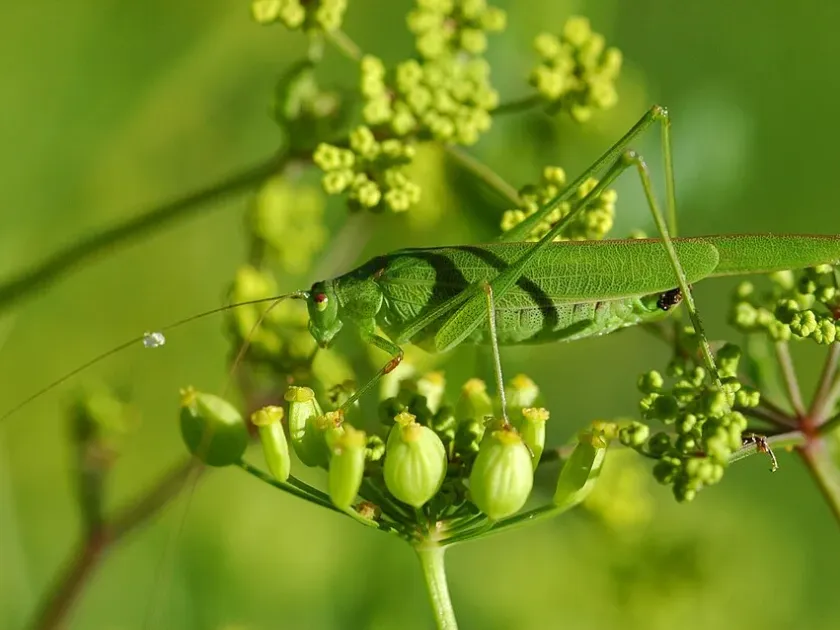
The Southern Oak Bush-Cricket (Phaneroptera nana) is a member of the Tettigoniidae family, characterized by its vibrant green coloration that provides excellent camouflage in dense vegetation.
These insects are recognizable by their extremely long, thread-like antennae which are much longer than their bodies. Adults typically measure between 12 to 15 mm in length and possess well-developed wings.
Their mouthparts are strictly of the chewing type, capable of tearing through tough leaf veins and fruit skins. The legs are slender, with powerful hind femurs that allow for significant jumping capacity.
Nymphs resemble smaller versions of the adults but lack wings. The species is known for ovipositing (laying eggs) directly into the leaf tissue of host plants, which makes detection difficult until hatching occurs.
Though active flyers, they prefer to remain hidden on the underside of leaves during the day, making manual inspection a slow and challenging process for agricultural workers.
What it damages
Phaneroptera nana is a polyphagous pest, meaning it feeds on a wide range of botanical species. In agricultural settings, it is particularly noted as a pest of vineyards and various ornamental shrubs.
In vineyards, these crickets cause damage by consuming young leaves and, more significantly, by gnawing on developing grapes. These wounds often lead to secondary infections, such as sour rot, ruining the fruit quality.
Vegetable crops, including tomatoes and eggplants, are susceptible to foliage feeding. The crickets leave characteristic jagged holes in the leaves, reducing the photosynthetic capacity of the plant.
Ornamental flowers, such as roses and chrysanthemums, often suffer from damaged petals and buds, rendering them unsuitable for commercial sale or aesthetic purposes.
Heavy infestations can lead to significant defoliation, which stunts plant growth and reduces the overall vigor of the host plant, potentially impacting yields in the following season.
When it appears
The lifecycle typically consists of one or two generations per year, depending on the local climate. Overwintering occurs in the egg stage, with eggs embedded within the plant tissue.
Nymphs emerge in late spring or early summer, depending on temperature patterns. They undergo several molts as they progress through nymphal stages before reaching adulthood.
Peak populations and the highest level of crop damage are usually observed from mid-summer through early autumn, as the insects reach their final reproductive stage.
As temperatures drop in late autumn, the activity levels decrease until the insects eventually die off after completing their egg-laying cycle for the next generation.
Agricultural monitoring should begin early in the season, focusing on detecting the first signs of nymphal feeding on low-lying vegetation before they spread to main crops.
Signs of infestation
The most prominent sign of infestation is the presence of irregular, ragged-edged holes in leaves, which differ from the cleaner cuts made by other types of pests.
Fruit damage appears as shallow, jagged indentations or hollows on the skin. In late stages of fruit development, these wounds may weep plant sap, which acts as a secondary attractant for ants and wasps.
Detection can be aided by shaking branches or foliage; the insects will often jump or fly away, revealing their presence. Night-time surveys with a flashlight can also expose active feeding.
Small, dark, pellet-like frass (excrement) deposited on the leaves is a common indicator of a localized feeding presence.
The distinct, rhythmic stridulation of males during twilight hours is a strong auditory cue that a mating population is established in the area.
Control measures
Integrated Pest Management (IPM) strategies are essential. Cultural control begins with maintaining a weed-free environment around crops, as many weeds act as primary hosts for the crickets.
Biological control options include the use of entomopathogenic fungi or selective bio-insecticides that target the nymphal stages while preserving beneficial insect populations.
Chemical control should be employed selectively using contact or systemic insecticides if population thresholds are exceeded, ensuring compliance with pre-harvest intervals.
Light trapping at night can be an effective monitoring tool and may help in reducing the number of adult crickets in areas with high density.
- Implement regular scouting protocols to identify infestations at the earliest nymphal stage.
- Clear surrounding vegetation to reduce potential oviposition sites for the crickets.
- Encourage natural predators such as birds and spiders in the agricultural landscape to help regulate populations.
Taxonomy
- Latin name
- Phaneroptera nana
- Order
- Orthoptera (locusts)
- Family
- Phaneropteridae
- EPPO code
- PHNENA
Discussion
No discussions yet — be the first.