
Short-winged bush-cricket
Phaneroptera brevis
Description
How to identify
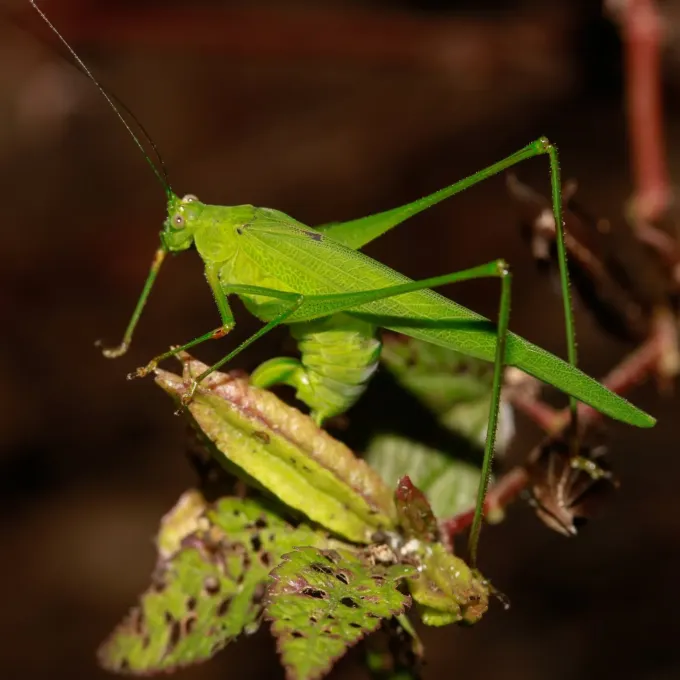
The short-winged bush-cricket (Phaneroptera brevis) is a member of the Tettigoniidae family, characterized by a vibrant light-green coloration. This hue provides excellent camouflage within the foliage of various host plants.
Adult insects feature slender bodies and long, thread-like antennae that extend well beyond the body length. The defining feature of this species is its relatively short elytra, which do not fully cover the abdomen, distinguishing it from other bush-cricket species.
They possess powerful hind legs adapted for jumping, allowing them to escape threats rapidly. Larvae resemble adults in body shape but are smaller and lack fully developed wings during their earlier developmental stages.
Females are equipped with a sickle-shaped ovipositor, which they use to insert eggs into plant tissues. Being primarily nocturnal, these crickets are often difficult to detect during the daylight hours, remaining hidden in dense canopy or foliage.
This species is widely distributed in warmer regions, favoring areas with moderate humidity and thick vegetation. They are frequently found in orchards, vineyards, and agricultural fields bordering wild shrubbery.
What it damages
The short-winged bush-cricket is a polyphagous pest capable of damaging a diverse range of crops. It is particularly notorious in vineyards, where it feeds on developing shoots and ripening grape clusters.
Beyond grapes, these insects feed on the leaves of various orchard fruits, including apple, pear, and peach trees. In vegetable gardens, they often target leafy greens, tomatoes, and beans, chewing through the foliage.
The damage is primarily mechanical, involving the consumption of leaf tissue, which reduces the plant's photosynthetic capacity and weakens its overall vigor. High populations can lead to significant defoliation of the plant.
Secondary damage includes the destruction of reproductive parts, such as flower buds and fruit set, leading to direct yield loss. Furthermore, the aesthetic value of the harvested produce is often ruined by bite marks and scarring.
Open wounds left by the cricket's feeding serve as entry points for secondary pathogens, including fungi and bacteria, which can lead to localized decay and further reduce the shelf life of the fruit.
When it appears
The life cycle of the species begins with the egg stage, which is the overwintering form. Eggs are laid directly into plant stems, leaf veins, or bark, providing protection against winter temperatures.
Larval emergence typically occurs in late spring or early summer, coinciding with rising temperatures. Larvae undergo several developmental stages while feeding actively on tender vegetation nearby.
Adults appear in mid-to-late summer, which is the period of highest pest pressure for growers. During this time, they require significant caloric intake for reproduction, making them most destructive to crops.
The species generally completes one generation per year, though high reproductive success can lead to rapid population build-ups in favorable years. Adults die off in late autumn after completing the oviposition process.
Warm and dry summers promote population growth. Conversely, extreme cold or excessively wet conditions during the egg-hatching period can significantly limit the survival rate of the first-instar larvae.
Signs of infestation
A primary indicator of infestation is the presence of irregular, notched holes in the leaves. These crickets often consume the leaf tissue between the veins, leaving behind a skeletonized appearance.
Damage to fruit is marked by deep, gouged pits or removed sections of skin, which makes affected produce susceptible to rot and secondary pests like wasps or fruit flies.
Nocturnal acoustic monitoring is a reliable diagnostic method; the stridulation (chirping) sounds made by males are a clear sign of their presence. Inspecting the undersides of leaves at dusk usually reveals the adults.
Small, dark, pellet-like frass (excrement) deposited on leaves is a definitive sign of recent feeding activity. Spotting this frass helps farmers identify where the crickets are concentrated within the crop canopy.
Severe infestations often cause the wilting or curling of the apical shoots, as the insects prefer the succulent tissue of young growth. Early detection is crucial to preventing mass crop loss.
Control measures
Cultural control involves rigorous weed management in and around the fields, as dense weeds serve as a primary refuge and food source for the crickets. Keeping headlands and alleyways mowed is highly effective.
Chemical control should be implemented using approved insecticides, focusing on the early larval stages when they are most vulnerable. Proper timing is essential to ensure minimal impact on beneficial insects.
Biological control methods, such as the use of entomopathogenic fungi or bacteria, can be employed as an environmentally friendly alternative to synthetic pesticides. These are particularly effective in humid conditions.
Light traps can be utilized as a secondary method to monitor and reduce adult populations, especially in small-scale orchard or garden settings where large-scale spraying is not feasible.
Encouraging natural predators, including birds, hedgehogs, and predatory insects, contributes to long-term population suppression. Maintaining a diverse ecological environment helps prevent cricket outbreaks.
Taxonomy
- Latin name
- Phaneroptera brevis
- Order
- Orthoptera (locusts)
- Family
- Phaneropteridae
- EPPO code
- PHNEBR
Discussion
No discussions yet — be the first.