
Pentamerismus
Pentamerismus
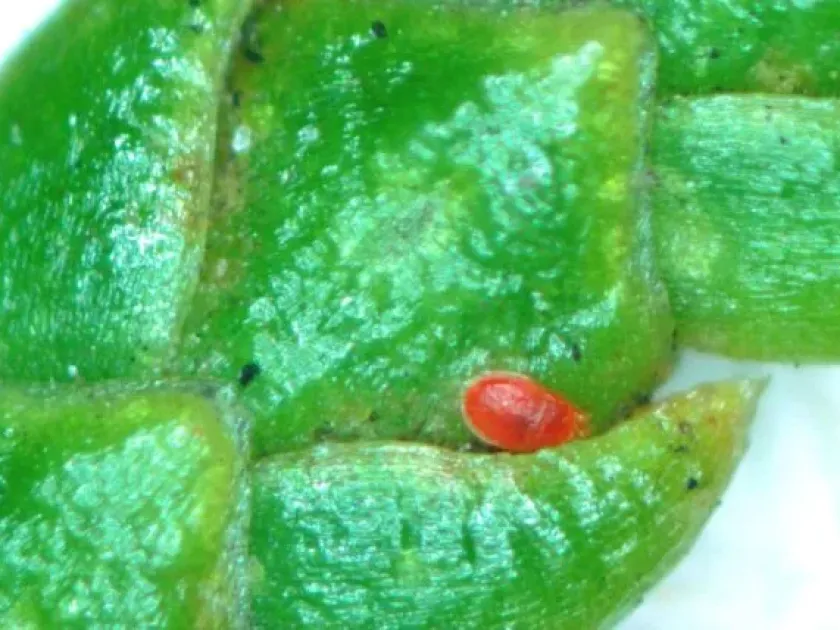
Description
How to identify
Pentamerismus is a genus of tiny mites belonging to the family Tenuipalpidae, commonly known as flat mites. These organisms are microscopic and difficult to detect without high-magnification tools.
Adult mites exhibit a flattened body morphology, which allows them to hide and feed within the microscopic crevices of plant surfaces. Their coloration ranges from pale yellow to reddish, depending on their life stage and feeding status.
The life cycle encompasses egg, larva, protonymph, deutonymph, and adult stages. These mites have a relatively rapid life cycle, which allows populations to explode in size within a single growing season.
Reproduction is typically sexual, though some species within the family exhibit forms of parthenogenesis. High fecundity ensures that a small starting population can quickly become a major infestation.
To identify them, agronomists should use a hand lens or field microscope, specifically examining the abaxial (underside) surface of leaves, where these mites prefer to aggregate and feed.
What it damages
These pests cause significant damage to a diverse range of crops, including agricultural, horticultural, and ornamental plants. They feed by piercing plant cells and extracting the internal contents.
The primary impact of feeding is the disruption of the plant's photosynthetic efficiency. This leads to reduced plant vigor, stunted growth, and a significant drop in overall crop yield and quality.
Damaged leaves show symptoms of localized chlorosis, which eventually spreads across the entire leaf surface. In severe cases, this results in leaf desiccation, curling, and premature senescence.
Water stress amplifies the damage caused by Pentamerismus, as the compromised leaf tissue loses moisture much faster than healthy tissue, leading to rapid wilting during hot weather.
Economic damage is substantial due to both the loss of biomass and the aesthetic degradation of high-value crops, making accurate and timely detection essential for successful farming operations.
When it appears
The seasonal occurrence of these mites is heavily influenced by temperature. Activity usually begins in the spring as temperatures rise, creating conditions suitable for rapid development.
Peak population levels typically occur during the summer months, particularly during prolonged periods of hot, dry weather. These conditions shorten the generation time, allowing for multiple overlapping generations.
As autumn approaches and day length decreases, mite activity slows down. They seek overwintering sites, such as bark crevices, plant debris, or soil surfaces near the base of the host plant.
Early-season scouting is crucial. Monitoring should begin as soon as the plant enters the active growth phase to identify initial colonies before they disperse throughout the field or orchard.
Overwintering adults emerge in the spring, ready to colonize new plant growth immediately, highlighting the importance of preventative measures during the early vegetative stages.
Signs of infestation
Early symptoms of infestation include minute light-colored stippling or spotting on the upper leaf surface, directly corresponding to feeding sites on the underside of the leaf.
As the infestation progresses, these spots coalesce into larger yellow or necrotic patches. The leaves may take on a dull, bronzed appearance and eventually deform due to loss of cell turgor.
Evidence of mite activity often includes the presence of cast skins (exuviae) left behind after molting, found on the undersides of leaves, sometimes accompanied by very fine silk webbing.
Severe infestations lead to massive leaf drop, which can significantly hinder the development of fruit or the overall structural integrity of the plant during the growing season.
In fruit crops, feeding damage can lead to skin blemishes or scarring on the fruit surface, drastically reducing its market value and potential for long-term storage.
Control measures
Effective management of Pentamerismus requires an integrated pest management (IPM) strategy that combines cultural, biological, and chemical methods.
Cultural practices, such as maintaining optimal irrigation and proper nutrient management, help plants remain resilient. Sanitation is also vital; removing infested crop debris reduces overwintering populations.
Biological control involves the use of predatory mites (such as Phytoseiidae) and other beneficial insects that naturally prey on these mites, maintaining their population below the economic threshold.
Chemical intervention should be reserved for periods when monitoring shows pest numbers exceeding the threshold. Using specific acaricides and rotating modes of action is necessary to prevent resistance development.
- Regular field scouting and monitoring with magnifying lenses.
- Implementation of proper crop rotation cycles.
- Targeted release of predatory mites as a preventative measure.
- Weed control around field edges to eliminate secondary host plants.
Taxonomy
- Latin name
- Pentamerismus
- Order
- Mites
- Family
- Tenuipalpidae
- EPPO code
- PENUSP
Discussion
No discussions yet — be the first.