
Pelophila
Pelophila
Description
How to identify
The genus Pelophila belongs to the Carabidae family, commonly known as ground beetles, within the order Coleoptera. These insects are typically found in moist environments, including riverbanks and damp agricultural lands.
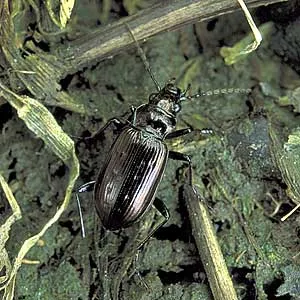
Adult beetles possess a body shape typical of the Carabidae family, featuring a flattened, oval-shaped structure. Their coloration ranges from dark brown to black, often exhibiting a slight metallic luster. Adults usually measure between 10 and 15 millimeters in length.
The larvae of Pelophila have well-developed chewing mouthparts and heavily sclerotized body armor. They are secretive in their behavior, primarily living within the upper layers of the soil or beneath dense organic debris.
Species diversity within this genus is relatively limited. The most well-studied representative is Pelophila borealis, which is highly adapted to cooler, northern latitudes.
Accurate species identification often requires a detailed examination of the pronotum shape and the structure of the elytra (wing cases), as morphology across the genus can be quite similar.
What it damages
While many ground beetles are considered beneficial entomophagous predators, certain species within the Pelophila group can become pests when population densities are high, particularly during the germination phase of crops.
The primary damage occurs during the early stages of plant development. Adults and larvae may feed on roots, gnaw at the stems near the soil surface, or entirely consume tender cotyledons.
Cereals, vegetable crops, and fodder grasses are at the highest risk, especially if fields are adjacent to wetlands, marshy areas, or bodies of water.
Damage is typically patchy rather than uniform. However, under ideal breeding conditions, these beetles can cause significant localized destruction, leading to reduced plant density in the affected areas.
Secondary damage often involves the introduction of soil-borne pathogens, such as fungal root rots, which infiltrate the plant tissue through the wounds created by the beetles' feeding activity.
When it appears
Pelophila activity begins in early spring, immediately following the thawing of the topsoil, as adult beetles emerge from their overwintering sites in search of food.
Mass emergence and peak feeding activity correlate with periods of high soil moisture. These insects thrive in damp conditions that remain saturated throughout the spring months.
The development cycle follows a complete metamorphosis: egg, larva, pupa, and adult. Depending on the geographical region, the species may produce one or two generations per season.
The period of highest risk for agricultural crops is the stage from seed germination to the onset of tillering, as the young, succulent tissues are highly attractive to the pests.
As summer progresses and soil moisture levels potentially decrease, adult beetle activity may subside; however, larvae often continue to develop in the soil, feeding on organic matter or roots until autumn.
Signs of infestation
The first indicator of a Pelophila infestation is the appearance of bare spots in the field, where seedlings appear yellowed, withered, or have collapsed due to damage at the root collar.
Upon inspecting the soil around damaged seedlings, growers may find characteristic tunnels or small burrows created by the larvae as they navigate the upper soil profile.
Adult beetle presence can be confirmed through soil sampling or by setting up pitfall traps around the perimeter of the field, which are most effective during the evening hours.
Visual signs include uneven, ragged leaf margins or entirely severed stems. In many cases, the adult beetles themselves can be found in the immediate vicinity of the damage during morning inspections.
Infestations are often accompanied by evidence of insect excrement, which can be identified near the base of the plant if the soil surface is examined closely.
Control measures
Effective management begins with proper pre-sowing soil cultivation, which serves to disrupt the habitat and breeding sites of the ground beetles.
Implementing a strict crop rotation strategy helps break the lifecycle of the pest, particularly by avoiding the planting of highly susceptible crops in waterlogged or low-lying areas known to harbor Pelophila.
The use of insecticidal seed treatments is highly effective in protecting the vulnerable germinating tissues and roots from early-season larval or adult feeding.
- Application of biological control agents, such as entomopathogenic fungi.
- Rigorous weed management, as weeds serve as alternative food sources and shelter for adult beetles.
- Optimizing sowing dates to ensure plants grow past the susceptible early developmental stages as quickly as possible.
In extreme cases of mass outbreaks, the application of registered, broad-spectrum insecticides may be necessary, ideally performed in the evening to maximize effectiveness and minimize impact on non-target species.
Taxonomy
- Latin name
- Pelophila
- Order
- Coleoptera (beetles)
- Family
- Carabidae
- EPPO code
- PPHLSP
Discussion
No discussions yet — be the first.