
Anubis baboon
Papio anubis
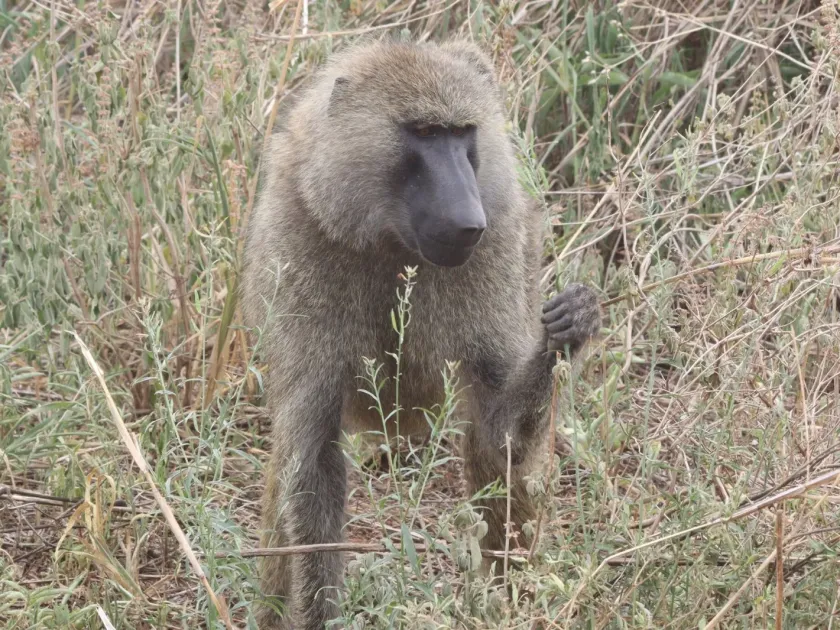
Description
How to identify
The Anubis baboon (Papio anubis) is a primate belonging to the Old World monkey family. They are large, robust animals known for their dog-like muzzles and strong limbs.
Adult males reach significant sizes, weighing up to 30 kg, and are characterized by thick olive-gray fur and powerful canine teeth used for defense and feeding.
These primates are highly social, living in complex hierarchical troops. This social structure allows them to forage effectively and react quickly to threats from farmers.
They possess high levels of intelligence and problem-solving abilities, which makes them particularly difficult to deter with simple mechanical barriers or traps.
Anubis baboons are remarkably adaptive, capable of thriving in varied environments and quickly learning how to access human food sources in farming areas.
What it damages
Baboons are major pests for cereal crops, especially maize. They often consume the crop during the milk stage, causing extensive damage to fields in a very short time.
Root crops such as cassava, sweet potatoes, and yams are also heavily targeted. Baboons excavate these tubers, leading to significant yield losses for smallholders.
Orchards face severe damage as baboons consume unripe fruits and break tree branches, which can permanently reduce the productive capacity of the affected trees.
In sugar cane plantations, baboons strip the stalks to access the sweet juice, often killing the plant and ruining entire rows of commercial crop.
Trampling damage occurs as troops move across fields. Their heavy foot traffic can crush seedlings and compact the soil, hindering the further development of the plants.
When it appears
Agricultural raids are most frequent during the dry season when natural forage and water sources in the wild become scarce for the troop.
The timing of the crop cycle is critical; baboons focus their efforts on fields when the crops are most palatable, specifically during the pre-harvest ripening phase.
Baboons are diurnal creatures, performing their raids primarily in the early morning and late afternoon to avoid the peak heat of the midday sun.
The reproductive cycles of the troops also influence raid patterns, as mothers need increased caloric intake, driving the group to exploit more nutrient-rich crops.
Raiding behavior is often seasonal, peaking during the specific months when maize or other staple crops are reaching maturity in a particular climatic region.
Signs of infestation
Clear signs of an Anubis baboon presence include broken stalks and partially eaten maize cobs scattered across the field, indicating the site of their feeding.
Troops leave distinct path-like trails through tall crops where the vegetation has been flattened, creating an easy-to-spot corridor from the field edge.
Footprints showing a primate anatomy are common in the soft soil or on surrounding tracks, often accompanied by piles of droppings containing crop waste.
Vocalizations are a tell-tale sign; the loud barking and screaming associated with troop coordination can be heard across the landscape during their foraging trips.
Excavated holes in fields of root vegetables, where the soil has been dug up manually by the baboons, are unmistakable indicators of their recent activity.
Control measures
Physical barriers remain the most effective solution. High, sturdy fences, sometimes reinforced with electrified wires, are necessary to exclude these intelligent animals.
Guarding the fields is a traditional and effective method. Farmers often work in shifts to drive the baboons away, utilizing noise and presence to deter raids.
Integrated pest management strategies are advised, combining constant monitoring with non-lethal repellents to make the area unattractive to the troop.
Community-based protection is crucial, as individual farmers often cannot stop a large troop; coordinating efforts across a wide area provides much better results.
- Use of electrified fencing systems
- Deployment of guard dogs and human patrols
- Regular crop rotation and clearing of crop remnants
- Use of bio-acoustic deterrents
Taxonomy
- Latin name
- Papio anubis
- Family
- Cercopithecidae
- EPPO code
- PAPOAN
Discussion
No discussions yet — be the first.