
Barbary macaque
Macaca sylvanus
Description
How to identify
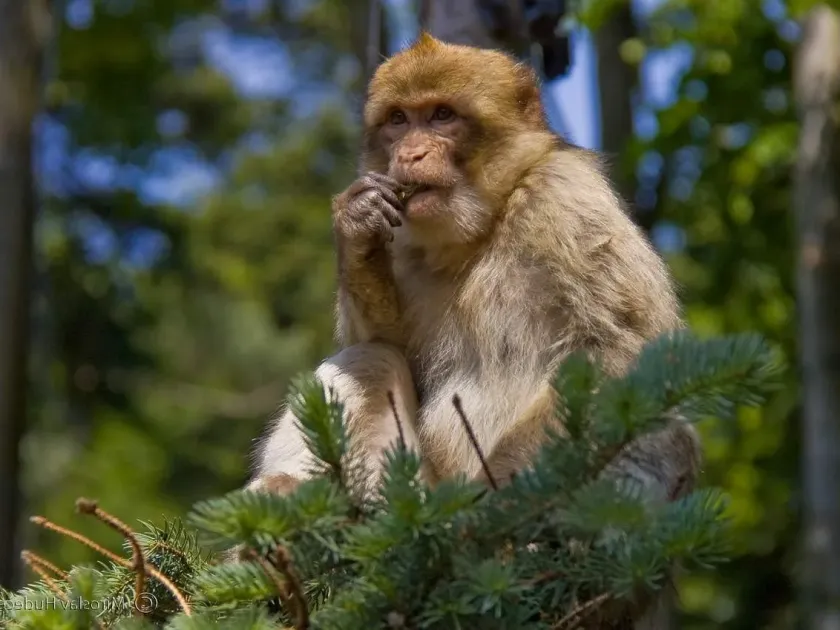
The Barbary macaque (Macaca sylvanus) is a primate belonging to the family Cercopithecidae. Adults are robust, tailless monkeys with dense, yellowish-brown fur.
They live in complex social groups, which allows them to effectively forage and explore new territories, including agricultural lands near their habitats.
Native to North Africa, they are highly adaptable and possess a high degree of intelligence, enabling them to solve problems and bypass simple barriers.
Their physical strength and agility allow them to move quickly between forest edges and cultivated fields, making them difficult to contain for farmers.
Understanding their behavior is crucial, as they are capable of learning human routines and exploiting lapses in field security.
What it damages
Barbary macaques primarily damage orchard crops, vegetables, and cereal fields located near their forest home ranges.
They exhibit a preference for succulent plant parts, including young shoots, ripe fruits, root vegetables, and grains in the milk-wax stage.
In orchards, they cause structural damage by breaking tree branches while climbing and foraging, which reduces the plant's health and productivity.
Cereal crops are severely impacted not only by the direct consumption of plants but also by widespread trampling by the foraging group.
Contamination of harvested products with waste and the introduction of weeds through seeds in their fur are additional concerns for agricultural health.
When it appears
The intensity of macaque activity is closely linked to the fruit ripening seasons and the availability of resources within their natural range.
Peak damage generally occurs during the summer and early autumn when cultivated fields provide a higher caloric intake compared to forest forage.
Drought years or periods of poor natural crop yield force the macaques to expand their territory, leading to increased frequency of farm incursions.
The breeding cycle of the group also influences their behavior, as lactating females require more energy, often leading to longer stays in cultivated fields.
Farmers should monitor their property lines closely during the harvest period, as that is when the attraction to cultivated plants is at its absolute maximum.
Signs of infestation
Typical signs of Barbary macaque presence include broken branches in orchards and scattered remains of partially consumed fruits under the trees.
On grain fields, patches of trampled crops and irregularly stripped stalks are clear indicators of a group's presence.
Root vegetables pulled from the soil and discarded or nibbled on the surface suggest an active foraging attempt by the animals.
The presence of footprints and fecal droppings at the field-forest boundary provides evidence of regular traffic and usage of the land as a feeding ground.
Vocalizations and aggressive chattering during early morning or evening hours often serve as auditory alerts that a group is nearing the field edges.
Control measures
Managing Barbary macaque incursions requires ethical and non-lethal approaches, as the species is legally protected in many of its remaining habitats.
The most effective physical solution is the installation of robust fencing, such as chain-link or electrified wire, to prevent unauthorized entry.
Automated scarecrow systems, including sound-emitting devices and motion-activated lights, can provide temporary deterrence for foraging groups.
Proper agricultural sanitation, such as prompt harvesting and clearing away fallen debris, reduces the incentive for macaques to enter fields.
Employing patrol dogs or regular human presence along the perimeter serves as an effective deterrent, leveraging the macaques' instinct to avoid conflict.
Taxonomy
- Latin name
- Macaca sylvanus
- Family
- Cercopithecidae
- EPPO code
- MCCASY
Discussion
No discussions yet — be the first.