
Green monkey
Chlorocebus
Description
How to identify
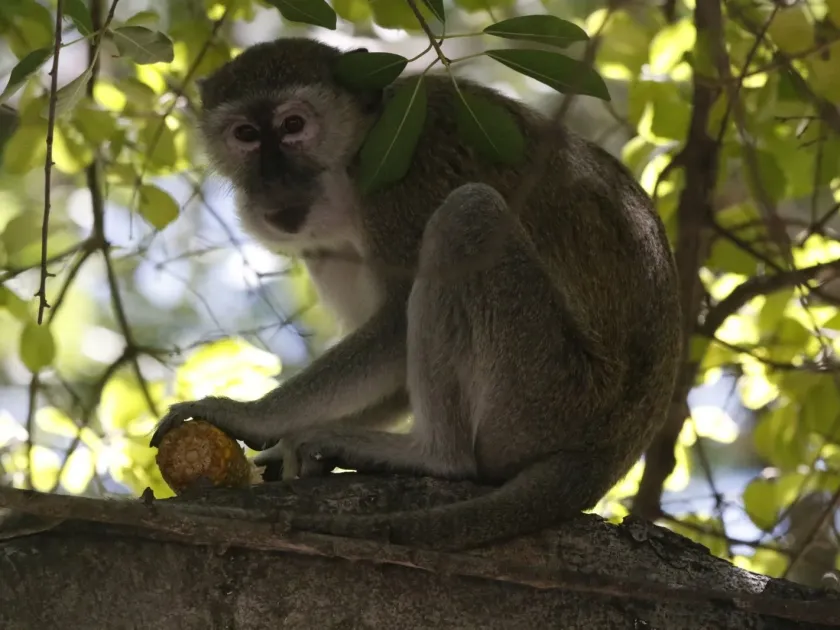
The green monkey (genus Chlorocebus) is a primate belonging to the Cercopithecidae family. These animals are characterized by their olive-green to gray fur, which provides excellent camouflage in their native habitats.
They are highly intelligent, social creatures that live in large troops. This social structure allows them to effectively coordinate their movements and raiding activities on human settlements.
Key morphological features include an elongated muzzle, prominent cheek pouches for storing food, and a long, muscular tail that aids in balance and navigation through complex environments.
These monkeys are highly adaptable, living in varied environments from tropical forests to savannas, and they easily transition into agricultural landscapes where they find abundant nutrition.
Their rapid reproductive cycle ensures that populations can recover quickly, making them a persistent challenge for farmers who attempt to manage their presence.
What it damages
Green monkeys are considered a significant agricultural pest, particularly in sub-Saharan Africa. They consume a wide variety of crops, making them a threat to food security in rural regions.
Cereal crops such as maize, millet, and sorghum are especially vulnerable during the grain-filling stage. Monkeys not only consume the grain but also cause massive physical destruction to the stalks.
Orchards are frequently raided, with monkeys causing damage to mangoes, bananas, and citrus fruits. They often break branches while foraging, which reduces the overall yield potential of the trees for subsequent seasons.
Vegetable gardens are also heavily impacted, with crops like tomatoes, potatoes, and various beans often being completely destroyed in a single raid by a troop.
In addition to direct consumption, they can act as vectors for diseases that affect both plant and animal health, increasing the operational risks for farms in these regions.
When it appears
The activity of green monkeys is constant throughout the year, but the level of damage intensifies significantly when crops reach their maturation phase.
During dry seasons, when natural forest food sources become scarce, monkeys migrate towards agricultural areas, leading to increased conflicts with farmers who rely on these crops for their livelihood.
Periods of peak damage typically coincide with flowering and fruit formation, as these are the most nutrient-rich stages for the monkeys to feed upon.
Daily foraging patterns usually occur during the early morning and late afternoon hours, when the troops move systematically through the fields to maximize their intake.
Seasonal migrations are dictated by food availability, meaning that years with poor natural yields often correlate with increased pressure on human-cultivated fields.
Signs of infestation
The most reliable sign of a green monkey raid is the presence of partially eaten fruits or vegetables dropped on the ground, often bearing distinct tooth marks.
In maize fields, damaged cobs with stripped husks and broken stalks are clear indicators of monkey activity, distinguishing them from smaller vertebrate pests.
Droppings found in and around the fields serve as physical confirmation that a troop has been using the land as a feeding ground.
Physical damage to fences, such as bent wire or broken posts, indicates that the monkeys are testing the boundaries of the farm to gain access to crops.
Audible signals, such as characteristic social vocalizations and alarm calls, indicate the presence of a troop currently occupying or moving through the agricultural area.
Control measures
Effective control of green monkeys requires a multi-layered approach because they are highly intelligent and adapt quickly to simple deterrents.
- Installation of electric fencing is one of the most effective mechanical methods to prevent primate access to fields.
- Use of high-tensile wire mesh fencing to physically exclude monkeys from high-value crop areas.
- Deployment of dynamic deterrents, such as shifting light and sound devices, to prevent habituation.
- Employment of livestock guard dogs trained specifically to monitor and patrol agricultural land against primates.
- Lethal or non-lethal population management strategies, applied in accordance with regional wildlife protection laws and ethical guidelines.
Taxonomy
- Latin name
- Chlorocebus
- Family
- Cercopithecidae
- EPPO code
- CLCSSP
Discussion
No discussions yet — be the first.