

European red mite
Panonychus ulmi
Description
How to identify
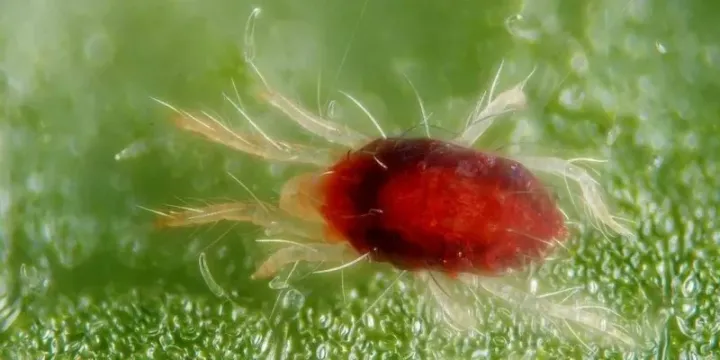
The European red mite (Panonychus ulmi) is a member of the Tetranychidae family. The adult female is characterized by a dark red, globose body, approximately 0.4 mm long, with long, white, curved bristles emerging from white tubercles.
The males are smaller, more elongated, and typically yellowish-brown or greenish in color. The eggs, which are essential for overwintering, are bright red, onion-shaped, and feature a central vertical stalk.
This species is highly adaptable and completes several generations per year depending on the climate. Development is significantly faster in hot and dry weather conditions.
Life stages include egg, larva, protonymph, deutonymph, and adult. The larvae possess three pairs of legs, whereas all subsequent active stages possess four pairs.
European red mite populations are known for their ability to spread rapidly through orchards via wind dispersal or movement between adjacent foliage in dense plantings.
What it damages
This pest is a major threat to pome fruits such as apples and pears, as well as stone fruits like plums, cherries, peaches, and sometimes grapes or almonds.
By feeding on leaf cells, the mites deplete the plant of chlorophyll, leading to a significant reduction in photosynthetic capacity and overall tree vigor.
Heavy infestations result in bronzing or browning of leaves, followed by premature leaf drop, which weakens the tree's ability to store carbohydrates for the following season.
Fruit quality is severely impacted; infestations can cause smaller fruit sizes, poor color development, and reduced sugar content, significantly lowering the market value of the produce.
The cumulative stress caused by mite feeding over the season reduces the tree's winter hardiness, increasing the risk of mortality or damage during severe cold winters.
When it appears
The overwintering eggs begin to hatch in early spring, typically correlating with the tight cluster or pink bud stage of apple trees.
Peak populations are usually observed during the mid-summer months, particularly in June and July, when temperatures consistently exceed 25°C.
As day length shortens and temperatures drop in late summer, the mites transition to producing diapause eggs, which are deposited in the bark and remain there until the next spring.
Early season monitoring is critical to prevent the population from reaching levels that require multiple intensive chemical interventions later in the year.
Regular orchard scouting, particularly checking the undersides of leaves during the peak vegetative growth period, is necessary for effective population management.
Signs of infestation
Initial signs appear as small, chlorotic stippling on the upper leaf surface, which occurs as the mites feed and destroy individual leaf cells.
Over time, the affected leaves turn a distinct bronze or rusty color, which is a classic indicator of severe infestation and massive chlorophyll destruction.
Close inspection with a hand lens reveals the presence of mobile mites and discarded white egg shells, which appear as shiny, light-reflecting specks on the leaf surface.
Massive clusters of bright red overwintering eggs found in the bark crevices, spurs, and leaf scars are clear indicators of a high pest pressure for the coming season.
Unlike many other spider mite species, Panonychus ulmi does not produce extensive webbing, which often leads growers to overlook the pest until damage is visible.
Control measures
Sustainable control involves an Integrated Pest Management (IPM) approach that balances biological, cultural, and chemical methods to suppress mite populations.
- Cultural Control: Proper pruning and irrigation management to maintain tree health and limit environmental stress.
- Biological Control: Conservation of predatory mites (such as Typhlodromus pyri) and other natural enemies like lady beetles.
- Dormant Oil Sprays: Application of horticultural oils in late winter to suppress overwintering eggs.
- Acaricide Application: Use of targeted miticides when population density exceeds economic thresholds, focusing on early-stage control.
- Resistance Management: Rotation of different chemical groups to prevent the development of resistant mite strains within the orchard.
Timing is the most important factor in European red mite control; proactive treatment during the egg hatch phase is significantly more effective than curative sprays.
Content graph
Connections · European red mite
Most often together:
Marketplace
Products · 26


Taurus z.p., Insecticide (pyridaben 200 g/kg)
Санрайз Кемікалз Ко. Лтд., Шанхай, Китай
Insecticides
0
0
·
50
4 offers
18.09 €per 1 l
Buy

Hexoran
Жеджианг Хебен Пестисайд енд Кемікалс Ко., Лтд., Китай
Insecticides
0
0
·
49
9 offers
79.82 €per 1 l
Buy


Anti-Scab Pro
ТОВ «Фабрика агрохімікатів», Черкаси, Україна
Insecticides
0
0
·
32
17 offers
18.6 €per 1 l
Buy

Biology
Taxonomy
- Latin name
- Panonychus ulmi
- Order
- Mites
- Family
- Tetranychidae
- EPPO code
- METTUL
Community
Discussion
No discussions yet — be the first.