
Forest web-spinning sawfly
Pamphilius silvaticus
Description
How to identify
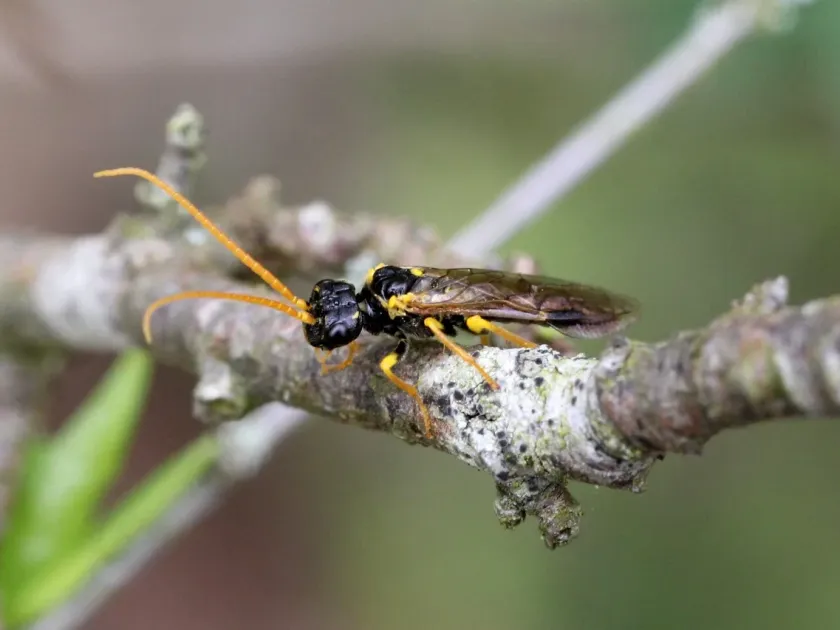
The forest web-spinning sawfly (Pamphilius silvaticus) is a member of the Pamphiliidae family within the order Hymenoptera. Adults are small insects, about 10–12 mm long, typically characterized by a shiny black body with distinct yellow markings on the head and abdomen.
The larvae, often referred to as false caterpillars, are grayish-green or brownish with a dark head. Unlike lepidopteran larvae, they lack prolegs, which is a key diagnostic feature for identification in the field.
The species has a univoltine lifecycle, meaning it completes one generation per year. They overwinter as larvae in the soil within earthen cells, pupating in the spring before emerging as adults during the blossoming period of host trees.
Females lay eggs singly or in clusters on the underside of leaves, usually along the veins. A single female can produce a significant number of offspring, enabling rapid population growth in favorable weather conditions.
This pest thrives in moderately humid and shaded environments, making it a common inhabitant of dense orchards and forest edges where its host plants are abundant.
What it damages
The forest web-spinning sawfly is a polyphagous pest, though it shows a marked preference for the Rosaceae family. Cultivated trees, including apple, pear, plum, and cherry, are the most frequent targets of its feeding activity.
In addition to orchard trees, the pest utilizes various wild woody species as hosts, such as hawthorn, rowan, and bird cherry, which serve as reservoirs for infestation in nearby agricultural settings.
The primary damage is caused by larvae consuming foliage. In cases of high infestation, the pest can cause severe defoliation, which severely compromises the physiological health of the host tree.
Loss of leaf surface area leads to reduced photosynthesis, hindering the accumulation of reserves necessary for winter survival and flower bud development for the following year.
Young trees are particularly susceptible to damage; repeated defoliation can lead to stunted growth, dieback of shoots, and increased vulnerability to secondary pests and winter frost.
Signs of infestation
The most visible sign of infestation is the presence of webbed leaf nests. The larvae use silk to draw leaf edges together, creating a tubular or rolled structure that serves as both food and protection.
Inside these silken shelters, one can find the larvae along with their frass (excrement), which appears as dark, granular deposits trapped within the webbing.
Early-stage damage often presents as skeletonized leaves where the larvae consume the parenchyma, leaving only the veins. Later, older larvae may consume entire leaves, leaving only the stalks behind.
The nests are commonly found on the tips of young branches. During an active infestation, these withered and tied-up leaves become apparent, standing out against the healthier parts of the tree canopy.
- Leaves tightly rolled and bound with white silk webbing.
- Skeletonized leaf tissue at the tips of shoots.
- Presence of dark granular frass within the leaf nests.
- Overall sparse appearance of the tree canopy during mid-summer.
Control measures
Manual removal and destruction of the silk nests is the most effective and eco-friendly control method for home gardeners. This should be performed early in the season before the larvae complete their development.
Cultural practices, such as deep autumn cultivation (tilling) of the soil beneath the canopy, can significantly reduce the pest population by disrupting the earthen cells and exposing larvae to predators and freezing temperatures.
Chemical control may be necessary in commercial or heavy infestation scenarios. Insecticides should be applied during the early stages of larval emergence before the protective nests are fully constructed.
Systemic or contact insecticides are typically effective if applied at the pink bud stage or shortly after petal fall, ensuring that the active ingredient reaches the larvae before they hide within the rolled leaves.
Biological control using Bacillus thuringiensis sprays provides a selective alternative that targets the larvae while preserving beneficial insects, though timing remains critical for maximum efficacy.
Taxonomy
- Latin name
- Pamphilius silvaticus
- Order
- Hymenoptera
- Family
- Pamphiliidae
- EPPO code
- PAMPSL
Discussion
No discussions yet — be the first.