
Pine web-spinning sawfly
Acantholyda posticalis
Description
How to identify
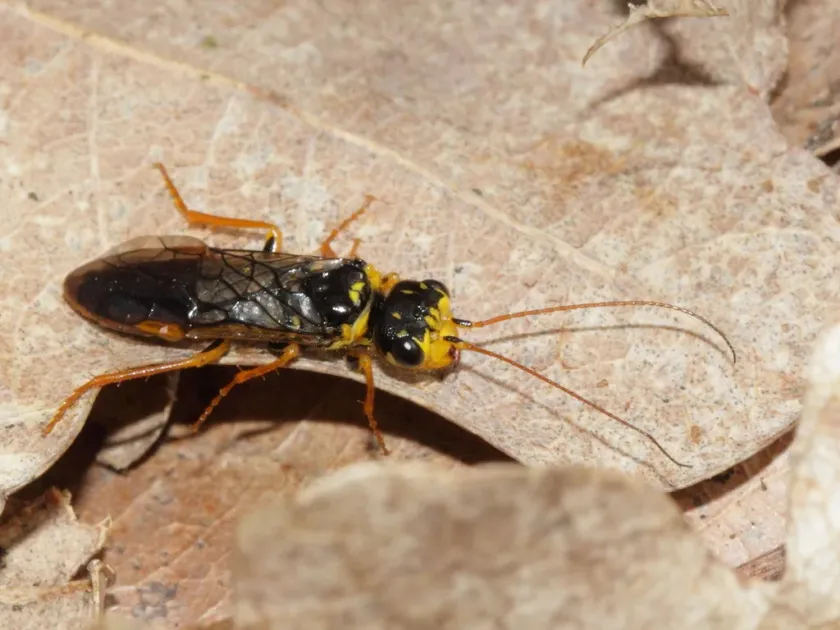
The pine web-spinning sawfly (Acantholyda posticalis) is a member of the Pamphiliidae family. Adults are robust insects, typically 12–15 mm in length, with a black body that often displays a metallic sheen and yellowish abdominal markings.
Larvae, known as false caterpillars, reach up to 25 mm. They are characterized by a greenish-grey body with a distinct dark dorsal stripe and a light-colored head. Notably, they lack abdominal prolegs, a key feature that distinguishes them from lepidopteran larvae.
The life cycle is generally univoltine, meaning one generation per year. However, some individuals may undergo extended diapause in the soil, emerging after two years or even longer in unfavorable conditions.
Pupation occurs in the soil at depths of 15–20 cm within prepared earthen cells. The emergence of adults in late spring is highly dependent on soil temperature and moisture levels.
Female sawflies deposit eggs individually on pine needles. The larvae hatch and immediately begin constructing their protective web nests, which are essential for their survival during the feeding stage.
What it damages
The primary host for this pest is the Scots pine (Pinus sylvestris). The larvae feed exclusively on the needles, causing significant defoliation that weakens the trees and makes them susceptible to other stressors.
In forest nurseries and young stands, the damage can be devastating. Repeated defoliation over several consecutive years often leads to the death of the tree, creating gaps in the forest canopy.
Beyond direct damage, the weakened state of the trees makes them prime targets for secondary invaders, including bark beetles and wood-boring insects, which often finalize the tree's collapse.
Economically, outbreaks can cover vast areas of forest, requiring expensive monitoring and control efforts to prevent large-scale timber losses and ecological degradation.
The impact is most severe during hot and dry growing seasons, where trees already stressed by lack of water are less capable of regenerating their lost foliage.
When it appears
Adult emergence typically begins in late May or early June. During this time, they are active during the day, searching for suitable host trees to lay their eggs on the foliage.
Larval development takes place throughout the summer months, specifically June through August. This is the period when they are most active in building their characteristic webs and feeding.
As autumn approaches, usually in late August or September, the mature larvae finish feeding, drop from the branches, and burrow into the soil to spend the winter in their earthen cells.
Weather patterns heavily influence population dynamics. A warm, dry spring often correlates with high survival rates and more significant subsequent outbreaks in the following year.
Predicting outbreaks requires soil sampling in the fall to assess the density of larvae overwintering, which serves as a reliable indicator for potential activity in the next season.
Signs of infestation
The most visible sign of infestation is the presence of web nests spun around the pine needles. These nests serve as both a food storage area and a shelter for the larvae.
Branches infested with the sawfly appear ragged, as needles are partially consumed or missing entirely, with the remains held together by silken threads.
Accumulated frass, appearing as small, dark pellets, can often be found on the ground beneath the canopy, serving as a clear indication of a heavy infestation above.
When disturbed, the larvae may exhibit a characteristic defensive posture or drop from the branches on silk threads, which can be observed by an attentive forest manager.
In severe cases, the tree crown may appear sparse and discolored mid-season, as the needles are removed by the larvae faster than the tree can maintain its photosynthetic needs.
Control measures
Integrated Pest Management (IPM) is crucial. Silvicultural practices, such as promoting mixed-species stands, help disrupt the pest's life cycle and provide habitats for natural predators.
Biological control methods, specifically the application of Bacillus thuringiensis or specific viral pathogens, are preferred for their environmental safety and specificity to sawfly larvae.
In cases of extreme outbreak threatening large forest tracts, carefully timed insecticide applications may be necessary, provided they comply with environmental regulations.
- Implementing regular forest health monitoring and aerial surveys.
- Preserving habitats for insectivorous birds and predatory wasps.
- Mechanical removal of nests in young plantations and nurseries to limit spread.
Sanitation cutting of severely damaged or dying trees is an effective measure to reduce the overall population pressure within a managed forest area.
Taxonomy
- Latin name
- Acantholyda posticalis
- Order
- Hymenoptera
- Family
- Pamphiliidae
- EPPO code
- ACATNE
Discussion
No discussions yet — be the first.