
Pine web-spinning sawfly
Acantholyda erythrocephala
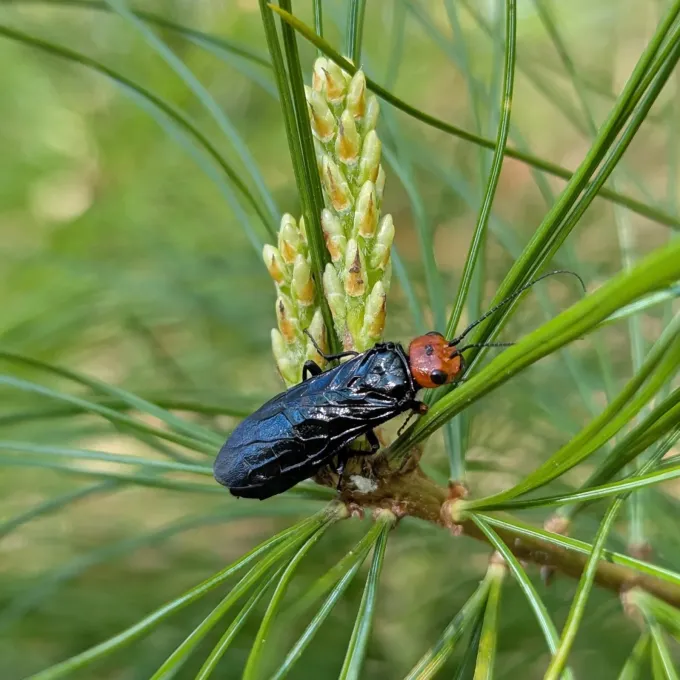
Description
How to identify
The pine web-spinning sawfly, scientifically known as Acantholyda erythrocephala, is a species of sawfly belonging to the family Pamphiliidae. Adults are approximately 10–14 mm long with a distinctive shiny black body and a bright red head.
The larvae are cylindrical and reach lengths up to 20 mm. They typically exhibit a yellowish-green to gray-green coloration with a darker stripe along the back and a brown head capsule.
The life cycle is univoltine, meaning there is only one generation per year. Adults emerge in late spring or early summer, synchronized with the active growth phase of pine needles.
After mating, females deposit eggs on the needles. Upon hatching, the larvae immediately begin spinning protective silk webs, which they use as shelters while feeding on the foliage.
The species overwinters as fully grown larvae in deep soil chambers, where they undergo pupation the following spring before emerging as adults to repeat the cycle.
What it damages
This sawfly primarily targets various pine species, with a strong preference for Pinus sylvestris. It is particularly destructive in young forest stands aged 10 to 30 years.
Larvae feed on old needles first, but during outbreaks, they consume current-year needles as well. This leads to severe defoliation of the tree crown and significantly reduces the tree's photosynthetic capacity.
Persistent infestations result in stunted height growth and poor diameter development. The overall vitality of the tree declines, making it susceptible to secondary pests such as bark beetles.
In mature stands, repeated defoliation can lead to top-kill, while in younger plantations, it may cause widespread tree mortality if not managed promptly.
The economic impact involves timber loss, reduced growth rates, and high costs associated with pest management and restoration of affected forest areas.
Signs of infestation
The most reliable sign of an infestation is the presence of silk webs or "tents" among the needles. These webs are often cluttered with larval frass, making them easy to spot upon inspection.
Heavily infested trees show yellowing and browning needles. Eventually, these needles drop prematurely, leaving branches looking thin and skeletonized, especially in the interior of the crown.
Close examination of the webs often reveals the presence of larvae. When disturbed, these larvae may thrash about or drop from the branch toward the forest floor.
During the fall, the webs become more prominent as they grow in size to accommodate the developing larvae. Observing these structures is key to early detection before widespread damage occurs.
Increased activity of woodpeckers or other insectivorous birds in a specific pine area can also serve as an indirect indicator of a sawfly population buildup.
Control measures
Chemical control using systemic or contact insecticides is effective if applied shortly after egg hatching, before the larvae construct heavy protective webbing.
Biological control methods include the use of parasitic wasps (hymenopterans) and entomopathogenic fungi, which can significantly regulate sawfly numbers under favorable conditions.
Mechanical control involves soil cultivation in the autumn, which disrupts the overwintering chambers of the larvae in the soil, leading to increased mortality due to exposure.
Sanitation practices, such as the removal of severely weakened or infested trees, are essential to minimize the breeding habitat for the sawfly population in forest stands.
- Application of Bacillus thuringiensis based products.
- Monitoring flight periods using pheromone traps.
- Promoting a diverse forest ecosystem to support natural predators.
Taxonomy
- Latin name
- Acantholyda erythrocephala
- Order
- Hymenoptera
- Family
- Pamphiliidae
- EPPO code
- ACATER
Discussion
No discussions yet — be the first.