
Common spruce web-spinning sawfly
Cephalcia abietis
Description
How to identify
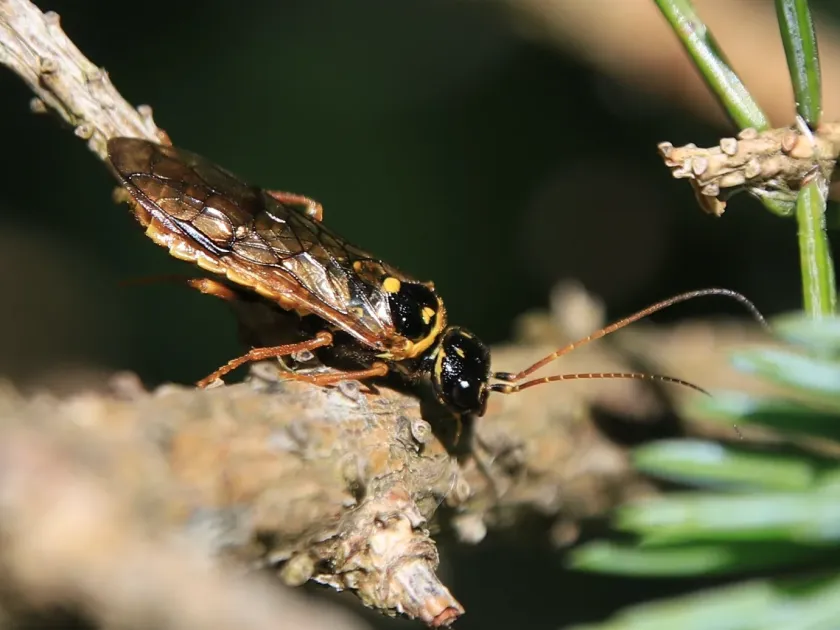
The adult Cephalcia abietis reaches 12–15 mm in length, featuring a black body with distinct yellow and orange markings on the thorax and abdomen. Its wings are transparent with prominent dark veins, characteristic of the Pamphilidae family.
Larvae develop within intricate web nests constructed from silken threads on spruce branches. The larvae possess a greenish to brownish body with a dark head, typically reaching 20–25 mm at maturity.
Adults possess strong mandibles used for both feeding and constructing their protective habitats. The female has a specialized ovipositor to insert eggs into the needles, ensuring the safety of the next generation.
Field identification is often based on the presence of these distinctive web nests in the canopy, as the insects prefer to remain hidden within these structures during their larval development.
Taxonomically, this species is classified within the order Hymenoptera, family Pamphilidae, which explains their unique biological trait of creating protective web shelters during the larval stage.
What it damages
The primary host for this pest is the Norway spruce, though it may occasionally damage other conifer species in dense forest stands during peak outbreaks.
Larvae feed on the needles, consuming them from the edges or entirely stripping them, starting with current-year needles and progressing to older growth. This defoliation severely impairs the tree's photosynthetic capability.
Heavy infestations lead to branch drying, premature needle drop, and a significant loss of vitality, making the affected trees susceptible to secondary pests like bark beetles.
Outbreaks can cover vast forest areas, resulting in substantial losses in wood growth and quality, requiring costly sanitation measures to be implemented by forest management.
The cumulative damage often results in decreased resistance to environmental stressors, such as drought or frost, further exacerbating the mortality rates of infected stands.
When it appears
Adult emergence typically occurs in late spring to early summer, heavily influenced by soil temperature and the specific microclimate of the forest environment.
Following mating, females deposit eggs, and larvae emerge within two to three weeks, immediately beginning the construction of their characteristic silken shelters.
By early autumn, larvae finish their development and descend into the soil, burying themselves to a depth of 10–15 cm to undergo pupation and winter dormancy.
The species is known for its ability to enter an extended diapause, sometimes remaining in the soil for several years, which complicates efforts to predict population surges.
Seasonality is strictly linked to spruce phenology, ensuring that the larval stage aligns with the growth of fresh foliage needed for rapid development.
Signs of infestation
The most reliable sign of an infestation is the presence of silk web nests on spruce branches, which become increasingly obvious as needles accumulate debris inside them.
Accumulated larval frass (excrement) within the webs gives the nests a messy, dark appearance, which is a key indicator during forest health inspections.
Gradual needle chlorosis followed by rapid browning and falling from the branches indicates the active feeding zones of the larvae within the crown.
- Visible silken web clusters between needles.
- Evidence of gnawed or partially consumed needle bases.
- Increased debris accumulation under infected branches.
- Presence of larvae upon physical inspection of webbed zones.
Severely infested trees often display a thinning canopy and an unhealthy, stunted appearance, clearly visible from the ground in managed stands.
Control measures
Effective management relies on monitoring population density using pheromone traps, which allow for timely intervention before large-scale defoliation occurs.
Biological control methods, particularly the use of Bacillus thuringiensis-based products, are highly effective and environmentally safe for protecting valuable timber stands.
Chemical control using systemic insecticides is generally reserved for severe outbreaks and must be applied with caution to minimize the impact on local non-target species.
Silvicultural strategies, such as promoting mixed-species stands, improve forest resilience and encourage the presence of natural predators, which are crucial for long-term population balance.
Encouraging natural entomophagous species, such as ichneumonid wasps, remains the most sustainable way to keep Cephalcia abietis populations below the damage threshold.
Taxonomy
- Latin name
- Cephalcia abietis
- Order
- Hymenoptera
- Family
- Pamphiliidae
- EPPO code
- CEPCAB
Discussion
No discussions yet — be the first.