
Web-spinning sawflies
Cephalcia
Description
How to identify
Web-spinning sawflies (Cephalcia) belong to the order Hymenoptera and the family Pamphiliidae. These insects are significant forest pests known for their specialized feeding habits on coniferous trees.
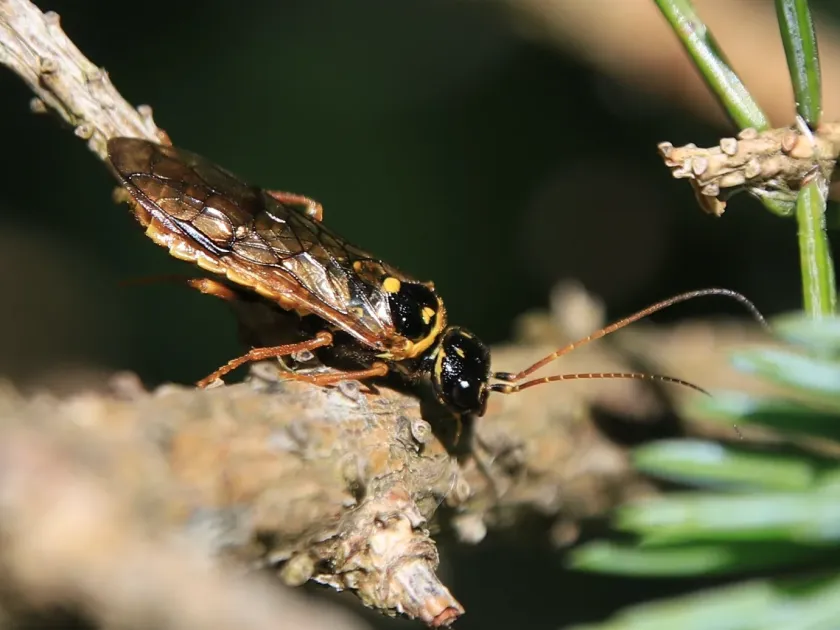
The adults are medium-sized insects with a robust appearance, typically featuring dark coloring with yellow or orange markings. They possess strong mandibles adapted for cutting conifer needles.
The larvae are distinct because they lack abdominal prolegs and produce silk threads. They use these threads to construct protective silken webs or nests on the branches of their host trees.
Their life cycle often includes a period of diapause, allowing them to remain in the soil for one or more years, which makes managing their populations challenging for foresters.
Morphologically, larvae are easily recognized by their cylindrical bodies and the presence of small cerci at the posterior end, which aid them in navigating their complex silk nests.
What it damages
The primary hosts for Cephalcia species are coniferous trees, with spruce (Picea) being the most commonly attacked, although pine trees can also suffer significant damage.
Larvae feed on needles, often preferring the current year's growth. In cases of heavy infestation, they can strip entire branches, leading to severe defoliation of the tree.
The loss of foliage prevents the tree from photosynthesizing efficiently, causing physiological stress that makes the host vulnerable to secondary pests like bark beetles.
In nurseries and young forest plantations, the damage caused by these sawflies can lead to stunted growth, reduced commercial value, and in some cases, the mortality of the seedlings.
Large-scale outbreaks can cause extensive damage across vast forest areas, resulting in significant economic consequences for the timber and wood-processing industries.
When it appears
Adult sawflies emerge in the spring or early summer, typically between May and June, depending on local temperature conditions and the host tree species' phenology.
Females lay their eggs on the needles, usually in the upper canopy. After a short incubation period, the larvae hatch and begin to build their characteristic silk nests.
The peak feeding activity of the larvae occurs during the summer months, specifically July and August, as they grow rapidly and consume large amounts of foliage.
As autumn approaches, the fully grown larvae drop to the forest floor. They burrow into the soil, where they form chambers and enter a state of dormancy to survive the winter.
The entire active period of the larvae is relatively short, but their impact on the tree's health is profound due to the intensity of their feeding during this window.
Signs of infestation
The most visible sign of an infestation is the presence of silk webbing on the branches. These webs contain frass, needles, and larvae, appearing as unsightly clumps in the canopy.
Needle drop is a common symptom; one can often find a carpet of discarded, partially eaten needles beneath the infested trees during the active feeding season.
The trees may show signs of thinning crowns or stripped branches that look like "brushes," as the larvae remove the green tissue from the needles.
A distinctive rustling or tapping sound can sometimes be heard under infested trees due to the constant rain of larval excrement falling onto the forest floor.
Careful inspection of the soil beneath the canopy may reveal larval chambers or cocoons if a significant population has built up over previous years.
Control measures
Biological control using Bacillus thuringiensis (Bt) sprays is an effective and environmentally friendly method for managing young larval populations in forest settings.
Chemical control involving systemic or contact insecticides can be used during outbreak years, provided the timing coincides with the most vulnerable larval stages.
Silvicultural management, such as maintaining diverse tree species and avoiding large-scale monocultures, helps reduce the risk of massive web-spinning sawfly outbreaks.
Encouraging natural predators, such as birds, parasitic wasps, and specific fly species, plays a crucial role in maintaining the population at a manageable level.
Monitoring programs utilizing pheromone traps are essential for early detection, allowing forest managers to implement timely interventions before extensive defoliation occurs.
Taxonomy
- Latin name
- Cephalcia
- Order
- Hymenoptera
- Family
- Pamphiliidae
- EPPO code
- CEPCSP
Discussion
No discussions yet — be the first.