
Peach web-spinning sawfly
Pamphilius persicum
Description
How to identify
The Peach web-spinning sawfly (Pamphilius persicum) is a member of the Pamphiliidae family, order Hymenoptera. The adult insect is a stout-bodied wasp, measuring about 10-12 mm, with a dark color and distinct yellowish markings.
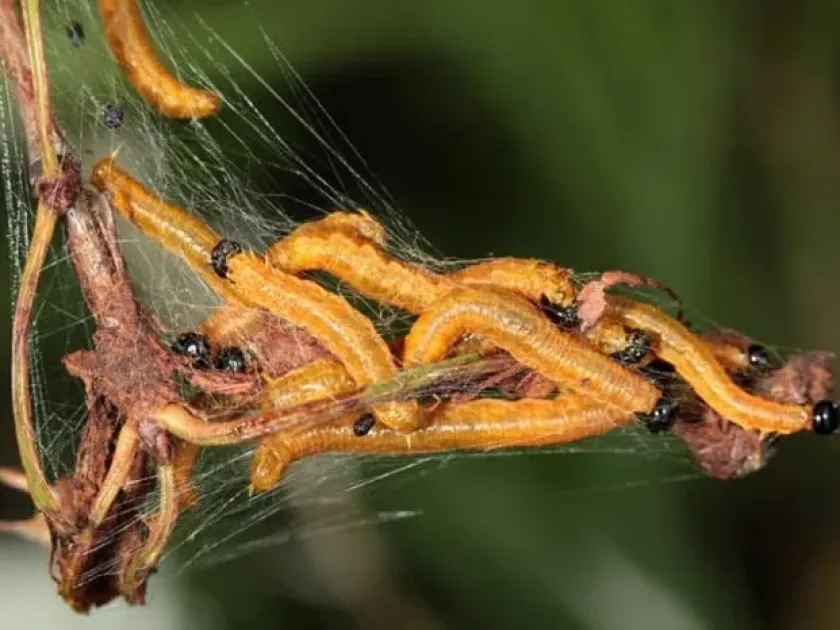
Larvae are cylindrical and greenish in color, reaching up to 20 mm in length. Unlike many other caterpillars, they lack abdominal prolegs, which is a key identifying morphological feature.
The pupation takes place in the soil at a depth of 10-15 cm, where the insect remains in a state of diapause throughout the winter and early spring until conditions become favorable.
This species is univoltine, meaning it produces only one generation per year, which makes its seasonal activity highly dependent on the tree's phenological cycle.
Adult females deposit their eggs on the underside of leaves, usually along the veins, securing them with a sticky secretion that holds the eggs firmly until hatching.
What it damages
The pest primarily targets stone fruit trees, including peach, apricot, and almond. It is recognized as a serious defoliator capable of causing significant canopy damage.
Larvae consume leaf tissue, often causing severe skeletonization of the foliage, which leads to reduced photosynthetic capacity and overall tree stress.
The characteristic web-spinning behavior results in the formation of dense, silken nests that protect the larvae but severely damage the structure and health of the leaves.
Severe infestations cause premature leaf drop, which weakens the tree's physiological status, reduces fruit quality, and compromises the formation of buds for the next season.
In young orchards, repeated defoliation can stunt tree growth and lead to increased susceptibility to winter damage and secondary infections by fungi or bacteria.
When it appears
Adult sawflies emerge from the soil during the spring, typically coinciding with the flowering phase of peach trees, which provides the necessary conditions for mating.
The larval stage is active during the late spring and early summer months, a period characterized by rapid growth of new foliage and moderate temperatures.
By mid-summer, the larvae reach their final instar, cease feeding, and migrate into the soil to prepare for their long period of dormancy until the following spring.
Favorable weather conditions for the species include warm, moist spring days, which facilitate high survival rates for eggs and early-stage larvae.
Effective management windows are restricted to the early larval development phase, before the larvae have fully constructed their protective web shelters.
Signs of infestation
The most prominent indicator of an infestation is the presence of rolled or folded leaves held together by fine, visible silken threads.
Inside these nests, one can observe clusters of larvae and their dark frass (droppings), which provide clear evidence of the pest's activity within the tree canopy.
Leaves affected by the sawfly often turn yellow and necrotic, eventually drying out and falling off, leading to sparse patches of foliage on the affected branches.
Skeletonized leaves where only the midribs and main veins remain are common findings in the vicinity of the silken nests constructed by the colony.
In some cases, the presence of adult wasps circling the branches during the early morning hours serves as a warning of impending egg-laying activity.
Control measures
Cultural practices, such as deep tilling or cultivation of the soil under the tree canopy in the autumn, can significantly disturb the pupal stage and reduce future populations.
Manual removal and disposal of webbed leaf nests is an effective non-chemical strategy for smaller trees or home gardens where infestation levels are low.
Systemic insecticides or contact-acting chemicals should be applied at the first sign of larval hatching to ensure that the active ingredient reaches the larvae before they are shielded by webs.
Biological control options, such as the application of Bacillus thuringiensis, offer a targeted approach that is less harmful to beneficial insects if applied at the correct timing.
Orchard monitoring via visual inspection of the canopy during the spring is critical to detect early activity and determine the necessity of intervention strategies.
Taxonomy
- Latin name
- Pamphilius persicum
- Order
- Hymenoptera
- Family
- Pamphiliidae
- EPPO code
- PAMPPE
Discussion
No discussions yet — be the first.